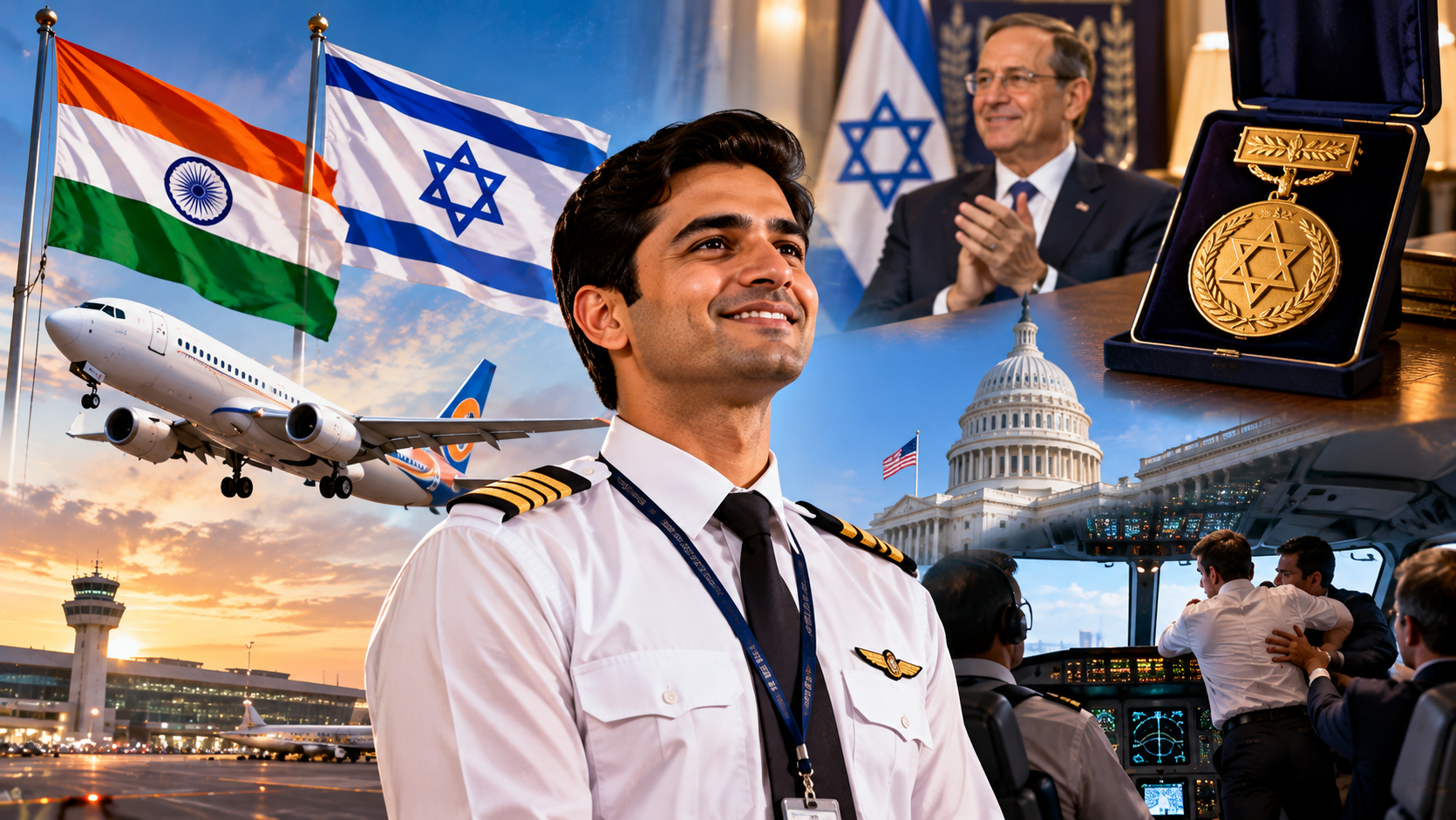
President Isaac Herzog announces the Presidential Award for Civil Heroism after the Indian captain helped prevent a suspected hijacking and crash; US Congress also recognises his extraordinary bravery
Israel Recognises Indian Captain’s Courage
Israel will honour Indian pilot Captain Smit Machchhar with its highest civilian award for his role in preventing a potential aviation catastrophe aboard a Flydubai passenger aircraft on September 30, 2026.
Israeli President Isaac Herzog announced the decision on Thursday during a ceremony in Jerusalem, where six Israeli passengers were presented with the Presidential Medal for Civilian Heroism for their actions during the incident involving Flydubai Flight FZ1073.
Herzog praised Machchhar’s courage, professionalism and determination, saying his actions helped avert a catastrophe. The award will be presented to the Indian captain after he recovers from his injuries.
The recognition highlights the role played by flight crew members and passengers in responding to an emergency that could have endangered the lives of everyone aboard the aircraft.
US Congress Also Honours Captain Machchhar
The Indian pilot has also received recognition in the United States for his actions during the incident.
US Congressman Raja Krishnamoorthi submitted a statement to the Congressional Record recognising Machchhar’s extraordinary bravery. According to the statement cited in the report, the captain’s actions helped save 172 people aboard the flight, including passengers and crew members.
Krishnamoorthi described Machchhar as an experienced aviator with 17 years of flying experience, including 11 years as a captain. The statement also highlighted the presence of four US citizens and 27 children aboard the aircraft.
The recognition from Israel and the US underscores the international significance of the incident and the captain’s role in preventing a potential mass-casualty disaster.
What Happened Aboard Flydubai Flight FZ1073?
The incident occurred on September 30, when Flydubai Flight FZ1073 was travelling from Dubai to Tel Aviv.
According to the supplied report, the aircraft’s 29-year-old Omani co-pilot attacked the Indian captain while the Boeing 737 MAX 8 was cruising at approximately 34,000 feet. The co-pilot allegedly disabled the autopilot and sent the aircraft into a steep dive.
The situation created an immediate emergency, placing passengers and crew members at serious risk.
Despite being injured, Machchhar managed to unlock the cockpit door, allowing cabin crew members and passengers to enter and restrain the co-pilot.
Their intervention helped prevent the situation from escalating further and enabled the aircraft to divert safely.
Emergency Landing in Saudi Arabia
Following the cockpit incident, the aircraft made an emergency landing at Prince Sultan bin Abdulaziz International Airport in Tabuk, Saudi Arabia.
The diversion brought the immediate danger to an end and allowed authorities to respond to the incident.
The emergency highlighted the importance of cockpit security, crew coordination and the ability of aviation personnel to respond under extreme pressure. It also demonstrated how quickly a situation involving a member of the flight crew can develop into a serious threat to aircraft safety.
International Investigation Underway
The incident has prompted an investigation involving civil aviation and intelligence agencies from the United Arab Emirates, Saudi Arabia, Israel and Oman, with assistance from the United States.
Investigators are examining the sequence of events, the alleged attack, the aircraft’s flight path and the circumstances surrounding the co-pilot’s actions.
Preliminary findings cited in the report indicate that the co-pilot allegedly told interrogators that he had attempted to crash the aircraft deliberately. Investigators reportedly believe he acted alone, rather than under instructions from a foreign terrorist organisation.
These findings remain subject to the investigation, and the full circumstances will depend on the conclusions reached by the relevant authorities.
Why the Incident Matters for Aviation Safety
The episode raises important questions about aviation security, cockpit access procedures and safeguards against threats originating from within a flight crew.
Commercial aviation relies on strict protocols, crew resource management and multiple layers of security to minimise risks. However, an incident involving a pilot or co-pilot can present an unusually difficult challenge because cockpit personnel have access to critical flight controls.
The actions of Machchhar, cabin crew members and passengers demonstrate the importance of emergency preparedness and coordinated responses. Investigators may also examine whether existing procedures require additional safeguards in light of the incident.
Any changes to aviation rules would depend on the findings of the investigation and assessments by the relevant aviation authorities.
A Moment of International Recognition for India
The decision by Israel to honour Machchhar, alongside the recognition from a US lawmaker, places the Indian captain's actions in the international spotlight.
His response under extreme pressure has drawn attention to the responsibilities carried by commercial pilots and the consequences of split-second decisions during an aviation emergency.
The award also serves as recognition of the coordinated efforts of the cabin crew and passengers who helped contain the threat after the cockpit door was opened.
Outlook
The immediate focus remains on Captain Machchhar’s recovery and the completion of the international investigation. Authorities will need to establish the precise sequence of events, determine the circumstances behind the alleged attack and assess whether additional safety measures are warranted.
For the aviation industry, the incident is a reminder that passenger safety depends not only on aircraft technology but also on trained personnel, robust emergency procedures and effective security safeguards.
Machchhar’s forthcoming honour recognises his reported contribution to saving lives during an extraordinary emergency, while the investigation is expected to provide further clarity on how the incident unfolded and what lessons can be drawn for aviation safety.