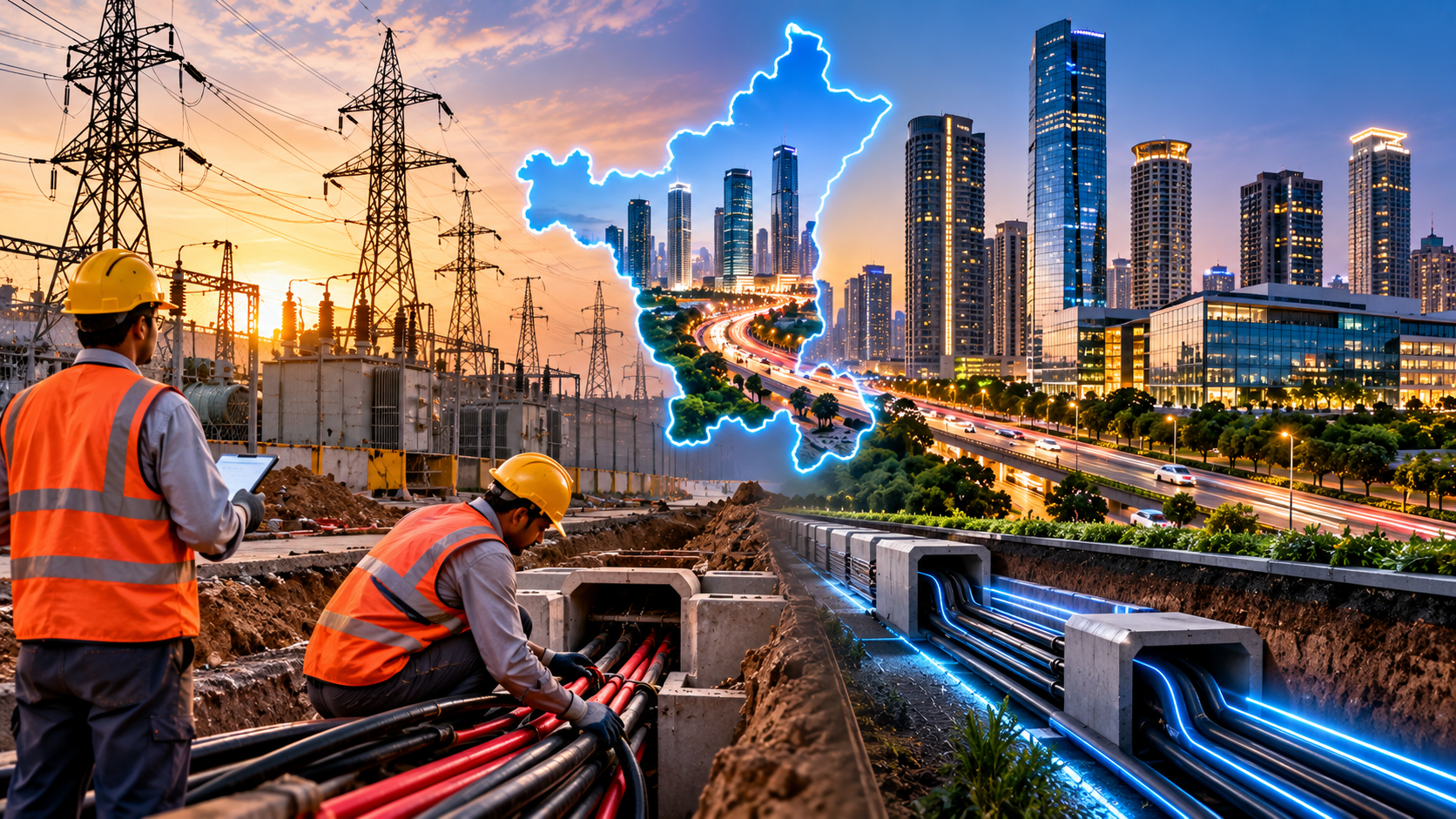
₹4,717 crore investment planned in underground cabling, substations and digital infrastructure as private distributor prepares to challenge state-run discoms, raising concerns over revenue losses and cross-subsidy arrangements
Haryana’s electricity distribution sector is set for a major structural change after the Haryana Electricity Regulatory Commission (HERC) granted a 25-year distribution licence to Eleven Power Private Limited for Gurugram and Nuh. The approval, issued on October 19, allows the company to develop a parallel electricity distribution network alongside the existing state-run utilities, potentially giving more than 830,000 consumers a choice of electricity supplier once operations begin.
The development marks Haryana’s first parallel electricity distribution licence and comes at a time when the state’s power distribution companies are facing financial pressure, infrastructure constraints and a backlog of applications for new connections. While the proposed entry of a private operator could improve service quality and infrastructure investment, it has also raised concerns about the financial stability of the existing distribution companies.
Eleven Power Plans ₹4,717 Crore Investment Over Five Years
Eleven Power has proposed investing ₹4,716.73 crore between FY27 and FY31, covering the five financial years from 2026-27 to 2030-31. The majority of the investment will be directed towards building and strengthening the electricity distribution network.
Of the total planned expenditure, ₹4,650.37 crore has been allocated to the wire business, which includes distribution infrastructure, while ₹66.36 crore is earmarked for the supply business. The company plans to develop power substations, underground cabling and supporting systems to serve residential, commercial, agricultural and industrial consumers.
Electricity supply is expected to commence in FY28, subject to the completion of infrastructure, transmission connectivity, safety approvals and other statutory requirements. The rollout will cover five divisions: Gurugram City, Gurugram Suburban, Manesar, Sohna and Nuh.
The company intends to install underground cables across Gurugram district, while Nuh will receive a combination of underground and overhead distribution networks. Of the proposed capital expenditure, ₹304.37 crore has been allocated to Nuh, where infrastructure development is scheduled to begin in the first phase.
Underground Cabling and Digital Systems at the Centre of Expansion
The proposed network is expected to focus on improving reliability in densely populated and rapidly developing areas. Underground cables can reduce exposure to weather-related damage, minimise certain types of external interference and support the growing electricity requirements of urban centres.
However, underground distribution systems generally require substantial upfront capital and can be more expensive to inspect, repair and maintain when faults occur. The eventual benefits will therefore depend on execution, maintenance standards, demand growth and the company's ability to manage costs.
Eleven Power has also proposed smart meters, digital billing and technology-enabled network management. These systems could improve consumption monitoring, billing accuracy, outage management and the identification of distribution losses.
The company has indicated that it plans to source 80 per cent of its electricity requirement from renewable energy and the remaining 20 per cent from thermal power. If implemented as proposed, this sourcing mix could make renewable electricity a significant component of its supply strategy.
State Discoms Dispute Infrastructure Cost Estimates
The entry of Eleven Power has exposed a difference of opinion over the cost of developing a comprehensive distribution network in Gurugram and Nuh.
Haryana's state-owned distribution companies have estimated that establishing a comprehensive network across the two districts would require ₹11,397.75 crore, more than twice Eleven Power's proposed investment. The private company has disputed this estimate, arguing that its planned network configuration would allow it to meet demand with a different infrastructure design.
The difference highlights a key issue for the rollout: whether the proposed investment will be sufficient to deliver reliable service across the entire licensed area while meeting future demand. The actual cost and effectiveness of the network will become clearer as infrastructure development progresses.
Pending Electricity Connections Prompt Regulatory Action
The regulator cited delays in issuing new electricity connections and approving increases in sanctioned load as important considerations behind the licence approval.
According to data cited in HERC's order, Dakshin Haryana Bijli Vitran Nigam (DHBVN) had 108,590 applications pending as of October 1, 2025, involving a load of 1,642.5 megawatts (MW). Uttar Haryana Bijli Vitran Nigam (UHBVN) had 20,603 applications pending as of September 30, 2025, involving 770.4 MW.
Together, the pending applications represented a load of 2,413 MW. These figures point to the scale of the connection backlog and the challenge of accommodating rising electricity demand from households, offices, shops, infrastructure projects and industrial establishments.
HERC observed that timely release of connections is a statutory responsibility of distribution licensees and that delays can affect consumer satisfaction as well as revenue generation. A second distributor could introduce competitive pressure to improve service delivery, although the outcome will depend on the speed of network development and the quality of operations.
The licence covers multiple categories of consumers, including households, agricultural users, commercial establishments and industries. HERC rejected objections that the private operator could restrict its focus to commercially attractive customers, citing its obligation to serve all consumer categories within the licensed territory.
Consumer Switching Will Depend on Regulatory Clearances
The licence does not mean consumers can immediately change their electricity supplier. Eleven Power must first secure the necessary transmission connectivity, safety approvals and other statutory clearances before commencing operations.
The company is also required to submit a consumer migration protocol for HERC's approval within 60 days. The protocol is expected to address metering arrangements, outstanding dues and the procedures consumers must follow to switch distributors.
These arrangements will be important in determining how smoothly competition is introduced. Clear rules on billing, deposits, arrears, meter ownership and service responsibilities will be essential to avoid confusion for consumers during the transition.
The regulatory framework will also need to ensure that competition does not compromise universal service obligations or create uncertainty over responsibility for maintaining the distribution network.
State Discoms Warn of Revenue Losses and Cross-Subsidy Risks
The existing state-run distribution companies have strongly opposed the decision, warning that the loss of high-paying customers could weaken their financial position.
In submissions to HERC, the utilities argued that Gurugram and Nuh together account for more than 42 per cent of their revenue. DHBVN reported that the two districts generated ₹9,493.75 crore in FY26 and estimated that losing premium consumers could result in annual revenue losses of up to ₹4,272 crore.
The concern is that private competition may attract consumers with relatively high electricity consumption and stronger payment profiles, while state utilities continue serving other customer categories under existing tariff and subsidy arrangements. If a significant portion of revenue shifts to the new distributor, the remaining consumer mix could become less financially favourable for the state-run companies.
Such an outcome could place additional pressure on their cash flows, operating efficiency and ability to fund infrastructure upgrades. However, the actual financial impact will depend on how many consumers migrate, the pace of market expansion, tariff structures and the costs that the existing utilities can adjust.
Haryana's two discoms had also reported a combined revenue gap of ₹4,484.71 crore in their FY27 tariff proceedings, underlining the financial challenges already facing the sector.
Haryana Government Plans Legal Challenge
Haryana Energy Minister Anil Vij has said that the state government will challenge HERC's decision before the Appellate Tribunal for Electricity. Power employee unions have also opposed the move, reflecting concerns about the implications for public utilities and the existing distribution framework.
The legal challenge could influence the implementation timeline and create uncertainty around the transition. Until the relevant proceedings and regulatory requirements are resolved, consumers should not assume that an immediate supplier switch will be available.
What the Development Means for Consumers and the Power Sector
For consumers in Gurugram and Nuh, the proposed entry of Eleven Power could create an alternative to the existing distributor and increase pressure to improve connection timelines, billing systems and supply reliability. The benefits, however, will depend on whether the new network is completed on schedule and whether service standards improve in practice.
For Haryana's state-owned discoms, the key challenge will be to protect financial sustainability while improving operational efficiency and retaining consumers. Their ability to reduce distribution losses, improve collections and manage costs could become increasingly important as competition develops.
For investors and businesses tracking India's power sector, the development highlights the growing importance of distribution infrastructure, private capital and regulatory frameworks in electricity markets. It also illustrates the tension between introducing competition and maintaining the financial viability of utilities responsible for serving a broad mix of consumers.
Market Outlook
The licence creates a potentially significant new competitive dynamic in Haryana's electricity distribution market, but the financial and operational outcomes remain uncertain. Eleven Power's proposed ₹4,716.73 crore investment offers the prospect of upgraded infrastructure and more consumer choice, while the state discoms face the risk of losing a portion of their high-value revenue base.
The key indicators to monitor will be the progress of statutory approvals, the start of network construction, actual capital expenditure, the implementation of consumer migration rules and any developments in the legal challenge. Consumer switching patterns, service quality and the effect on the state utilities' revenue and cash flow will ultimately determine whether the new arrangement delivers lasting benefits.
The broader lesson is that competition alone does not guarantee better electricity services or stronger financial performance. The success of the model will depend on effective regulation, transparent consumer protections, reliable infrastructure and the ability of both private and public distributors to meet their obligations sustainably.