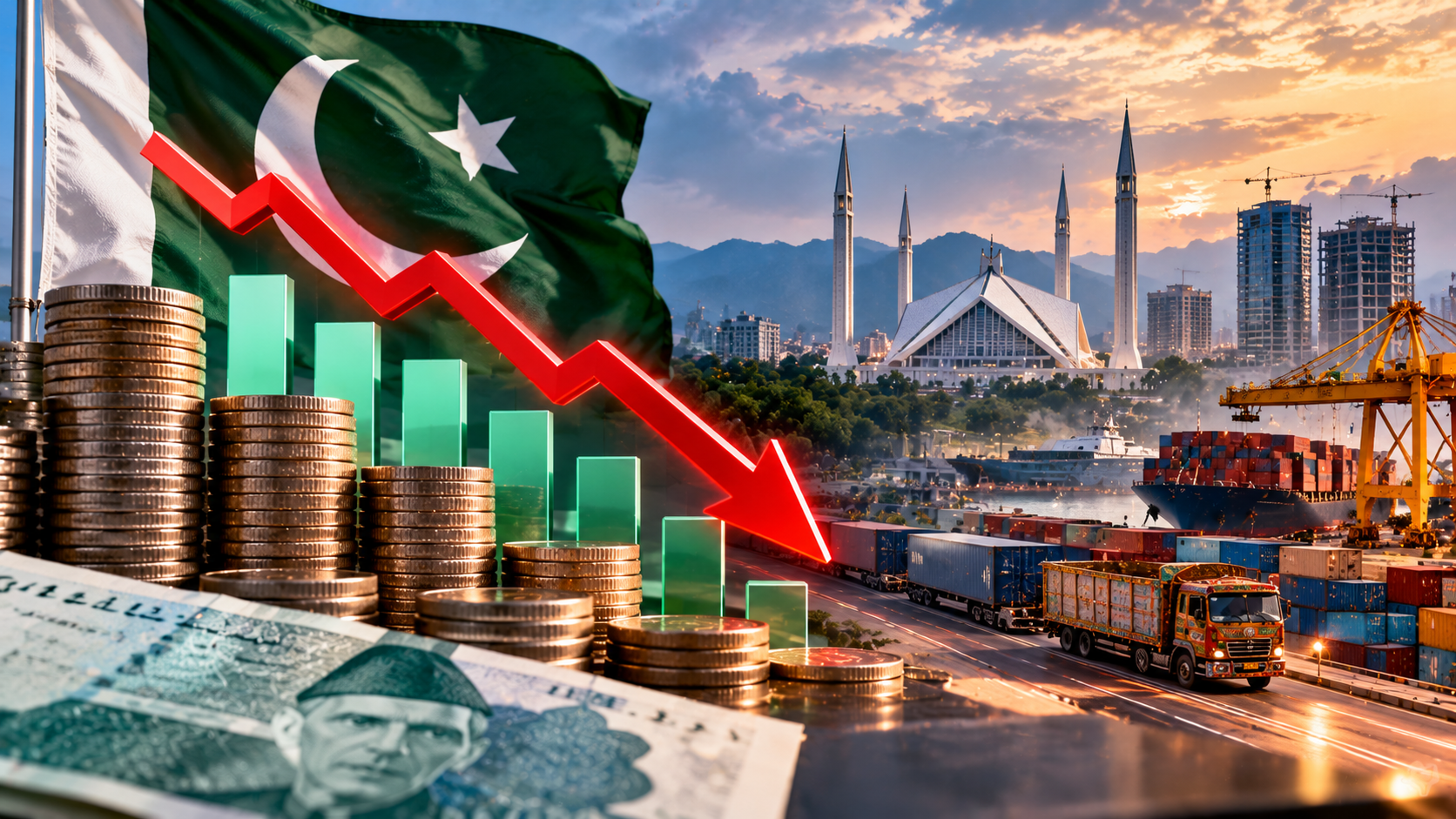
Revised estimate falls below the government’s earlier 3.7% projection; economy expands to $450.4 billion, but per capita income of $1,896 highlights continuing pressure on household purchasing power
Pakistan has revised its gross domestic product (GDP) growth estimate for the financial year 2025-26 (FY26) to 3.65%, marginally below its earlier projection of 3.7%, as growth in the industrial and services sectors moderated. The revision highlights the challenges facing the country’s economic recovery, despite an increase in the nominal size of the economy and a modest rise in per capita income.
According to a report by Dawn, the revised estimate was approved at the 118th meeting of Pakistan’s National Accounts Committee (NAC), held at the Pakistan Bureau of Statistics. In May 2026, the government had lowered its FY26 growth forecast from 4% to 3.7%.
The latest assessment indicates that Pakistan’s recovery remains gradual, with manufacturing, trade and several public services recording slower growth than previously estimated. Although the economy has expanded in dollar terms, persistent inflationary pressures continue to weigh on household purchasing power and the ability of consumers to save and invest.
GDP Growth Falls Short of Earlier Government Projection
Pakistan’s revised GDP growth estimate of 3.65% for FY26 is below the government’s earlier projection of 3.7%. The adjustment reflects revisions to sectoral growth estimates and updated national accounts data.
The latest estimate is broadly consistent with forecasts from major international financial institutions. The International Monetary Fund (IMF) projected Pakistan’s FY26 growth at 3.6%, while the World Bank and Asian Development Bank estimated growth at 3.7%. The State Bank of Pakistan also expected economic growth to remain close to 3.7%.
The convergence of these projections suggests that the country’s recovery is progressing at a moderate pace. However, the overall growth rate does not fully capture the pressures faced by households, businesses and public finances.
The NAC also revised Pakistan’s FY25 GDP growth rate to 3.11%, compared with the earlier estimate of 3.18%. The revisions reflect updated economic data and changes in the measurement of national output.
Economy Expands to $450.4 Billion
Pakistan’s economy increased in nominal dollar terms to $450.4 billion in FY26, up from $410.96 billion in FY25. The increase was attributed mainly to the services sector, followed by industry and livestock.
However, an increase in the dollar value of GDP does not necessarily indicate an equivalent improvement in real economic activity or living standards. Nominal GDP can change because of price movements, exchange-rate effects and revisions to economic measurements, in addition to changes in actual output.
Real GDP growth, which adjusts for price changes, therefore remains a more useful measure of the economy’s underlying expansion.
Pakistan’s per capita income rose to $1,896 in FY26 from $1,824 in FY25. While this represents an improvement in dollar terms, the increase has not necessarily translated into stronger purchasing power for households, particularly when inflation raises the cost of essential goods and services.
The reported per capita income was also described as the lowest in the region, highlighting the income gap Pakistan continues to face compared with neighbouring economies.
Industrial Growth Revised Down to 3.34%
Pakistan’s industrial sector grew by an estimated 3.34% in FY26, lower than the earlier projection of 3.51%. The revision points to uneven performance across manufacturing, mining and other industrial activities.
Large-scale manufacturing (LSM), measured through the Quantum Index of Manufacturing, recorded growth of 5.01%, down from the previous estimate of 6.11%. The revision indicates that manufacturing activity was weaker than initially assessed.
Manufacturing performance is particularly important for Pakistan because it influences employment, industrial investment, exports and demand for imported raw materials and machinery. Slower expansion can also affect tax collections and the financial position of businesses operating in manufacturing-linked supply chains.
Mining and quarrying, in contrast, showed improvement. Its growth estimate increased from 0.38% to 1.52%, supported by stronger activity in gas, crude oil and coal production.
Gas output grew by 2.84%, crude oil by 5.12% and coal by 2.73%, according to the revised figures. The improvement in these activities provided some support to the broader industrial sector, although it was not sufficient to prevent a downward revision to overall industrial growth.
Services Sector Growth Slows to 3.81%
The services sector, a major contributor to Pakistan’s economy, recorded revised growth of 3.81% in FY26, compared with the earlier estimate of 4.09%.
Wholesale and retail trade growth was revised down to 2.37% from 3.71%. The NAC attributed the slowdown to decreases in manufacturing and imports, which affected activity across the trade segment.
The performance of wholesale and retail trade is an important indicator of domestic demand. Slower growth may reflect weaker consumption, subdued business activity or reduced demand for goods moving through distribution networks.
Several other services categories, however, recorded improvements. Transport and storage growth increased to 3.23% from 2.31%, supported by upward revisions in railways, water transport and air transport.
Information and communication emerged as a stronger-performing segment, with growth revised upward to 9.53% from 7.52%. Finance and insurance growth also improved substantially, rising to 4.23% from the previous estimate of 0.32%, mainly due to better performance in the insurance industry.
These gains indicate that parts of Pakistan’s services economy continue to expand, even as trade and other activities face pressure.
Public Services and Social Sectors Record Slower Growth
The revised estimates also showed moderation in several public and social service categories.
Growth in public administration and social security slowed to 5.67% from 8.54%. Education growth was revised down to 4.17% from 5.23%, while human health and social work growth declined to 5.52% from 6.85%.
These revisions point to a more moderate expansion across a range of public services. However, sectoral growth figures alone do not establish whether service quality or access improved or deteriorated, as those outcomes also depend on spending levels, efficiency and population needs.
The slowdown in these categories nevertheless forms part of the broader picture of an economy growing below its earlier expectations.
Quarterly Growth Shows a Weak Fourth Quarter
Pakistan’s revised quarterly estimates showed growth of 3.89% in the first quarter, 4.31% in the second quarter and 4.42% in the third quarter of FY26.
The fourth quarter, however, recorded GDP growth of just 2%, according to the NAC figures reported by Dawn.
The weaker fourth-quarter performance suggests that economic momentum softened towards the end of the financial year. While quarterly growth rates can be affected by seasonal patterns, base effects and sector-specific developments, the moderation warrants attention when assessing the durability of the recovery.
The updated quarterly figures also underline why annual growth estimates should be examined alongside sectoral and quarterly trends rather than viewed in isolation.
Inflation Continues to Pressure Household Purchasing Power
Despite the increase in GDP and per capita income, inflation remains a major concern for Pakistani households. Rising prices reduce the amount of goods and services that consumers can purchase with a given level of income, potentially limiting discretionary spending and savings.
This pressure can also affect businesses. When households spend more on essential items, demand for non-essential products and services may weaken. Companies can face higher operating costs while finding it difficult to pass on the full increase to customers.
For a sustainable recovery, Pakistan will need to support real income growth alongside increases in overall output. Greater productivity, investment, employment generation and stable prices will be important in translating economic expansion into improvements in living standards.
Key Economic Challenges Ahead
Pakistan’s revised growth outlook highlights several priorities for policymakers: strengthening manufacturing, supporting domestic demand, improving productivity and maintaining macroeconomic stability.
Industrial investment and export competitiveness will be important for generating employment and reducing vulnerability to external financing pressures. At the same time, improvements in the services sector, particularly information and communication, could support economic diversification if accompanied by broader productivity gains.
The government will also need to balance growth-supportive measures with fiscal discipline and inflation management. The effectiveness of these policies will influence business confidence, private investment and the pace of the country’s economic recovery.
Market Outlook
Pakistan’s FY26 GDP growth estimate of 3.65% points to a moderate recovery that has fallen slightly short of the government’s previous expectations. The economy’s expansion to $450.4 billion and the rise in per capita income to $1,896 offer some positive signals, but slower manufacturing, weaker trade growth and a 2% expansion in the fourth quarter highlight continuing vulnerabilities.
For investors and businesses tracking South Asia, the key indicators to monitor include inflation, industrial production, export performance, domestic consumption, currency stability and the policy response to slower growth. Stronger performance in information and communication, finance and insurance, and mining offers some support, but broader-based expansion will be necessary for a more durable recovery.
Ultimately, the quality of Pakistan’s economic growth will matter as much as its headline rate. Sustained improvements in productivity, real household incomes and private-sector investment will be essential if the country is to turn modest GDP expansion into stronger economic resilience and better living standards.