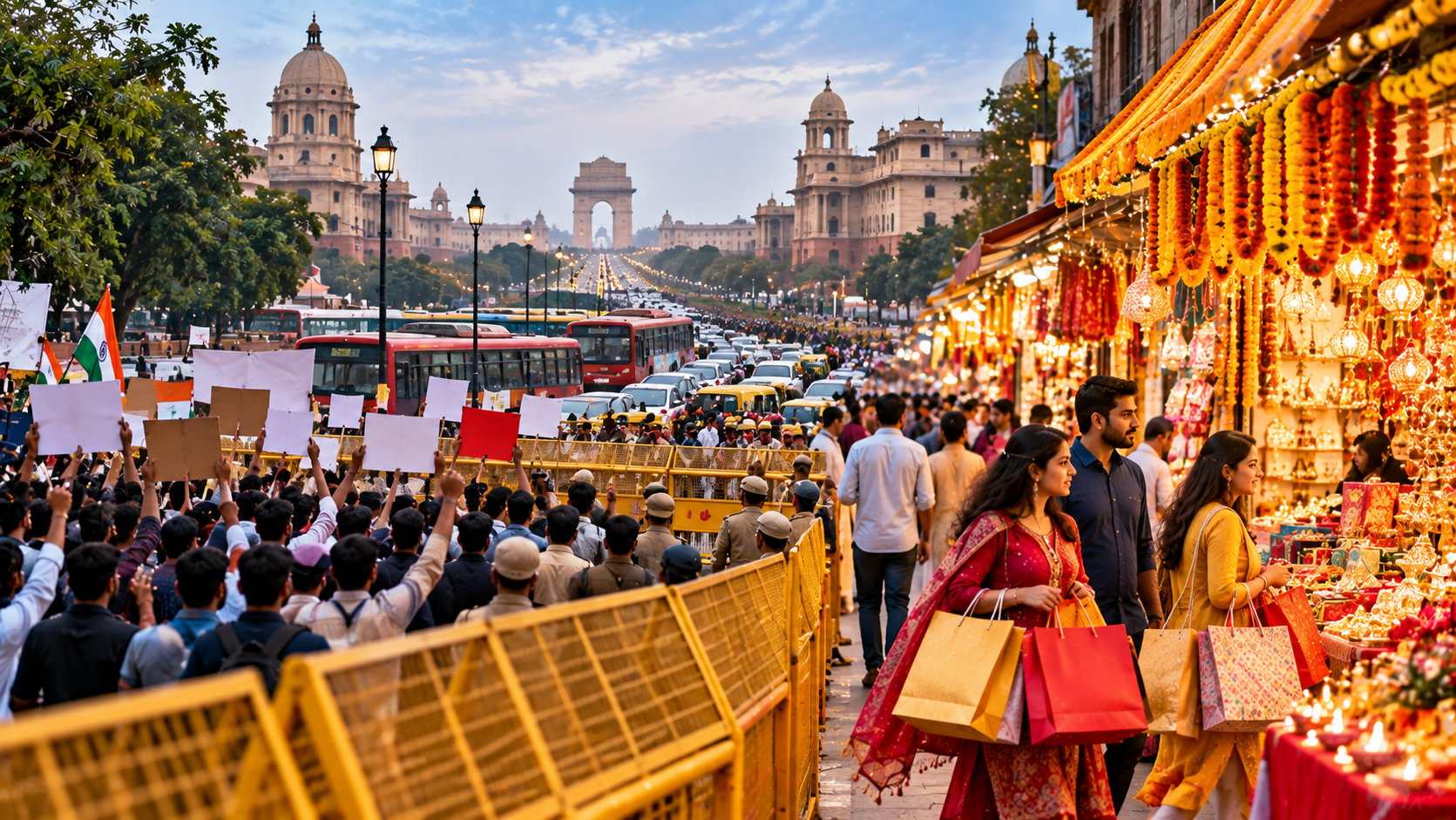
CTI urges Centre to restrict demonstrations in key commercial areas, citing falling customer footfall, traffic congestion and metro disruptions ahead of the festive shopping season
Traders Seek Relief Ahead of Diwali
The Chamber of Trade and Industry (CTI) has urged the Central government to restrict large-scale protests in Delhi's major commercial and central areas from Navratri through Diwali, arguing that repeated demonstrations are hurting businesses during one of the most important shopping periods of the year.
In a letter to Prime Minister Narendra Modi, CTI chairman Brijesh Goyal called for tighter arrangements around Jantar Mantar, Parliament Street, Connaught Place and parts of Lutyens' Delhi. The organisation also proposed creating a permanent protest zone outside central Delhi to reduce disruption to commercial activity.
The demand comes as traders prepare for the festive period, with Navratri and Ramlila events beginning around October 11, followed by Diwali and the wedding season. Retailers typically rely on higher consumer spending during these weeks to support sales across clothing, jewellery, electronics, household goods, gifts and other categories.
CTI Claims Business Activity Has Fallen 70%
According to a survey cited by CTI, business activity in Delhi's markets has declined by around 70 per cent over the preceding three days.
The organisation also claimed that the number of customers arriving from outside Delhi for shopping had dropped sharply, from an estimated two to three lakh people daily to approximately 40,000–50,000.
Local customer footfall reportedly fell by more than 50 per cent, according to the traders' body. These figures represent CTI's estimates and have not been independently verified in the supplied report.
If the decline persists, it could affect retailers that depend heavily on seasonal sales, particularly businesses in crowded markets where customers rely on public transport and convenient road access.
Metro Disruptions and Traffic Congestion Add to Concerns
CTI said repeated metro station closures, traffic congestion and restrictions around protest locations were discouraging shoppers from visiting central Delhi.
Large demonstrations can affect commercial areas beyond the immediate protest venue when roads are barricaded, traffic is diverted or public transport access is restricted. Such disruptions may also affect delivery vehicles, employees, suppliers and customers travelling between different parts of the city.
For retailers, even temporary access problems can reduce walk-in purchases, particularly during the festive season, when many shopping decisions are made through visits to physical stores.
Goyal said the organisation respected the constitutional right to peaceful protest but argued that large gatherings in central commercial districts could impose substantial costs on businesses during a crucial sales period.
Traders Seek New Rules for Large Gatherings
CTI general secretary Gurmeet Arora called for fresh government guidelines governing demonstrations involving more than 1,000 people at Jantar Mantar and other prominent locations.
The organisation wants authorities to establish clearer arrangements for crowd management, traffic movement and public access to commercial areas. Such guidelines could help businesses and shoppers anticipate restrictions and reduce uncertainty around major gatherings.
However, any new framework would need to balance the economic concerns of traders with the right to peaceful assembly and freedom of expression.
Permanent Protest Zone Proposed Outside Central Delhi
The traders' body has suggested creating a designated protest area outside central Delhi, with Burari and Ramlila Maidan mentioned as possible locations.
A permanent venue, CTI argues, could provide a recognised space for demonstrations while reducing the frequency of disruptions in busy commercial and administrative districts.
The effectiveness of such a proposal would depend on accessibility, public transport connections, crowd capacity, security arrangements and whether protest organisers consider the designated location suitable.
Any relocation policy would also need to follow applicable legal requirements and preserve access to lawful demonstrations.
October 10 Protest Adds to the Debate
The demand comes ahead of a proposed October 10 demonstration by the Cockroach Janata Party, which has called for the resignation of Chief Election Commissioner Gyanesh Kumar over allegations concerning electoral-roll revision.
The planned protest has prompted heightened security preparations in the national capital. Authorities are expected to manage crowd movement and traffic around sensitive areas, with the possibility of restrictions affecting commuters and businesses.
The debate over protest locations has therefore become a question not only of public order but also of how the capital manages competing demands on roads, transport infrastructure and commercial spaces.
Festive Season Holds Major Significance for Retailers
The period around Navratri, Diwali and the wedding season is important for Delhi's retail ecosystem. Clothing and jewellery stores, electronics outlets, markets selling household goods and small independent traders often depend on concentrated seasonal demand.
A sustained decline in customer visits could affect sales, inventory turnover and short-term cash flow. Smaller businesses with limited financial reserves may be particularly exposed if disruption coincides with higher inventory and staffing costs.
At the same time, the overall effect on the retail sector will depend on how long the restrictions or disruptions last, whether shoppers shift to online purchases and whether customer footfall recovers before the main festive shopping days.
Market Outlook
The dispute highlights the economic consequences that can arise when large public demonstrations overlap with peak retail periods. For traders, predictable access to markets and transport connectivity can be as important as consumer demand in determining festive-season sales.
The immediate issues to watch are the government's response to CTI's request, any revised rules for large gatherings, the arrangements for the October 10 protest and the extent to which customer footfall recovers.
A designated protest zone or clearer crowd-management guidelines could help reduce disruption, but a durable solution will require coordination among police, transport authorities, protest organisers and business representatives.
For now, the reported fall in activity remains a claim made by CTI rather than an independently confirmed measure of Delhi's overall retail performance. The broader economic impact will become clearer as the festive season progresses and more information emerges on actual sales and customer visits.