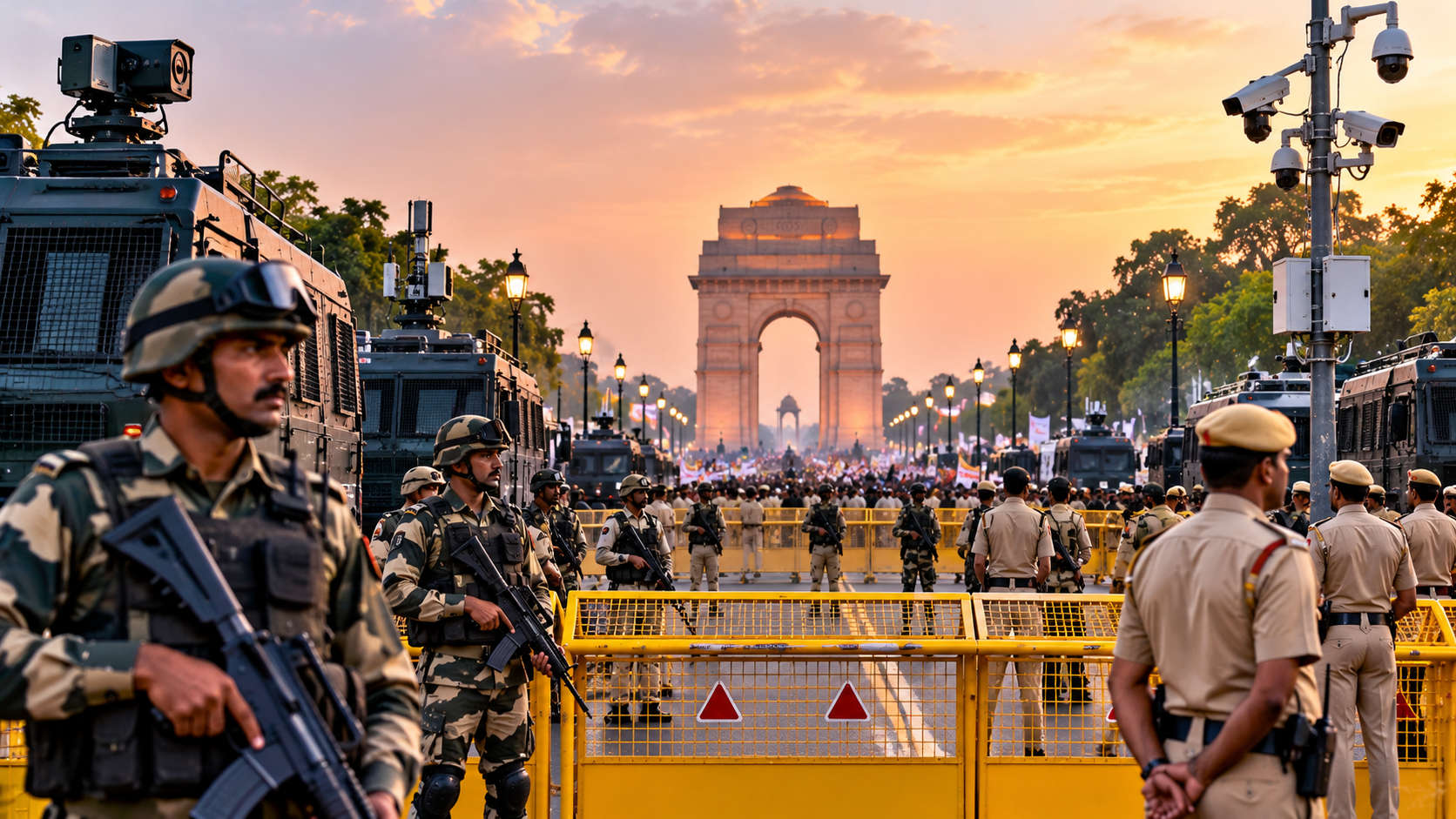
Security tightened across the national capital as authorities prepare for a large gathering, monitor interstate movement and consider restrictions around central Delhi
Security Forces Mobilised Across Delhi
Security arrangements have been significantly intensified across Delhi ahead of the proposed October 10 protest by the Cockroach Janta Party (CJP), with authorities preparing for the possibility of a large mobilisation in the national capital.
Around 11,000 additional personnel from Central Armed Police Forces (CAPF) are reportedly being deployed between October 8 and 12. The move would take the overall presence of central forces in Delhi to around 26,000, according to reports.
Delhi Police are also expected to deploy around 20,000 personnel during the protest, creating a substantial security presence across central Delhi and other areas considered sensitive.
Why Is the CJP Planning a Protest?
The CJP has proposed holding a demonstration in Delhi on October 10, with Jantar Mantar identified as the proposed venue.
The protest is focused on Chief Election Commissioner Gyanesh Kumar and the Election Commission, amid continuing political controversy over alleged irregularities in the Special Intensive Revision (SIR) of electoral rolls.
The proposed Delhi demonstration follows a similar protest held in Mumbai on October 2. Opposition parties and civil society groups have also organised demonstrations over the issue and have demanded accountability from the Election Commission.
110 Additional CAPF Companies Deployed
The additional central deployment includes 110 CAPF companies. These comprise 85 companies of the Central Reserve Police Force (CRPF), 10 companies of the Sashastra Seema Bal (SSB), seven companies of the Indo-Tibetan Border Police (ITBP), seven Rapid Action Force (RAF) companies and one Central Industrial Security Force (CISF) company.
At least five of the deployed companies are expected to comprise women personnel. The deployment is intended to strengthen crowd-management capabilities, particularly given expectations of significant participation by women protesters.
The Rapid Action Force, which specialises in handling riots and large public gatherings, is expected to play an important role if the situation requires additional crowd-control measures.
Delhi Police Intensifies Surveillance
Authorities are preparing multiple layers of security around central Delhi and possible protest routes.
Police are expected to increase surveillance along routes connecting Delhi with neighbouring states, particularly Uttar Pradesh and Rajasthan. Barricades and additional checking points may be established at selected entry points to prevent large groups from reaching central Delhi without authorisation.
CCTV networks and facial-recognition systems are also expected to be used to monitor movement and identify potential gathering points.
Police are additionally keeping an eye on buses travelling towards the New Delhi district, while railway stations and major bus terminals could remain under enhanced surveillance.
Neighbouring States Asked to Remain Alert
The security preparations are not limited to Delhi.
Neighbouring states, including Uttar Pradesh and Haryana, have reportedly been asked to maintain heightened vigilance as authorities anticipate that protesters could travel from outside the national capital.
Monitoring interstate transportation could become an important part of the security strategy if large groups attempt to enter Delhi ahead of the demonstration.
Metro Services and Markets Could Be Affected
The heightened security measures could have an impact on everyday movement in central Delhi.
Authorities may impose temporary restrictions on selected metro stations if crowd movement or security conditions warrant such action. Markets and commercial areas could also face temporary closures or restrictions depending on the size and behaviour of the gathering.
Commuters travelling through central Delhi on October 10 may therefore face diversions, additional security checks or longer travel times.
Permission for Protest Remains a Key Issue
The proposed demonstration has also raised questions over whether the organisers will receive formal permission to hold the gathering at the proposed venue.
Reports indicate that Delhi Police had not granted permission for the October 10 protest as of October 8.
Authorities are reportedly preparing temporary detention facilities in case large numbers of protesters arrive and refuse to comply with directions to disperse.
The approach reflects the administration's attempt to prevent a repeat of confrontations seen during earlier protests related to the Election Commission and electoral-roll revision issue.
Political Tensions Continue to Rise
The planned demonstration comes amid heightened political tensions between opposition parties and the Election Commission.
Recent protests in Delhi have already resulted in the detention of opposition leaders and the registration of cases against Congress leaders Rahul Gandhi and Priyanka Gandhi Vadra over allegations linked to an earlier demonstration.
With another major mobilisation planned, authorities are likely to focus on preventing clashes, maintaining access to important government areas and ensuring that public transport and essential services continue to operate.
What to Expect on October 10
The scale of the security deployment indicates that authorities are preparing for a potentially large gathering rather than treating the proposed demonstration as a routine protest.
The key areas to watch will be movement towards central Delhi, the response of protesters if permission is denied, possible restrictions around Jantar Mantar, public transport disruptions and the conduct of political leaders and security personnel.
The administration's challenge will be to maintain public order while allowing legitimate political expression, particularly as the dispute over electoral-roll revision continues to generate political mobilisation.