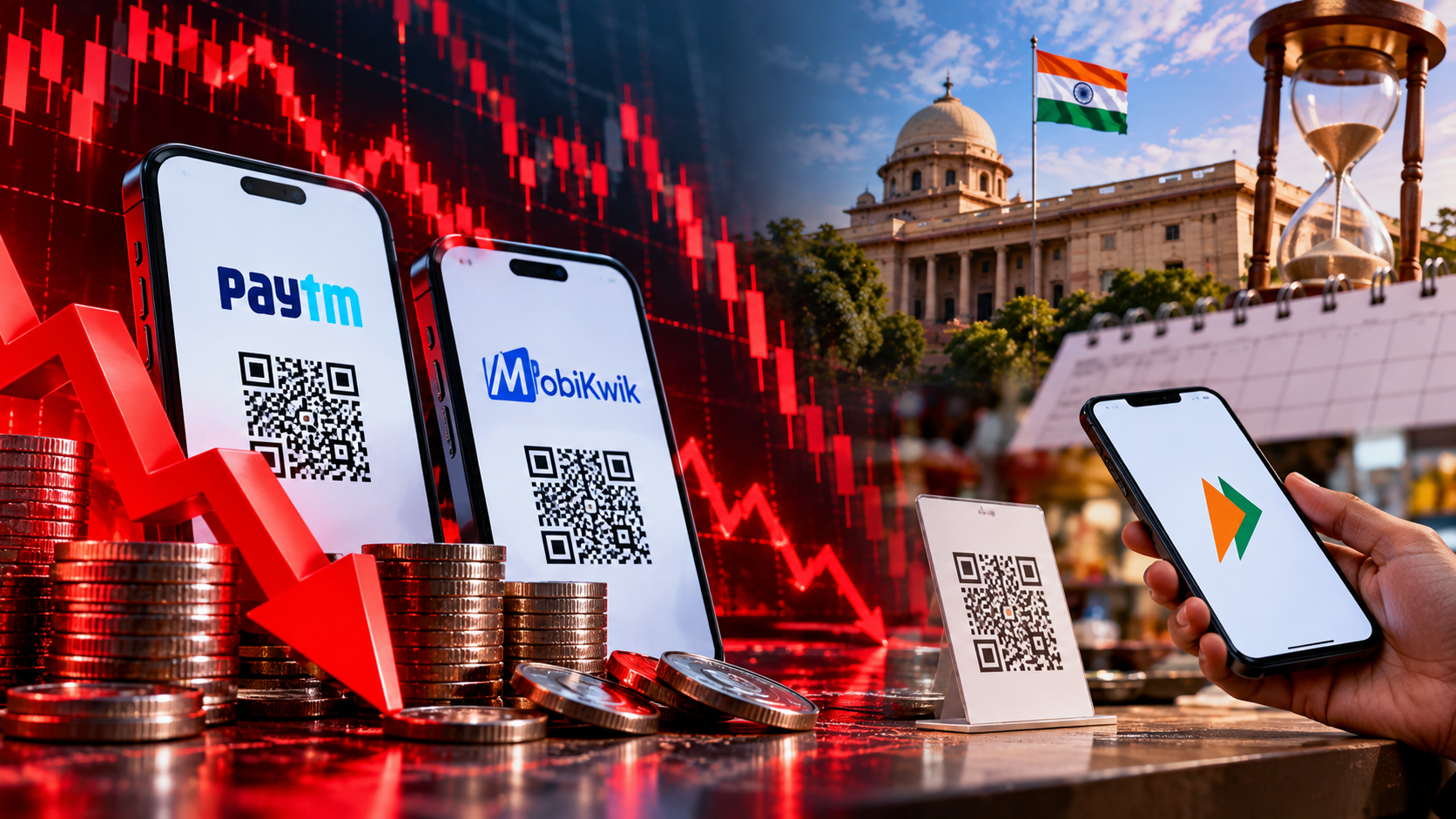
Proposed delay in the new UPI merchant discount rate framework triggers profit-booking in digital payment stocks; investors reassess the timing of potential monetisation benefits
Shares of digital payments companies Paytm and MobiKwik came under heavy selling pressure on Thursday after reports suggested that implementation of the proposed UPI merchant discount rate (MDR) framework could be deferred to January 1, 2027, from the earlier proposed October 15 rollout.
There is no final decision on the revised implementation date yet, but the possibility of a delay was enough to trigger selling in fintech stocks as investors reassessed the near-term earnings impact of UPI monetisation.
Paytm Shares Fall 10% From Recent High
Shares of One97 Communications, the parent company of Paytm, fell as much as 10 per cent to ₹1,560.60 on the BSE during intraday trading.
The stock had already rallied sharply in recent months, making Thursday's decline a significant bout of profit-booking. Paytm shares had touched a 52-week high of ₹1,856.50 on September 16, 2026, and had gained around 96 per cent from their 52-week low of ₹947.15 recorded on March 30.
At the latest reported level of ₹1,641.90, the stock was down ₹90.10, or 5.20 per cent, while the day's trading range extended from ₹1,558.80 to ₹1,671.
The sharp move indicates that expectations around UPI monetisation had become an important factor in the stock's recent rally.
MobiKwik Also Faces Heavy Selling
MobiKwik shares were also under pressure, declining around 7 per cent to ₹238.25 during intraday trading.
The fall came after the stock had gained approximately 22 per cent over the preceding three trading sessions, making the latest decline partly a result of profit-booking following its recent sharp rally.
Trading activity increased significantly, with millions of shares changing hands across the NSE and BSE.
The simultaneous weakness in both stocks indicates that investors are closely tracking developments around the proposed UPI MDR framework and its potential impact on the revenue outlook for payment companies.
Why UPI MDR Matters for Fintech Companies
UPI has transformed India's digital payments ecosystem, but payment companies have historically operated under significant restrictions on monetising many UPI transactions.
The proposed MDR framework could create a new revenue opportunity for payment ecosystem participants by allowing a charge on eligible merchant transactions above ₹2,000.
Under the proposal outlined in the report, an MDR of 0.4 per cent would apply to eligible person-to-merchant UPI transactions above ₹2,000, with the charge capped at ₹300 for transactions of ₹75,000 and above.
Small merchants and person-to-person transactions would remain exempt under the proposed structure.
For companies such as Paytm and MobiKwik, the framework could potentially create an additional revenue pool, although the actual benefit would depend on transaction mix, merchant negotiations, competitive pricing and the eventual structure of the regulations.
Delay Could Push Back Earnings Benefits
The possible postponement from October 15 to January 1 could delay the point at which payment companies begin recognising the potential benefits of the new MDR framework.
The proposed delay is reportedly intended to provide merchants, banks and payment companies with additional time to prepare, particularly during the peak festive season.
For investors, however, even a short delay can affect near-term earnings expectations when stocks have already rallied strongly on the prospect of improved monetisation.
The market reaction therefore reflects not only the delay itself but also the possibility that the earnings benefits expected by investors could take longer to materialise.
Brokerage Expectations Remain Positive
The potential revenue opportunity has already attracted positive attention from analysts.
A September brokerage assessment had indicated that the proposed MDR was higher than earlier expectations of around 25 basis points. The analysis suggested that Paytm's earnings estimates could benefit meaningfully from a higher revenue pool, even after accounting for exemptions, competitive pricing and other adjustments.
The potential earnings benefit would therefore depend on the final rules and how much of the MDR translates into revenue for payment platforms.
A higher headline MDR does not automatically translate into an equivalent increase in profitability because the ecosystem involves banks, payment service providers, merchants and other participants.
Paytm’s Recent Rally Makes the Stock More Sensitive
Paytm's sharp recovery from its March low has increased the stock's sensitivity to changes in earnings expectations.
The stock had almost doubled from its 52-week low before Thursday's sell-off, creating significant gains for investors who entered during the earlier recovery phase.
As valuations and expectations rise, any change in the expected timing of regulatory or earnings catalysts can result in heightened volatility.
The stock's recent performance therefore needs to be viewed against both its improving business outlook and the substantial re-rating already reflected in its share price.
MobiKwik Faces a Different Earnings Equation
MobiKwik's recent 22 per cent three-session rally also left the stock vulnerable to profit-booking.
The company operates across digital payments and financial services, making its growth prospects dependent on transaction volumes, customer acquisition, monetisation and expansion of its financial-services business.
A clearer UPI MDR framework could potentially improve monetisation prospects, but the impact will depend on the final rules and the company's ability to capture an attractive share of the resulting revenue pool.
Bigger Question Is Sustainable UPI Monetisation
The latest market reaction highlights a broader issue for India's digital payments industry: how payment companies can convert enormous transaction volumes into sustainable profits.
UPI has become one of the world's largest digital payment systems, but transaction growth alone does not guarantee proportional revenue growth.
A formal MDR structure could potentially improve the economics of merchant payments. At the same time, competitive pressures could prevent payment platforms from retaining the entire MDR, particularly if merchants have multiple payment options.
The final economics will therefore depend on how the MDR is distributed across the ecosystem.
Investors Await Final Government Decision
For now, the January 1, 2027 implementation date remains a reported possibility rather than a confirmed final decision.
Investors will be watching for official clarification on the implementation timeline, eligible transaction categories, MDR distribution and the treatment of different merchant segments.
Any confirmation that the framework remains intact but is merely being deferred could reduce uncertainty. Conversely, changes to the proposed MDR rate, exemptions or transaction thresholds could lead to another round of earnings-estimate adjustments.
Market Outlook
Paytm and MobiKwik shares are likely to remain volatile until there is greater clarity on the UPI MDR rollout timeline. The immediate pressure reflects a combination of uncertainty over the implementation date and profit-booking after strong recent gains.
For Paytm, the key question is whether the proposed MDR framework can create a meaningful and sustainable revenue stream without significant leakage through competitive pricing and ecosystem costs. For MobiKwik, investors will similarly assess whether increased UPI monetisation can translate into stronger operating leverage and profitability.
The broader digital payments opportunity remains significant, but investors may increasingly distinguish between transaction growth and actual monetisation. Confirmation of the MDR framework and its implementation timeline could therefore become an important catalyst for fintech stocks in the coming months.