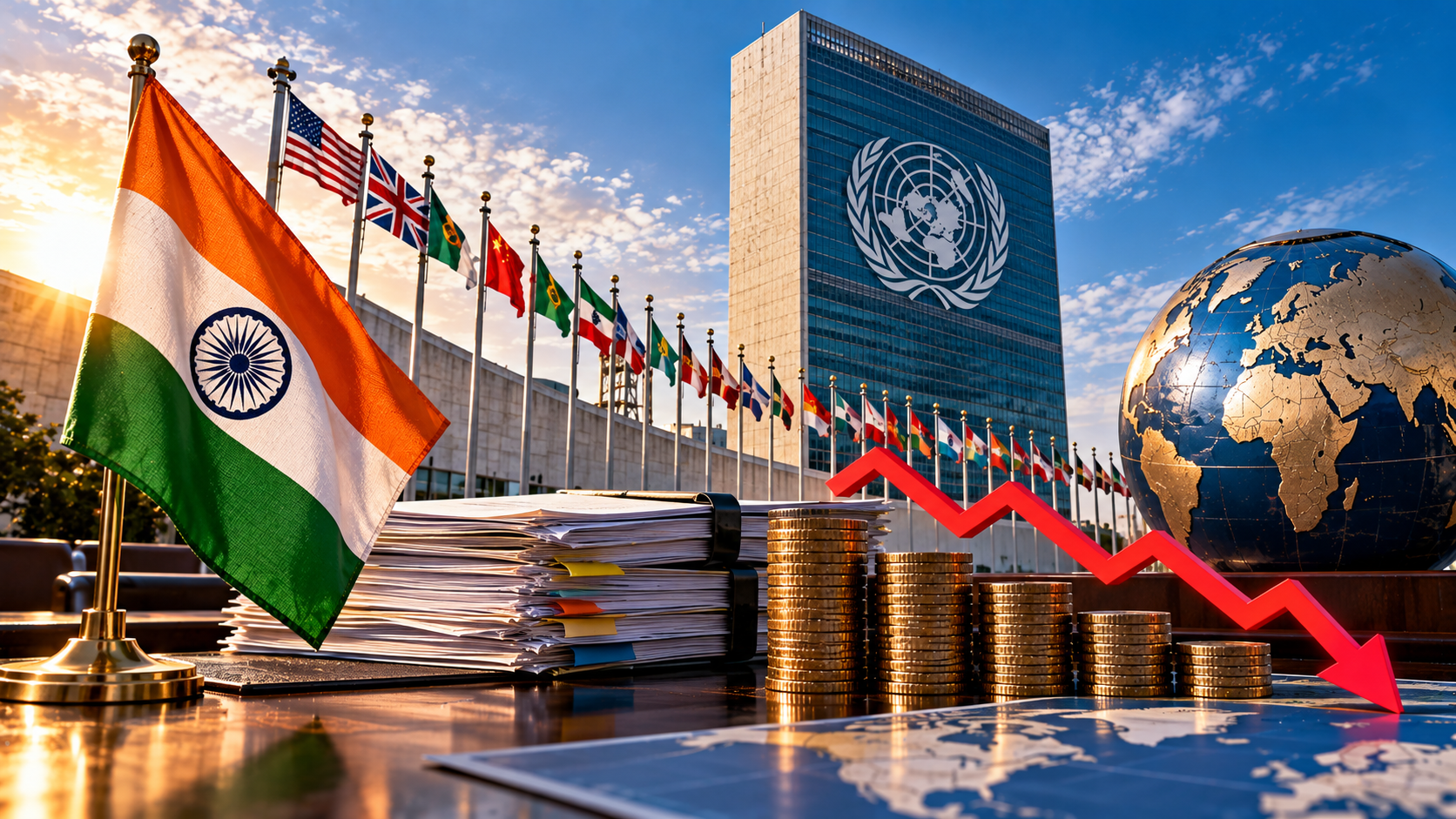
India has urged all United Nations member states to fulfil their financial obligations on time, warning that persistent arrears and uncertain cash collections are threatening the organisation’s financial stability, including its peacekeeping operations.
India Flags Persistent Financial Stress at the United Nations
India has expressed concern over the United Nations’ challenging financial position in 2026, highlighting substantial unpaid member-state contributions and low cash balances that could constrain the organisation’s operations. New Delhi has called for full, timely and unconditional payment of assessed contributions, describing it as an obligation under the UN Charter.
Speaking at the 81st session of the UN General Assembly’s Fifth Committee, which examines administrative and budgetary matters, Surendra Adhana, Counsellor at India’s Permanent Mission to the United Nations, said uncertainties surrounding collections had contributed to the organisation’s liquidity difficulties.
India’s intervention comes as the UN continues to face a gap between its budgetary requirements and the funds actually received from member states. Although regular-budget arrears declined slightly compared with the previous year, India said the outstanding amount remained unacceptably high.
Regular Budget Arrears Stand at $1.46 Billion
According to India’s statement, unpaid assessments for the UN regular budget stood at $1.46 billion in 2026, down from $1.87 billion a year earlier. Despite the improvement, more than 90 per cent of the outstanding regular-budget arrears were attributed to a single member state.
The concentration of unpaid contributions creates a significant financial vulnerability for the organisation. When a large portion of outstanding dues depends on a single contributor, delays in payment can have a disproportionate effect on available cash and the UN’s ability to meet its expenditure commitments.
The United States is the largest financial contributor to the UN regular budget, accounting for 22 per cent of the total. It also contributes 27 per cent of the peacekeeping budget under the applicable assessment framework.
Washington paid $725 million towards the regular budget and an additional $102 million for peacekeeping in September, according to the report. However, the United States continued to owe more than $4 billion in combined regular-budget and peacekeeping arrears.
The figures underline the difference between making substantial payments and clearing all outstanding financial obligations. India has stressed that predictable and complete contributions are essential for effective budget management.
Peacekeeping Finances Face Greater Pressure
India described the financial situation surrounding UN peacekeeping as even more concerning than the regular-budget position.
Unpaid peacekeeping assessments reportedly increased to $4.1 billion, compared with $3.7 billion a year earlier. Collections remained broadly stagnant at around $1.4 billion, widening the gap between outstanding obligations and the money received.
Two member states together accounted for approximately 88 per cent of the unpaid peacekeeping assessments, according to Adhana’s statement.
Peacekeeping operations require dependable funding for personnel, equipment, logistics, transport and support services. Persistent payment delays can complicate planning, create pressure on reimbursements and make it more difficult for the organisation to manage missions within approved budgets.
The rising arrears therefore represent more than an accounting concern. They raise questions about the UN’s capacity to maintain predictable funding for operations mandated by its member states.
Stronger Collections Offer Limited Relief
India acknowledged that collections had improved during the third quarter, providing some relief to the organisation’s immediate cash position. However, Adhana cautioned that this improvement would need to continue if the UN was to avoid renewed liquidity pressure.
By September 30, 141 member states had paid their regular-budget assessments in full, compared with 136 at the same point a year earlier.
The increase indicates that more countries are meeting their payment obligations, but the overall financial position remains heavily influenced by the size and timing of contributions from the largest outstanding debtors.
For the UN, the timing of payments is particularly important. Even when assessed contributions are eventually received, delays can create short-term cash shortages that affect expenditure planning and operational flexibility.
A sustained improvement would require not only more member states paying in full, but also meaningful progress in collecting large outstanding amounts.
China and the United States Remain Key Contributors
The United States and China are among the leading contributors to UN funding, although their assessed shares differ across regular-budget and peacekeeping arrangements.
China paid $641.4 million towards its regular-budget contribution in September, according to the report. The United States remains the largest contributor to both the regular budget and peacekeeping funding, but its substantial outstanding arrears continue to be a central concern.
India has urged member states with the financial capacity to do so to take prompt action to meet their obligations. Its position is that the organisation cannot maintain sound financial management if approved expenditure is not matched by reliable and timely contributions.
The issue also highlights the dependence of multilateral institutions on the willingness of member governments to honour their funding commitments, even when political disagreements or domestic budgetary pressures complicate international payments.
India Highlights Its Own Payment Record
India said it had consistently paid its assessed contributions in full and on time, often ahead of schedule. It was among 55 member states that settled their regular-budget assessments in full within the 30-day payment period this year.
India made a payment of $35.18 million in February, according to the report.
New Delhi’s intervention emphasises that timely contributions are a shared responsibility and an essential part of maintaining the credibility and operational effectiveness of the United Nations.
India has called for prudent budgetary management and a financially sound organisation that does not accumulate unpaid obligations. It has also urged member states to take corrective action before liquidity shortages begin to disrupt essential functions.
Why the UN’s Liquidity Position Matters
The UN’s financial position has implications for international diplomacy, humanitarian assistance, peacekeeping and administrative operations. A prolonged cash shortage can force the organisation to manage spending more cautiously, defer payments or adjust the pace of activities.
The impact is particularly relevant to peacekeeping, where operations depend on coordinated funding for personnel and field logistics. Financial uncertainty can also complicate planning for humanitarian and development programmes, although the precise operational consequences depend on available funds, payment schedules and the budgetary arrangements of individual activities.
The situation demonstrates the importance of maintaining a reliable flow of contributions rather than depending on occasional large payments to resolve immediate shortages.
For member states, the challenge is to balance domestic fiscal priorities with their commitments to international institutions. For the UN, it is to improve collection predictability, manage expenditure responsibly and maintain transparency about the consequences of delayed payments.
Outlook: Arrears Clearance Is Critical to Financial Stability
India’s warning places the UN’s funding arrangements under renewed scrutiny at a time when regular-budget arrears remain substantial and peacekeeping dues have increased. The decline in regular-budget arrears offers some encouragement, but it does not resolve the underlying concentration of unpaid contributions.
The next key indicators will be whether large outstanding dues are cleared, whether third-quarter collection momentum continues and whether peacekeeping receipts improve enough to reduce the growing backlog.
A sustained recovery in collections could ease immediate cash pressures and give the organisation greater flexibility in managing approved programmes. Continued delays, however, would leave the UN vulnerable to further liquidity constraints despite the contributions already received from many member states.
India’s central message is that the organisation’s financial health depends on collective responsibility: assessed contributions must be paid in full and on time if the United Nations is to carry out its mandate effectively.