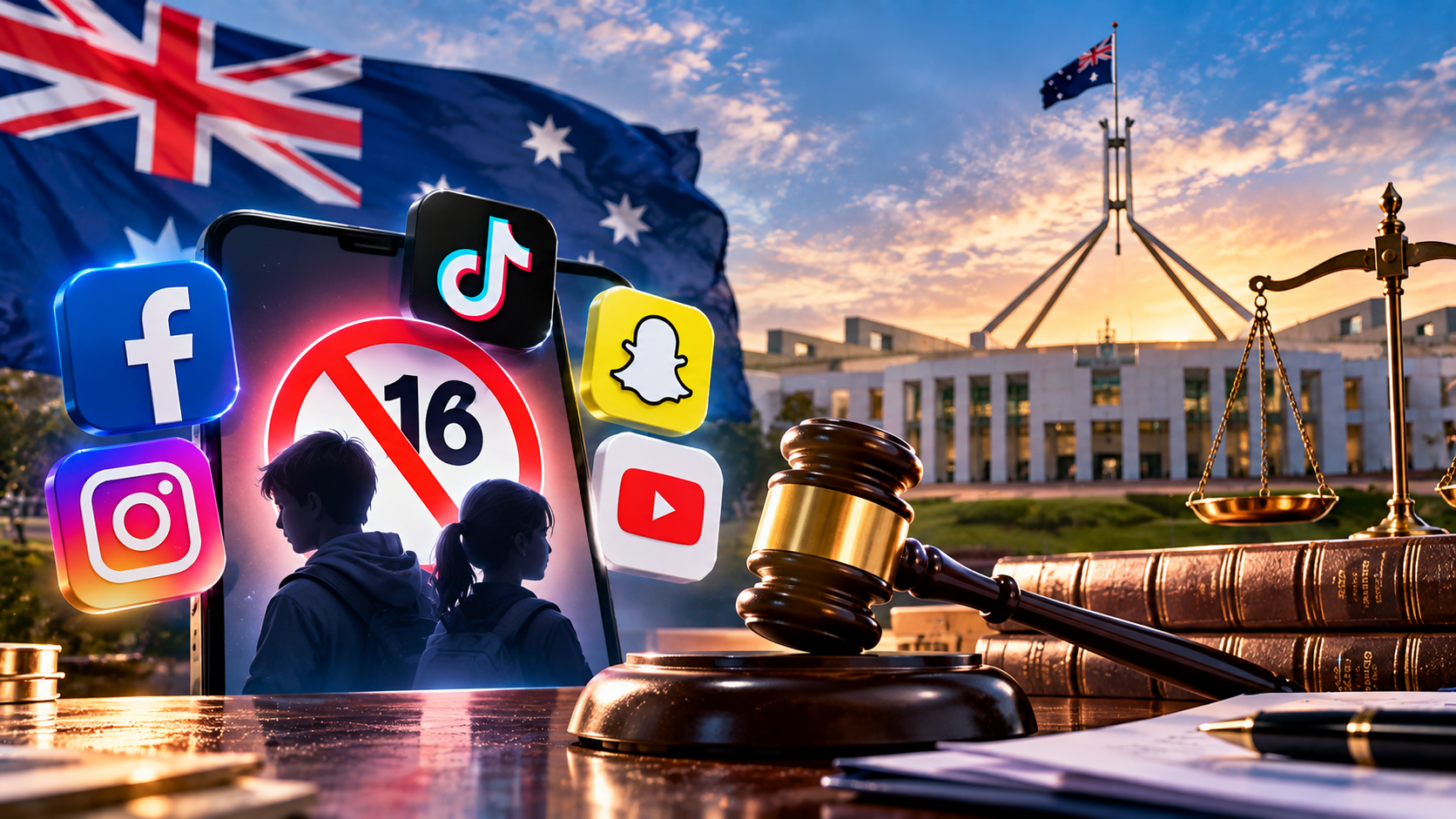
The Australian government is preparing legal action against five major social media platforms over alleged failures to prevent children under 16 from holding accounts. Companies face potential penalties of up to A$109.2 million as regulators intensify scrutiny of age-verification systems and online child safety.
Australia Steps Up Enforcement of Social Media Restrictions
Australia is preparing to take legal action against Facebook, Instagram, TikTok, Snapchat and YouTube over alleged non-compliance with its nationwide ban on social media accounts for children under 16, Communications Minister Anika Wells has said.
The proposed action marks a significant escalation in the government's efforts to enforce the legislation, which was introduced to protect children from harmful online content and the potential risks associated with social media use.
In an interview in Sydney, Wells said she expected proceedings against the five platforms to move forward. The country's online safety regulator, the eSafety Commissioner, has been investigating whether the companies took adequate steps to prevent underage users from accessing their services.
The investigation, announced in March, covers Facebook and Instagram, both owned by Meta Platforms, as well as TikTok, Snapchat and YouTube. The platforms could face legal consequences if regulators establish that they failed to meet their obligations under the law.
The allegations have not yet been established in court, and the companies' responses to the proposed proceedings were not immediately available.
Age-Verification Systems Under Regulatory Scrutiny
A central issue in the investigation is whether social media companies have implemented effective measures to identify and prevent underage users from creating or retaining accounts.
An eSafety report published in July found that many users below the minimum permitted age were still able to maintain existing accounts or create new ones. The report pointed to shortcomings in age-verification and age-assurance mechanisms as a key factor.
The findings have raised questions about the effectiveness of systems that rely on users entering their dates of birth or completing basic account-registration checks.
For regulators, the challenge is to ensure that platforms take reasonable steps to prevent prohibited access while maintaining appropriate privacy protections. More robust age-assurance measures could involve additional verification procedures, although their implementation may create technical and operational challenges for technology companies.
The Australian government's position is that platforms must demonstrate meaningful compliance rather than simply introduce rules that underage users can easily circumvent.
Maximum Penalty Doubled to A$109.2 Million
Australia has increased the maximum penalty for breaches of the under-16 social media restrictions to A$109.2 million, equivalent to approximately US$76 million.
The higher penalty substantially increases the potential financial consequences for companies found to have violated the law. The final outcome would depend on the applicable legal provisions, evidence presented and decisions by the Federal Court.
The government has also expanded the investigative powers available to eSafety Commissioner Julie Inman Grant. These powers include requiring social media companies to produce documents and compelling current or former employees to answer questions.
According to Wells, the expanded authority is helping the regulator gather evidence needed to prepare potential cases against the five platforms.
The move signals that enforcement will involve more than public warnings or voluntary compliance measures. Regulators are preparing to use formal legal mechanisms to examine whether companies have fulfilled their responsibilities.
Government Says Platforms Must Be Held Accountable
The government has defended the legislation, arguing that the problem lies with alleged failures by companies to comply rather than with the law itself.
In an October 15 speech to the National Press Club, Wells said technology platforms were not doing enough to adhere to the age restrictions and reiterated the government's determination to hold them accountable.
The distinction is important for the future of the policy. If legal proceedings establish that platforms failed to take reasonable steps, the cases could strengthen the government's enforcement approach and influence how companies implement age restrictions.
The outcome could also shape future discussions about the responsibilities of digital platforms in protecting children, particularly as governments worldwide examine the effects of social media on young users.
The eSafety Commissioner operates as an independent regulator and is accountable to Australia's Parliament through the communications minister.
Meta, TikTok, Snapchat and YouTube Face Growing Compliance Pressure
The investigation covers some of the world's largest digital platforms, each with extensive user bases and different approaches to account verification, content distribution and safety controls.
Meta operates Facebook and Instagram, while TikTok is owned by ByteDance. Snapchat is operated by Snap Inc., and YouTube is part of Google.
The companies could face increased compliance costs if regulators require stronger age-assurance systems, more frequent monitoring or changes to account-management procedures.
Potential legal action may also prompt technology companies to review their existing safeguards and documentation to demonstrate that they have taken reasonable steps to comply with the legislation.
Representatives for Meta and the eSafety regulator had no immediate comments on the minister's remarks. Representatives for Snap, TikTok and Google did not immediately respond to requests for comment, according to the report.
The absence of immediate responses should not be interpreted as an admission of wrongdoing.
Implications for the Global Technology Industry
Australia's enforcement efforts could become an important test case for governments considering stricter age limits on social media.
Technology platforms operate across multiple jurisdictions, each with its own rules governing child protection, privacy, digital identity and online content. As governments increase scrutiny of underage access, companies may need to adapt their compliance systems to different legal requirements.
Stronger age verification could increase spending on technology, safety teams, legal support and regulatory reporting. Depending on how the requirements are implemented, platforms may also face changes to user-registration processes and account retention.
However, the financial impact on individual companies will depend on the scale of any required changes, the final legal findings and whether penalties are imposed.
For investors, the issue highlights the growing importance of regulatory risk in the technology sector. Legal costs, compliance spending and restrictions on access to particular user groups can affect business operations, although the impact will vary considerably across companies.
The proceedings may also influence how platforms balance growth objectives with safety obligations, especially in markets where regulators are introducing stricter rules for children and teenagers.
Market Outlook: Regulatory Risk Becomes More Important for Big Tech
Australia's proposed legal action marks a new phase in the enforcement of its under-16 social media ban. The immediate focus will be on the evidence gathered by the eSafety Commissioner, the legal proceedings that follow and whether the Federal Court determines that any platform failed to meet its obligations.
If enforcement results in substantial penalties or demands for stronger age-verification systems, technology companies could face higher compliance costs and increased regulatory scrutiny. The case may also encourage other governments to examine whether similar restrictions are practical and enforceable.
For investors, the development reinforces the need to assess regulatory exposure alongside user growth, advertising revenue and profitability when evaluating major technology companies.
The broader issue extends beyond Australia: as governments seek stronger protections for young people online, the ability of digital platforms to demonstrate effective compliance is likely to become an increasingly important part of their long-term business and risk-management strategies.