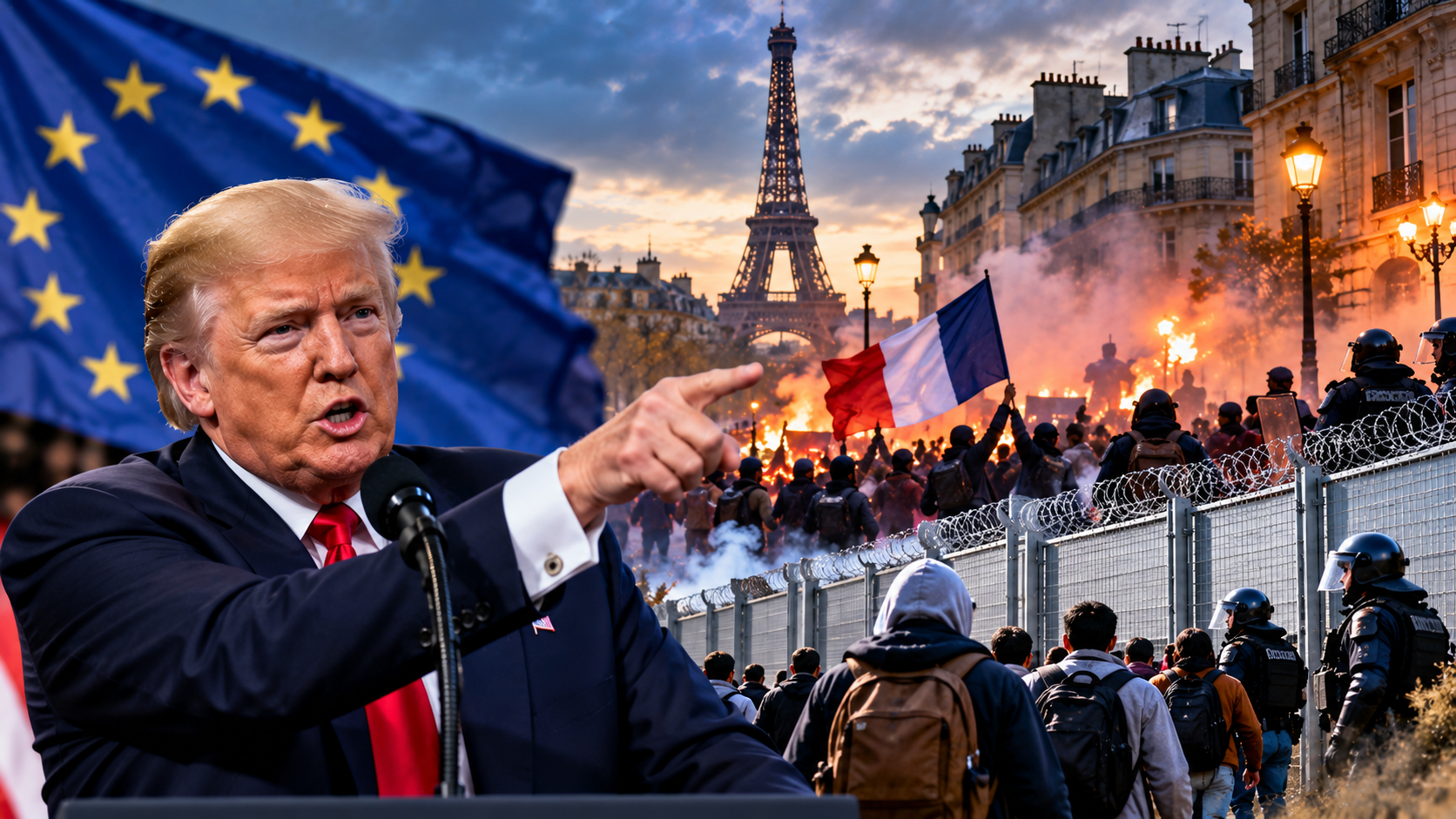
US President Donald Trump has blamed immigration for escalating unrest in France and urged European governments to close their borders and deport individuals who pose security threats. The remarks come as French authorities impose local curfews, intensify policing and assess damage from violent protests and widespread looting.
Trump Links European Unrest to Immigration Policies
US President Donald Trump has issued a stark warning about Europe's future, arguing that European nations risk severe instability unless they strengthen border controls and remove individuals who pose a threat to public safety.
Speaking to reporters outside the White House on Monday, Trump attributed the unrest in France primarily to immigration, rejecting suggestions that domestic policy and education-related issues were the main causes. He reiterated that he had previously advised French President Emmanuel Macron to tighten border controls.
Trump also extended his criticism to other European countries, including Italy, arguing that governments must address criminal activity and restore public order to protect national sovereignty.
His comments reflect his long-standing position on immigration and border enforcement. However, his assertions linking the wider European unrest directly to immigration represent his political assessment rather than an established explanation for the violence.
Trump Calls for Stricter Borders and Deportations
Trump argued that European governments should strengthen border controls and deport individuals who commit crimes or pose security risks.
He warned that Europe would face serious consequences if governments failed to address border management and public safety. He also contrasted European policies with his administration's approach to border enforcement in the United States.
The US president's remarks come amid heightened political debate across Europe over immigration, law enforcement, social integration and the handling of violent demonstrations.
The issue presents a complex challenge for European governments, which must balance border management and public security with legal obligations, individual rights and the economic and social considerations associated with migration.
Trump's comments are likely to add to transatlantic political debate over immigration policy, particularly as European leaders face pressure to respond to public concerns about safety and disorder.
Bordeaux Imposes Night Curfew Following Violent Unrest
The latest developments come as authorities in Bordeaux, southwestern France, introduced a temporary night curfew for unaccompanied minors following severe unrest and widespread looting over the weekend.
The order, announced by Sophie Brocas, prefect of Gironde and Nouvelle-Aquitaine, took effect on Tuesday and is scheduled to remain in place until the morning of October 26.
Under the measure, minors under 18 are prohibited from being in specified public areas between 10 p.m. and 7 a.m. unless accompanied by a parent or legal guardian.
The restrictions cover several commercial streets and public spaces affected by the violence, including Rue Sainte-Catherine, Rue de la Porte-Dijeaux, Cours de l'Intendance, Promenade Sainte-Catherine, Place Saint-Projet and Place du General-Sarrail.
Authorities introduced the measure in response to riots on Saturday, October 17, which officials described as involving an unprecedented level of violence. Several thousand people reportedly targeted commercial areas in central Bordeaux, damaging storefronts and looting shops.
Police Deployments and Arrests Increase
French security forces carried out extensive operations to contain the disturbances in Bordeaux. According to the report, approximately 400 police officers and gendarmes were deployed, supported by two water cannons and two armoured vehicles.
Nearly 120 people were arrested over Saturday and Sunday in connection with the unrest and face prosecution.
The violence caused significant damage to commercial premises, prompting authorities to coordinate with municipal officials and business representatives on recovery measures.
Brocas condemned the destruction and expressed support for affected shopkeepers, stressing that the right to demonstrate did not justify looting or attacks on businesses.
The local administration is expected to assess the economic damage and coordinate responses with city officials and regional trade chambers.
For retailers and other businesses in affected areas, the immediate concerns include property damage, interrupted trading, potential revenue losses and the cost of restoring premises.
French Government Expands Security Measures
The unrest has prompted a broader response from the French government, with Prime Minister Sébastien Lecornu instructing regional authorities to introduce partial curfews in selected urban areas.
Reports cited in the supplied account said the disturbances involved attacks on municipal buildings, including town halls, and the looting or damage of hundreds of businesses.
President Emmanuel Macron criticised security failures that he said contributed to the spread of the protests. He also rejected calls for Interior Minister Laurent Nunez to resign.
The scale of the response illustrates the pressure facing French authorities as they attempt to restore order, protect commercial districts and prevent further violence.
The reported figure of at least 2,400 arrests relates to the wider unrest described in the report and should not be confused with the nearly 120 arrests reported specifically in Bordeaux over the weekend.
The use of curfews and expanded policing reflects the government's immediate emphasis on public safety, although the longer-term response will also depend on investigations into the violence and the underlying causes of the disturbances.
Immigration Debate Deepens Across Europe
Trump's remarks are likely to intensify the debate over immigration and public security at a time when several European governments are confronting competing political and economic pressures.
Supporters of tougher border policies argue that governments must strengthen controls and enforce deportation laws against individuals who are not legally entitled to remain or who meet applicable removal criteria.
Critics of broad immigration restrictions argue that violent incidents should be investigated on the basis of evidence and individual responsibility rather than attributed to entire migrant communities.
The distinction is important because public disorder can have multiple causes, including political tensions, local grievances, criminal activity and failures in public security. Establishing the factors behind a specific incident requires evidence rather than political generalisations.
European governments must therefore address immediate security risks while ensuring that enforcement measures comply with domestic law and applicable human-rights obligations.
Economic Consequences for Businesses and Local Communities
The unrest also has a direct economic dimension. Looting, property damage and temporary restrictions on movement can affect retailers, restaurants, transport operators and other businesses operating in affected districts.
Shopkeepers may face repair expenses, lost sales and higher security costs. If disturbances continue, businesses could experience weaker footfall and reduced consumer confidence, particularly in city-centre commercial areas.
Local authorities may also need to allocate additional resources to policing, emergency response, public infrastructure repairs and support for affected businesses.
The wider economic impact will depend on how quickly normal activity resumes, the extent of the damage and whether similar incidents spread to other cities.
For investors, the immediate implications are likely to be concentrated among affected local businesses and sectors exposed to disruptions in retail activity, tourism and urban services. The unrest alone does not establish a broader deterioration in the European economy, and any wider market impact would depend on the duration and geographic spread of the disturbances.
Outlook: Security Response and Political Debate Remain in Focus
The immediate priority for French authorities is to contain the violence, protect commercial districts and restore normal public activity. The temporary curfew in Bordeaux and additional security measures elsewhere are intended to reduce the risk of further incidents.
Trump's comments have placed immigration policy at the centre of the political discussion, but the causes of the unrest and the effectiveness of the government's response will need to be assessed separately from the political rhetoric surrounding it.
Developments to watch include the enforcement of local curfews, further arrests and prosecutions, the scale of damage to businesses, and any additional security measures announced by French authorities.
For Europe, the episode highlights the continuing challenge of balancing public safety, immigration enforcement, civil liberties and social cohesion. The longer-term consequences will depend on whether authorities can restore order while addressing the specific factors that contributed to the disturbances.