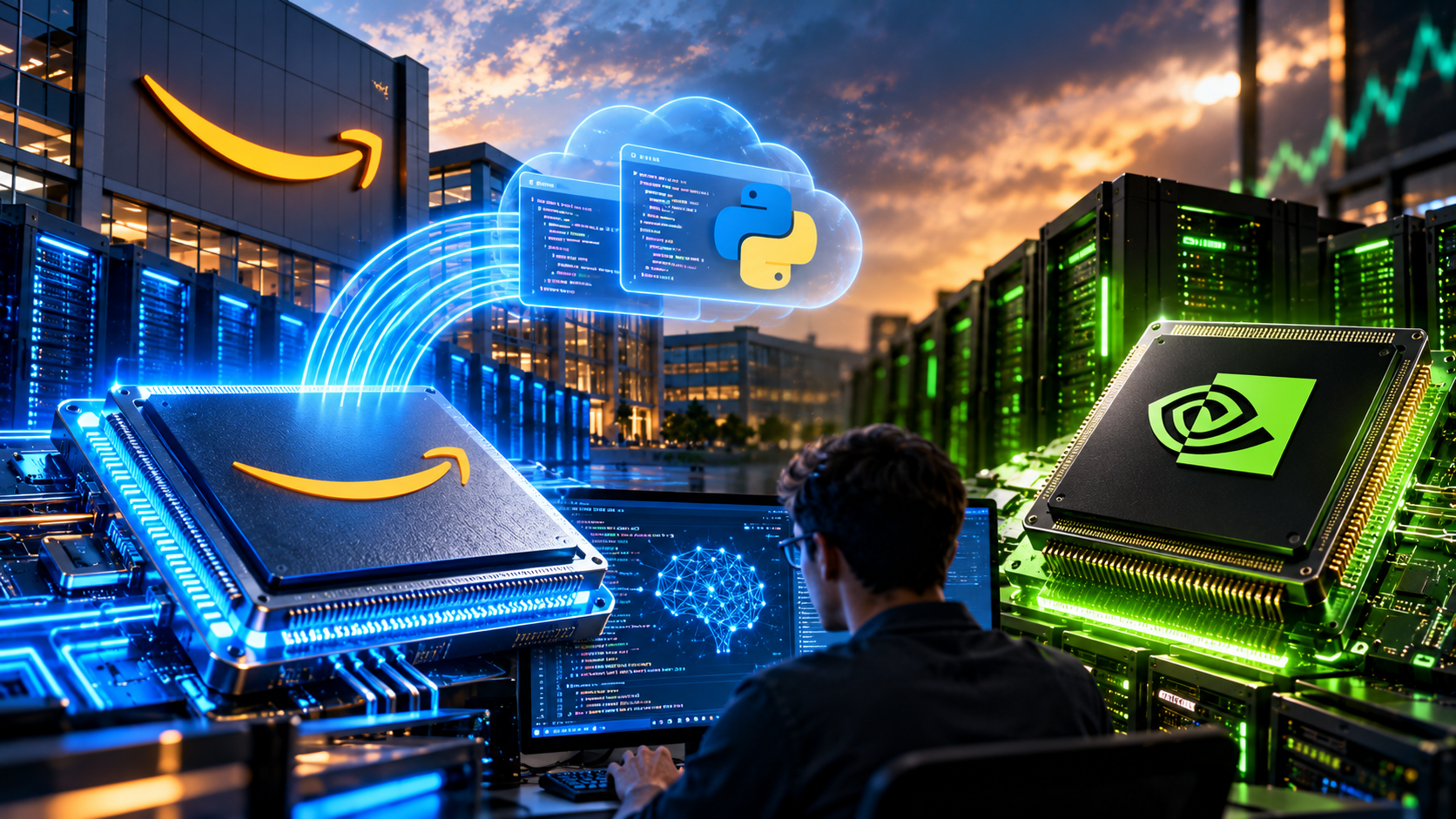
Amazon is introducing TorchNeuron, a free, open-source software tool designed to let developers run PyTorch-based AI code on its in-house Trainium chips with minimal changes. The initiative aims to reduce dependence on Nvidia’s computing ecosystem, lower AI infrastructure costs and strengthen Amazon Web Services’ position in the rapidly expanding artificial intelligence market.
Amazon Targets Nvidia’s Software Advantage
Amazon.com is stepping up its challenge to Nvidia in the artificial intelligence computing market with the introduction of TorchNeuron, a software tool designed to make its custom AI chips easier for developers to use.
According to Amazon’s Annapurna Labs chip division, TorchNeuron allows developers to run code written using PyTorch on Amazon’s Trainium AI accelerators with a single configuration change, without requiring them to rewrite their applications.
The company plans to release the software publicly as a free, open-source offering, potentially making it easier for businesses, researchers and AI startups to experiment with Amazon’s hardware.
The announcement, scheduled for a developer conference in Silicon Valley on Monday, October 19, reflects Amazon’s broader strategy to compete with Nvidia not only through chip performance and pricing but also by simplifying the software experience for AI developers.
Why PyTorch Compatibility Matters
PyTorch is one of the most widely used open-source frameworks for developing and training artificial intelligence models. It is stewarded by Meta and has become a key component of modern AI development, from large language models to computer vision and robotics applications.
Nvidia’s competitive advantage extends beyond its graphics processing units (GPUs). Its CUDA software ecosystem has spent more than a decade building developer tools, libraries and optimisation capabilities that help AI applications run efficiently on Nvidia hardware.
This combination of hardware and software has created significant switching costs for businesses that have built their AI infrastructure around Nvidia.
Moving workloads to another chip platform can require developers to modify code, optimise performance, test compatibility and retrain technical teams. These additional steps can discourage customers from adopting alternative hardware, even when competing chips offer attractive prices.
TorchNeuron is intended to reduce this friction by allowing existing PyTorch-based applications to run on Amazon’s Trainium chips with minimal code changes.
Trainium Chips Form the Core of Amazon’s AI Strategy
Amazon has been developing its own AI accelerators through Annapurna Labs to reduce its reliance on external chip suppliers and offer customers alternative computing infrastructure.
Trainium is designed for AI model training and related workloads, allowing Amazon Web Services (AWS) to offer specialised hardware alongside its broader cloud computing services.
By combining proprietary chips with software that supports familiar development frameworks, Amazon can attempt to improve the economics of AI computing for customers already using its cloud platform.
The strategy has two important objectives. First, it allows Amazon to compete more directly with Nvidia-based infrastructure. Second, it can help AWS retain customers by offering an integrated environment for building, training and deploying AI applications.
If customers can migrate workloads with less engineering effort, the decision to test alternative hardware becomes easier. However, actual adoption will depend on performance, compatibility, reliability and the total cost of running AI workloads.
More Than 30 Early Customers Testing the Software
Colin Brace, vice-president of software at Annapurna Labs, said the initiative was designed to reduce the number of steps required for developers to try Amazon’s in-house chips.
According to Brace, more than 30 early customers across areas including robotics, world models and voice AI were already using the software.
He also said switching to Amazon’s chips could deliver substantial cost savings.
The early customer base suggests that Amazon is targeting a range of AI applications rather than limiting the product to conventional model training. Robotics, voice-based AI and world models can require significant computing resources, making hardware efficiency and infrastructure costs important considerations.
However, early adoption does not establish that every workload will achieve the same savings. The actual benefit will depend on model architecture, computing requirements, software optimisation and the pricing of the underlying cloud services.
Open-Source Strategy Could Accelerate Adoption
Making TorchNeuron available as free, open-source software could help Amazon attract developers who want to evaluate Trainium without committing to a major infrastructure change at the outset.
Open-source tools can encourage experimentation, community contributions and wider integration with existing development workflows. They may also reduce the perceived risk of adopting a new platform by allowing developers to inspect and adapt software components.
For Amazon, broader developer adoption could translate into greater demand for its AI chips and cloud computing services. The company would benefit if developers began building and optimising applications for Trainium as part of their regular workflows.
Nevertheless, successful adoption will require more than easier migration. Developers will also assess the maturity of software libraries, debugging tools, documentation, model support and the availability of technical assistance.
The extent to which TorchNeuron supports different PyTorch operations and complex production workloads will therefore be an important factor in determining its long-term value.
Google and Other Cloud Providers Intensify Competition
Amazon is not the only cloud computing company seeking to reduce dependence on Nvidia.
Google has developed its own AI accelerators and is also working to attract developers through improved PyTorch support and software tools.
The broader industry trend is towards vertically integrated AI infrastructure, where cloud providers combine proprietary chips, software frameworks, data centres and cloud services.
This approach gives companies greater control over computing costs, hardware availability and system optimisation. It can also create alternatives to Nvidia's dominant position in AI computing.
However, Nvidia retains a substantial advantage through its established CUDA ecosystem, broad hardware adoption and extensive developer support. Competitors must demonstrate that their alternatives can deliver comparable results across a wide range of workloads, not simply offer lower headline prices.
What TorchNeuron Means for Nvidia
TorchNeuron highlights the growing importance of software compatibility in the competition for AI infrastructure spending.
Nvidia’s position is supported by the combination of its GPUs, CUDA ecosystem, developer familiarity and optimised AI software. If alternative platforms become easier to use, some customers may be more willing to evaluate competing chips.
For Amazon, the opportunity lies in converting software convenience into greater Trainium usage and cloud revenue. If customers can move workloads with fewer engineering changes and achieve lower operating costs, AWS could become more competitive for selected AI tasks.
For Nvidia, the development adds to the pressure from major technology companies building their own accelerators. However, the launch alone does not indicate an immediate loss of market leadership.
The competitive impact will depend on the scale of adoption, the workloads supported, the performance achieved and whether the claimed cost advantages persist in production environments.
Implications for the AI Industry and Investors
The launch reflects a broader shift in the AI industry, where the cost and accessibility of computing are becoming as important as raw chip performance.
Training and running advanced AI models require substantial computing resources. Businesses are therefore looking for ways to reduce infrastructure expenses without compromising performance or reliability.
If tools such as TorchNeuron make alternative hardware easier to adopt, cloud customers could gain more flexibility when selecting infrastructure providers. Greater competition could also encourage improvements in pricing, performance and software support.
For investors, Amazon's strategy could strengthen the role of AWS in the AI infrastructure market if Trainium adoption increases. Nvidia investors, meanwhile, will need to monitor whether competing chip platforms gain meaningful traction among enterprise customers.
The potential impact on each company's financial performance will depend on actual customer adoption, infrastructure utilisation, capital expenditure and margins rather than the software announcement alone.
Market Outlook: Software Compatibility Could Reshape AI Chip Competition
Amazon's TorchNeuron initiative addresses one of the most important barriers to AI chip competition: the difficulty of moving workloads away from an established software ecosystem.
By offering a free, open-source tool designed to run PyTorch code on Trainium with minimal modifications, Amazon is attempting to make its hardware a more accessible alternative to Nvidia-powered infrastructure.
The early participation of more than 30 customers provides an initial indication of interest, but broader adoption will depend on real-world performance, compatibility and demonstrable cost savings.
For the AI industry, easier migration between chip platforms could encourage greater competition and give businesses more choices when building AI infrastructure. For investors, the key indicators will be Trainium usage, AWS growth, customer retention and evidence that competing platforms can deliver sustained economic advantages.
The central question is whether Amazon can turn easier software migration into large-scale customer adoption. If it succeeds, TorchNeuron could become an important component of the company's effort to challenge Nvidia's influence over the AI computing ecosystem.