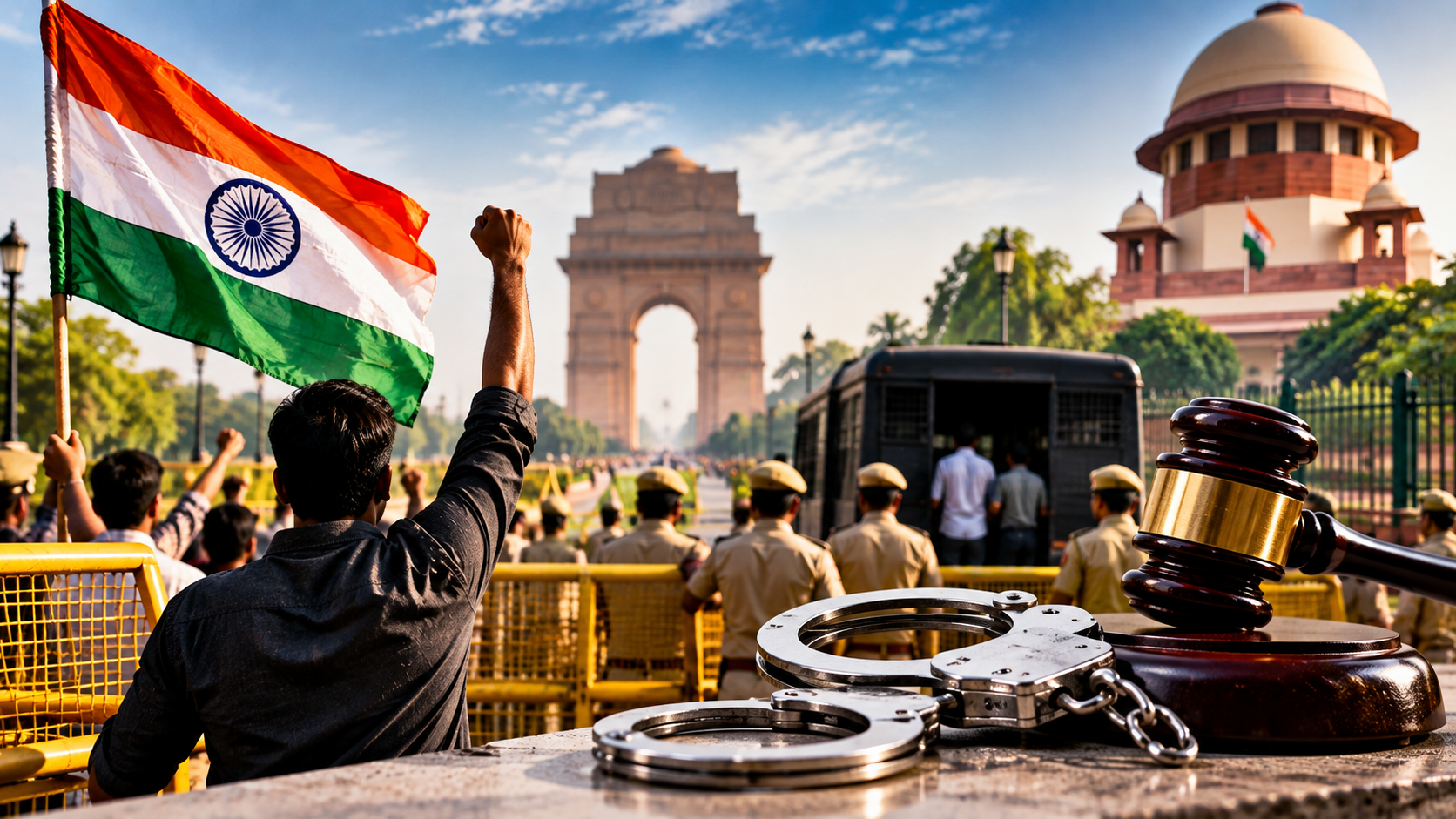
Saurav Das and Ashutosh Ranka Remanded to Five Days of Judicial Custody Over Alleged Jantar Mantar Trespass; Cockroach Janta Party Founder Questions Action Against Protesters
A political controversy erupted on Wednesday, October 14, 2026, after Cockroach Janta Party (CJP) founder Abhijeet Dipke criticised the government over the five-day judicial custody of party leaders Saurav Das and Ashutosh Ranka. The two leaders were sent to judicial custody and lodged in Delhi's Tihar Jail following their detention over an alleged breach of restrictions at Jantar Mantar.
Speaking to reporters in Nagpur, Dipke accused Prime Minister Narendra Modi's government of imposing what he described as an “unofficial emergency”. He questioned the action against the two leaders, arguing that their protest involved waving the Indian national flag and raising slogans demanding the resignation of Chief Election Commissioner (CEC) Gyanesh Kumar.
The development has brought renewed attention to the balance between the right to peaceful protest, restrictions imposed by authorities at designated public spaces and the legal procedures governing detentions and judicial custody.
However, the circumstances surrounding the case remain important. According to police sources cited in the report, Das and Ranka were detained after allegedly crossing barricades and entering the Jantar Mantar area without authorisation. Their detention was linked to alleged violations of peace bonds and trespassing into an area that had been denotified as a protest site.
Abhijeet Dipke Accuses Government of Creating an ‘Unofficial Emergency’
Reacting to the judicial custody of the two CJP leaders, Dipke sharply criticised the government and questioned why the protesters had been placed in custody for five days.
He argued that waving the national flag should not result in such action and invoked the Emergency imposed in India in 1975 to underline his criticism of the present situation.
Dipke said the government should formally declare an Emergency if that was its intention, rather than taking actions that he characterised as an unofficial version of one.
His remarks reflect the CJP founder's political opposition to the handling of the protest and his concerns about the treatment of demonstrators. The statements represent Dipke's political position and should be distinguished from the legal grounds cited by authorities for detaining the two leaders.
The controversy is likely to remain centred on whether the restrictions were enforced in accordance with applicable law and whether the response by authorities was proportionate to the alleged conduct.
Why Were Saurav Das and Ashutosh Ranka Sent to Judicial Custody?
According to police sources cited in the report, Das and Ranka were detained early Tuesday after allegedly breaching barricades and entering the Jantar Mantar area without authorisation.
The two were reportedly raising slogans demanding the resignation of Chief Election Commissioner Gyanesh Kumar.
Jantar Mantar has historically served as a venue for demonstrations in the national capital. However, access to designated protest areas can be subject to official permissions, security arrangements and restrictions imposed by the relevant authorities.
Police sources said the two CJP leaders had allegedly violated their peace bonds and trespassed into an area that had been denotified as a protest site. They were subsequently sent to five days of judicial custody on Wednesday and lodged in Tihar Jail.
Judicial custody means that individuals are held under the authority of a court rather than remaining in police custody. It does not, by itself, establish guilt or amount to a final determination of the allegations.
The further course of the case will depend on the applicable legal proceedings and decisions by the competent court.
Protest Over Chief Election Commissioner Gyanesh Kumar
The protest by Das and Ranka was reportedly linked to demands for the resignation of Chief Election Commissioner Gyanesh Kumar.
The issue has also featured in the broader political debate, with Opposition parties raising concerns about electoral processes and the alleged misuse of electoral mechanisms. The INDIA bloc has been associated with protests around the demand to reclaim Jantar Mantar as a protest venue and raise concerns over alleged “vote chori”.
The allegations and political demands remain contested, and the claims made by political groups should not be treated as established findings without supporting evidence.
For the CJP, the detention of its leaders has become a separate point of confrontation with the government. Dipke has sought to frame the episode as a question of constitutional rights and freedom of expression rather than merely a dispute over access to a particular location.
The authorities' position, as reflected in the report, centres on alleged violations of restrictions governing entry into the area.
Dipke Invokes Dr Babasaheb Ambedkar and the Constitution
Dipke also announced that he would visit Deekshabhoomi in Nagpur to pay tribute to Dr Babasaheb Ambedkar.
Deekshabhoomi holds historical significance as the place where Ambedkar embraced Buddhism along with thousands of followers on October 14, 1956.
In his remarks, Dipke emphasised the importance of the Indian Constitution and Ambedkar's ideas, asserting that the country's political and social future should remain guided by constitutional principles.
He also criticised what he described as attempts to impose the ideology of the Rashtriya Swayamsevak Sangh (RSS) on the country. These comments formed part of his broader political response to the detention of the CJP leaders.
The invocation of Ambedkar's legacy places the dispute within a wider debate over constitutional rights, democratic participation, freedom of expression and the role of public protest in a democratic system.
CJP Says Its Movement Is Independent but Shares Common Concerns With INDIA Bloc
Clarifying the party's position on Opposition-led demonstrations, Dipke said the Cockroach Janta Party was an independent pressure group and intended to remain independent.
He added that this independence did not mean the CJP was opposed to the INDIA bloc. According to Dipke, the movements pursued by the two groups shared common objectives.
The statement suggests that the CJP intends to maintain its separate political identity while supporting issues on which its position aligns with that of the broader Opposition.
The episode could bring further attention to the relationship between independent pressure groups and established political alliances, particularly when both raise similar concerns over electoral accountability and the right to protest.
Whether the CJP participates in future joint demonstrations or continues with separate campaigns will depend on its subsequent decisions and the direction of the broader political movement.
Constitutional Rights and Restrictions on Public Protests
The case has renewed the debate over the relationship between peaceful assembly and the restrictions authorities can impose to maintain public order.
The right to assemble peacefully is constitutionally protected in India, subject to reasonable restrictions under applicable law. Authorities may regulate the location, timing and manner of demonstrations, but the legality of any particular action depends on the relevant facts, legal provisions and judicial scrutiny.
In this case, the central questions include the alleged breach of barricades, the reported restrictions on access to Jantar Mantar, the alleged violation of peace bonds and the legal basis for placing the two leaders in judicial custody.
The political criticism directed at the government raises questions about proportionality and the treatment of demonstrators. At the same time, the allegations cited by police must be assessed through the legal process rather than assumed to be either proven or baseless.
The court proceedings and any subsequent official statements will be important in establishing the factual and legal position.
Political Outlook: Custody Row Could Intensify Debate Over Protest Rights
The judicial custody of Saurav Das and Ashutosh Ranka has triggered a sharp political response from CJP founder Abhijeet Dipke, who has described the episode as an “unofficial emergency” and questioned the action taken against the two leaders.
The dispute now involves competing concerns: the authorities' stated allegations of unauthorised entry and violations of restrictions, and the CJP's argument that the action raises questions about constitutional freedoms and the right to protest.
Further developments will depend on the legal proceedings, any clarification from the authorities and the response of political groups supporting or opposing the protest.
Overall, the episode highlights the continuing tension between public-order restrictions and democratic protest in India. The allegations against the two CJP leaders remain subject to legal proceedings, while Dipke's remarks have turned their custody into a broader political debate over constitutional rights, accountability and freedom of expression.