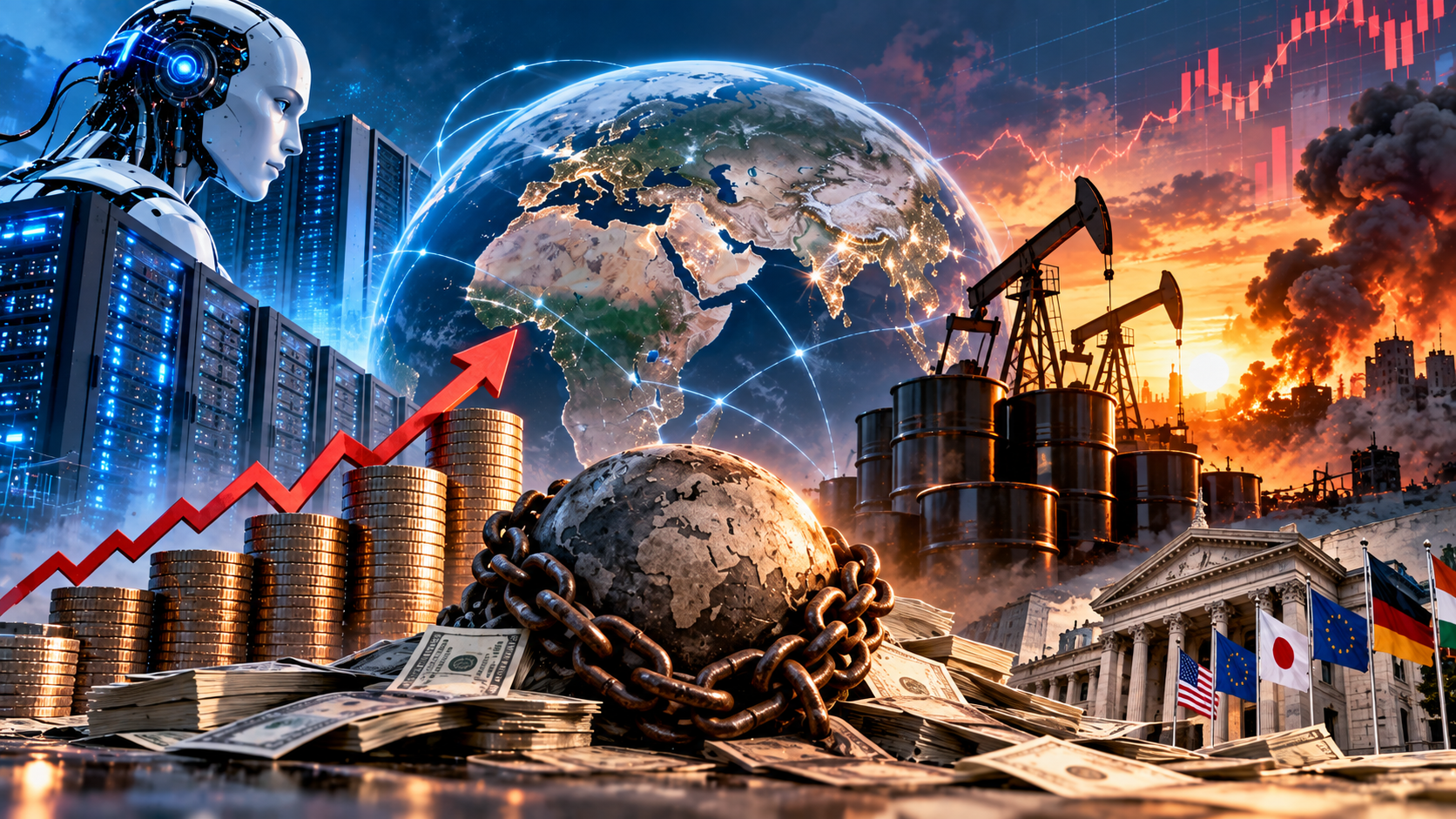
IMF chief warns that an uneven AI boom, prolonged energy shock and record global debt could intensify inflation, inequality and financial-market risks
The global economy is entering a more complicated phase as three major forces — an uneven artificial intelligence investment boom, persistent energy and commodity shocks, and record levels of public and private debt — increasingly interact with one another, International Monetary Fund (IMF) Managing Director Kristalina Georgieva has warned.
Speaking in Singapore ahead of the IMF-World Bank annual meetings in Bangkok, Georgieva said policymakers need to act urgently as the benefits of the AI-driven expansion remain concentrated in a relatively small group of economies, while inflationary pressures from energy, food, tariffs and government spending continue to pose risks.
Her comments come at a time when global bond yields have risen sharply, sovereign debt markets are under pressure and geopolitical conflicts are disrupting commodity supply chains.
AI Boom Is Delivering Uneven Global Growth
Artificial intelligence has emerged as one of the strongest drivers of investment and market optimism. Massive spending on data centres, semiconductors, computing infrastructure and related technologies has boosted activity in countries positioned at the centre of the AI supply chain.
However, Georgieva cautioned that the economic benefits are not being distributed evenly.
The AI investment boom is generating stronger growth and record exports for some Asian economies that manufacture chips, servers and other technology equipment. Equity markets have also benefited as investors anticipate productivity gains and increased corporate earnings from AI adoption.
But many economies remain outside the core AI value chain.
Georgieva said AI-related trade is largely benefiting economies embedded in the technology investment ecosystem, while bypassing many others. This creates the possibility of a widening gap between countries that possess advanced technology, capital and infrastructure and those that lack these capabilities.
AI Infrastructure Is Also Adding to Energy Demand
The rapid construction of data centres and other AI infrastructure is creating another economic challenge: rising energy consumption.
Large-scale computing facilities require substantial and reliable electricity supplies. As AI investment accelerates, the additional demand for power could put further pressure on energy markets, particularly when supply is already being affected by geopolitical disruptions.
This creates a complex policy challenge. The same AI boom that supports investment and growth can also contribute to inflation through higher demand for electricity, equipment and other resources.
Georgieva therefore described the AI construction boom as inflationary, adding it to a broader list of inflation risks facing the global economy.
Energy Shock Could Persist Into 2027
The global energy outlook remains another major concern.
Conflicts in the Middle East and Ukraine have disrupted commodity supply chains and increased uncertainty around fuel availability. According to Georgieva, pressure on key commodity supplies is expected to continue into 2027.
So far, she described the energy shock as large but contained. However, the situation could become more challenging as the Northern Hemisphere enters the colder months.
Rising seasonal demand, combined with efforts by countries to rebuild strategic energy reserves, could create additional pressure on prices.
Higher crude oil and energy prices can quickly spread through the global economy by increasing transportation, manufacturing, electricity and input costs. For central banks, this creates the difficult combination of higher inflation and potentially weaker growth.
Record Debt Adds Another Layer of Risk
Global debt has surpassed $365 trillion, according to the Institute of International Finance, creating another significant vulnerability for the world economy.
The increase in borrowing has become particularly challenging as interest rates and bond yields move higher.
For years, governments benefited from a relatively favourable environment in which borrowing costs remained low. Georgieva noted that policymakers had enjoyed an unusually easy period because interest rates remained below economic growth rates for an extended period.
That environment has now changed.
Higher interest rates increase debt-servicing costs, leaving governments with less fiscal room to respond to economic shocks. Countries carrying large deficits may increasingly have to choose between additional spending, higher taxes, reduced expenditure or greater borrowing.
Advanced Economies Face Difficult Fiscal Choices
Georgieva particularly highlighted advanced economies as major offenders when it comes to accumulated public debt.
The rise in sovereign bond yields is increasing pressure on government budgets as older debt is refinanced at higher interest rates.
This could force governments to reconsider spending programmes that were easier to sustain when borrowing costs were much lower.
The challenge is especially complicated because governments are simultaneously facing demands for higher defence spending, infrastructure investment and support for households affected by elevated living costs.
Inflation Risks Are Coming From Multiple Directions
The IMF chief warned that inflation risks are no longer concentrated around a single factor.
AI infrastructure investment is increasing demand for energy and equipment. Energy and food disruptions can raise input costs. Tariffs can increase the prices of imported goods, while higher defence expenditure can add to demand.
Large fiscal deficits can also contribute to inflationary pressure when government spending remains elevated.
This combination makes the inflation outlook more difficult for central banks to manage.
Georgieva called for central banks to maintain a “prudently hawkish bias”, suggesting policymakers should remain cautious about easing monetary policy too quickly while inflation risks remain elevated.
Bond Markets Become a Critical Pressure Point
The global bond market is increasingly central to the economic risks highlighted by the IMF.
US, European and Japanese government bond yields have reached multi-decade highs, increasing financing costs for governments, companies and households.
A prolonged bond sell-off could also affect equity valuations. Higher risk-free yields generally make fixed-income assets more attractive relative to equities and can place pressure on high-valuation growth stocks.
This creates a particularly important tension for markets: AI optimism is supporting stock prices, while rising bond yields are simultaneously increasing the discount rate applied to future corporate earnings.
AI Rally and Bond Sell-Off Create Market Tension
The divergence between equity and bond markets has become increasingly notable.
Expectations surrounding AI-driven productivity and earnings growth have helped push equities towards new highs, while concerns over inflation, government borrowing and geopolitical risks have pushed bond yields higher.
The sustainability of this trend will depend partly on whether AI-related earnings growth can continue to justify elevated valuations.
If AI productivity gains translate into stronger corporate profits, equity markets may continue to absorb higher interest rates. But if inflation remains persistent and bond yields rise substantially further, valuation pressures could become more pronounced.
Geopolitical Risks Remain Closely Linked to the Economic Outlook
The latest economic risks cannot be separated from geopolitics.
The conflict involving Iran and the wider Middle East has contributed to disruptions in fuel supplies and higher energy costs. The Russia-Ukraine conflict continues to affect commodity and trade flows.
These developments demonstrate how quickly geopolitical events can move from regional conflicts into global inflation, supply-chain and financial-market risks.
For policymakers, the challenge is therefore not simply managing domestic demand but also responding to external shocks that are difficult to predict.
What It Means for Emerging Markets
Emerging markets could face a particularly complicated environment.
Higher US and global bond yields can encourage capital to move towards safer or higher-yielding assets, potentially putting pressure on emerging-market currencies and financial markets.
At the same time, elevated energy prices can worsen import bills for countries dependent on crude and commodity imports.
However, economies with strong domestic demand, manageable external balances and improving productivity could remain relatively resilient.
The spread of AI technology could also create opportunities for emerging economies if they can develop the skills, digital infrastructure and manufacturing capabilities required to participate in the new technology supply chain.
Market Outlook
The IMF's warning highlights a global economy facing several interconnected risks rather than a single dominant threat.
The AI investment cycle remains a powerful source of growth and market optimism, but its benefits are currently concentrated among a limited group of economies. At the same time, rising energy demand, geopolitical disruptions and higher commodity prices could keep inflation elevated.
For financial markets, the most important variables to monitor will be crude oil prices, global bond yields, inflation data, central-bank policy and the sustainability of AI-related earnings growth.
A prolonged rise in energy prices combined with higher sovereign yields could increase pressure on equity valuations and emerging-market currencies. Conversely, stabilising commodity prices and evidence of genuine productivity gains from AI could allow the global expansion to remain more resilient.
The broader message for investors is that the next phase of the global cycle may be defined by a difficult balancing act between technology-led growth, inflation risks and the growing cost of debt. The ability of policymakers to manage these forces without triggering a sharper slowdown will remain crucial for global markets.