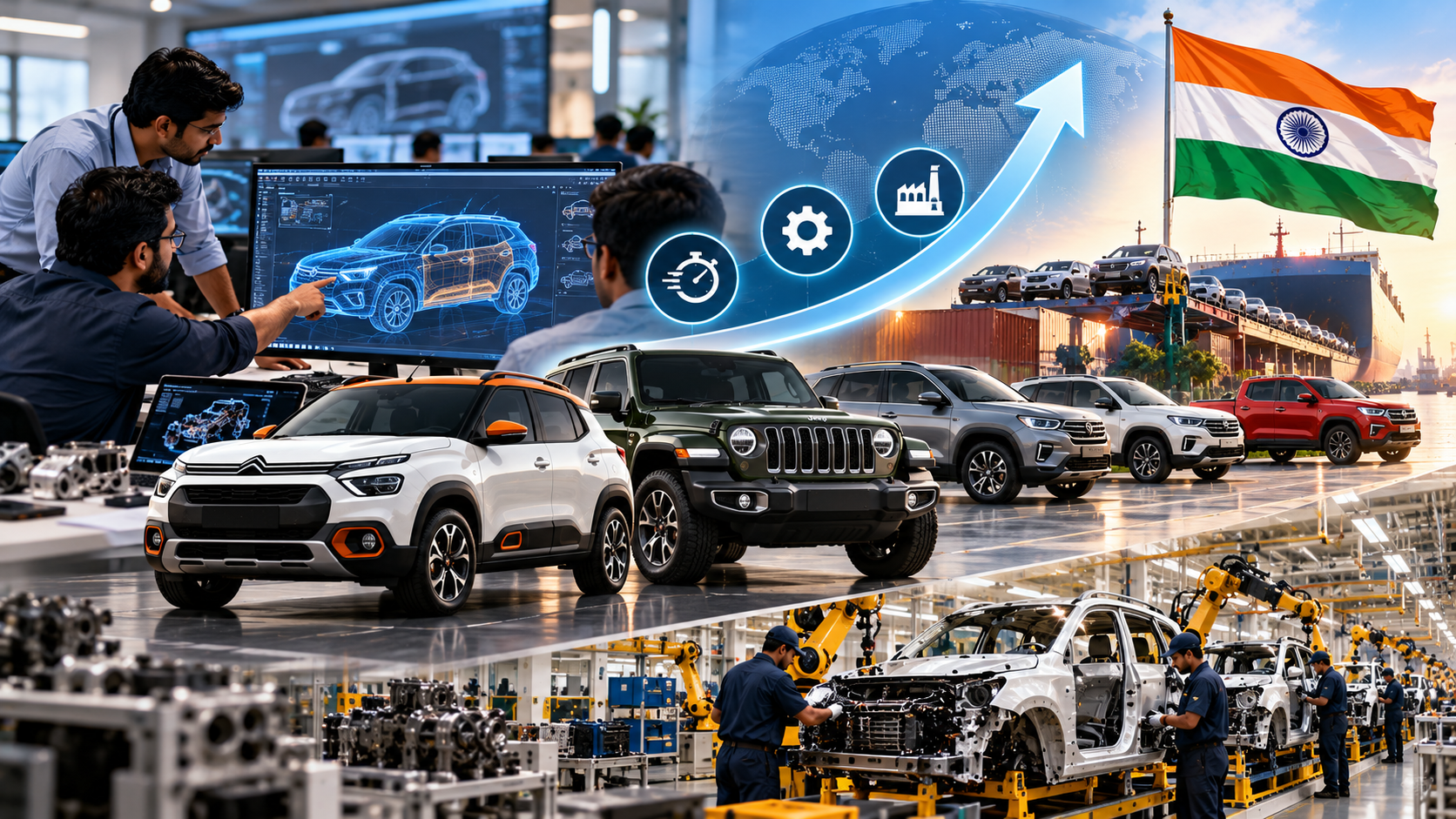
Automaker aims to reduce product development cycles from 48 months to 24 months and increase localisation beyond 90% as it prepares to launch 12 Citroen and Jeep models under its FaSTLAne 2030 roadmap
Stellantis India is looking to accelerate product development, strengthen local manufacturing and expand its vehicle portfolio as it seeks to improve its competitiveness in the Indian automobile market. The company aims to reduce the time required to develop new vehicles from around 48 months to approximately 24 months, while increasing localisation across its products.
Under its FaSTLAne 2030 roadmap, the automaker plans to introduce 12 products across its Citroen and Jeep brands, including seven new models. The company has also announced an investment of ₹4,000 crore over the next three years, primarily directed towards new products, localisation and improvements in customer experience.
The strategy reflects a broader effort to make India an important manufacturing and engineering base, not only for domestic sales but also for supplying vehicles to international markets.
Vehicle Development Timeline Targeted to Fall to 24 Months
Stellantis India Managing Director and Chief Executive Officer Shailesh Hazela said the company is working towards reducing the global vehicle development cycle from approximately four years to two years.
The shorter development timeline is intended to help the automaker respond more quickly to changing customer preferences, technological developments and competitive pressures. Faster product development could also allow the company to introduce updated models more frequently and improve the efficiency of its engineering resources.
Stellantis operates a software and technology centre in Bengaluru, which forms part of its global network of four major technology centres. The Indian engineering team works on vehicles for Jeep and Citroen as well as models intended for international markets.
The centre's role could become increasingly important as automotive development relies more heavily on software, electronics, digital systems and integrated vehicle platforms. Achieving a shorter development cycle, however, will require coordination across engineering, testing, sourcing, manufacturing and regulatory approvals.
₹4,000 Crore Investment to Support New Models
The company plans to invest ₹4,000 crore over the next three years as it prepares to expand its product lineup in India.
The investment will primarily support product development, greater localisation and customer experience initiatives. These priorities are central to the company's attempt to strengthen its presence in a market where buyers remain sensitive to pricing, features, reliability and after-sales service.
Stellantis currently offers four models under each of its two brands in India.
Jeep's existing lineup includes the Compass, Wrangler, Meridian and Grand Cherokee. Citroen's portfolio includes the C3, BasaltX, AircrossX and C5 Aircross.
The planned launches are expected to broaden the range of vehicles available to Indian customers and help the company target additional market segments.
Jeep to Add Four Models Across SUV and Pickup Segments
Jeep is expected to introduce four new models under the expansion plan. The proposed lineup includes one SUV each in the B, C and D segments, along with a D-segment pickup.
The additions would expand the brand's coverage across different vehicle sizes and customer requirements. SUVs remain an important part of India's passenger vehicle market, with buyers increasingly looking for a combination of road presence, cabin space, technology and utility.
A broader product range could help Jeep reach customers beyond its existing model portfolio. However, the commercial success of the launches will depend on pricing, product specifications, fuel-efficiency expectations, service coverage and the company's ability to compete with established rivals.
The planned pickup could also provide an opportunity to address demand for vehicles that combine passenger comfort with utility, although its positioning and intended customer base will be important factors.
Citroen Plans Three New Models
Citroen is expected to introduce three new models: a C-segment SUV, a D-segment multi-purpose vehicle (MPV) and an A-segment car.
The planned additions would give the brand a wider presence across vehicle categories, ranging from smaller cars to larger family-oriented vehicles.
Expanding the lineup could help Citroen appeal to a broader group of buyers. Yet, the brand will need to build awareness, demonstrate value for money and strengthen customer confidence in after-sales service to convert new launches into sustained sales growth.
The performance of the upcoming models will therefore depend not only on their design and features but also on dealership reach, maintenance costs and resale-value expectations.
Localisation to Exceed 90% Across Products
Local manufacturing and sourcing are key components of Stellantis India's strategy. According to Hazela, Citroen's current localisation level is approximately 90-95%, while Jeep's stands at around 70-75%.
The company aims to build on its local engineering and supplier network to achieve localisation of more than 90% across its products in India.
Higher localisation can reduce exposure to imported components and foreign-exchange fluctuations, although the actual benefit depends on the origin, cost and availability of individual parts. It can also help manufacturers manage supply chains more efficiently and tailor vehicles to domestic market requirements.
Local sourcing may support more competitive pricing, an important consideration in India's price-sensitive passenger vehicle market. It can also create opportunities for component manufacturers and suppliers as production volumes increase.
However, achieving high localisation while maintaining global quality standards requires investment in supplier capabilities, technology, testing and quality control.
Tata Motors Partnership to Expand Global Manufacturing Opportunities
Stellantis India has a longstanding manufacturing partnership with Tata Motors Passenger Vehicles through Fiat India Automobiles Private Limited, a 50:50 joint venture between Tata Motors and Stellantis.
The two companies have recently signed a definitive agreement to expand their collaboration into advanced technology and product development.
Under the expanded partnership, the companies plan to jointly develop vehicles for more than 50 global markets and manufacture them in India through the joint venture.
The arrangement could improve the utilisation of manufacturing facilities, support economies of scale and strengthen India's role in global automotive supply chains. Joint development may also help the partners share selected engineering and manufacturing capabilities.
The benefits will depend on how effectively the companies coordinate product planning, intellectual property, technology integration, production capacity and export requirements.
What the Strategy Means for India's Automobile Industry
Stellantis India's plans come as global automakers seek to improve development efficiency, localise supply chains and identify manufacturing bases that can serve both domestic and international markets.
India offers a large passenger vehicle market, an established automotive component ecosystem and engineering talent capable of supporting global development programmes. Greater investment in local engineering and supplier networks could strengthen these advantages.
For component manufacturers, increased localisation may create opportunities to supply more parts to global vehicle programmes. For consumers, additional models could increase choice and competition, although pricing and product availability will determine how widely the benefits are felt.
At the same time, the company faces the challenge of translating investment and product announcements into sustained sales growth. Strong competition, changing consumer preferences and the cost of introducing new technologies will remain important factors.
Market Outlook
Stellantis India's ₹4,000 crore investment, planned launch of 12 products and target of reducing vehicle development time to 24 months represent an ambitious attempt to strengthen its position in India. Higher localisation could improve cost competitiveness, while the expanded partnership with Tata Motors may create opportunities to manufacture vehicles for international markets.
The key indicators to monitor will be the timing of new model launches, progress towards localisation above 90%, customer response to the expanded Jeep and Citroen portfolios, and the commercial contribution of the Tata Motors partnership.
For investors tracking the automobile and auto-component sectors, the plan could create opportunities across engineering, manufacturing and domestic sourcing. However, the eventual impact will depend on execution, sales volumes, margins and the company's ability to establish stronger demand for its brands.
The central test for Stellantis will be whether faster development and greater local sourcing translate into vehicles that meet Indian buyers' expectations on price, features, ownership costs and service. Achieving those goals will be essential to turning its investment programme into sustainable growth.