Liberia-Flagged Aframax Rio Comes Under Drone Boat Attack Near Sochi as Black Sea Shipping Risks Intensify
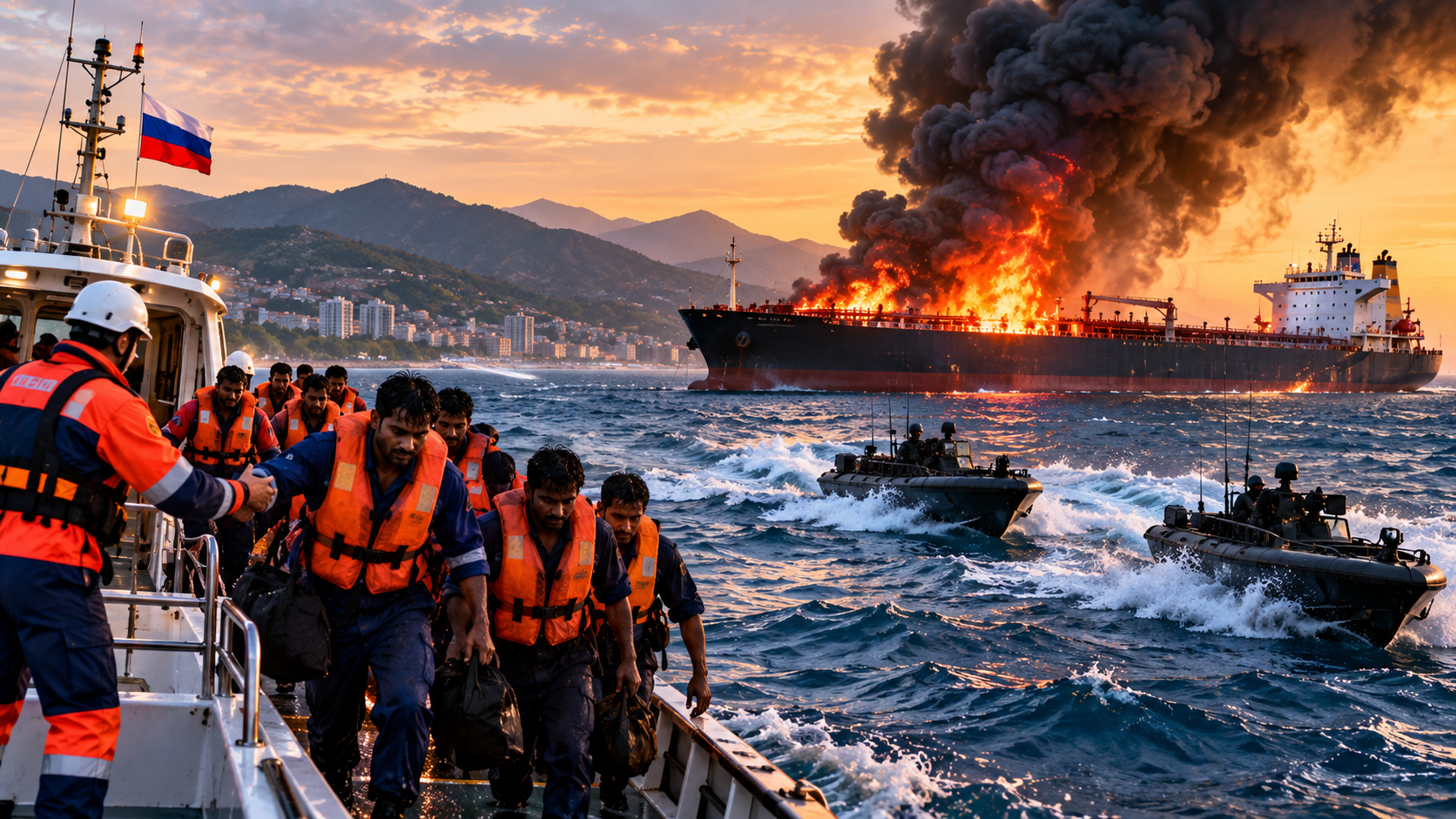
All 23 Indian crew members aboard a Liberia-flagged oil tanker were rescued after the vessel came under attack by unmanned surface vessels off Russia's Black Sea coast, Russian authorities said.
The Aframax Rio tanker was attacked on Tuesday near Sochi, a major Russian resort city on the Black Sea. According to Russia's Transport Ministry, the entire Indian crew was evacuated safely to shore and preliminary information indicated that no crew member was injured.
The incident has once again highlighted growing security risks for commercial shipping in the Black Sea, a crucial maritime corridor connecting major energy, agricultural and industrial markets.
Tanker Attacked by Unmanned Surface Vessels
The Aframax Rio, an oil tanker capable of carrying a large cargo, came under attack from unmanned surface vessels, or drone boats, while operating in Black Sea waters.
Russian authorities said a fire broke out following the attack and that the blaze was initially too intense for firefighting teams to approach the vessel.
Oil continued to burn in the affected area, with firefighting operations expected to begin only after the intensity of the flames declines sufficiently for rescue and emergency vessels to reach the tanker safely.
The incident has triggered a major emergency response, with Russia's transport authorities coordinating efforts to manage the consequences of the attack.
All 23 Indian Seafarers Safe
The most significant development was the successful evacuation of all 23 Indian nationals working aboard the tanker.
Russian authorities confirmed that the crew had been taken safely to shore and that there were no reported injuries among the Indian sailors based on preliminary information.
The incident nevertheless underscores the risks faced by Indian seafarers working on international commercial vessels operating through conflict-affected maritime routes.
India has a large pool of maritime professionals working across global shipping networks, making the safety of Indian crew members an important diplomatic and commercial concern whenever attacks occur in international waters.
Sochi Takes Precautionary Measures
The attack prompted local authorities in Sochi to impose temporary restrictions along parts of the city's coastline.
Sochi Mayor Andrey Proshunin said access to beaches and sea embankments had been temporarily prohibited as a precautionary measure. Residents and visitors were advised to avoid the affected areas until authorities issued further instructions.
The restrictions reflect concerns not only over the tanker fire but also over the possibility of secondary hazards from burning oil and ongoing emergency operations.
Black Sea Shipping Under Growing Pressure
The latest attack comes amid a broader increase in threats to commercial shipping and port infrastructure in the Black Sea as the Russia-Ukraine conflict continues.
The region is a strategically important trade corridor for energy, grain and other commodities. Disruptions to shipping can therefore have consequences far beyond the immediate conflict zone.
The Black Sea has long been important for the movement of agricultural commodities, petroleum products and other bulk cargoes. Any sustained disruption could increase shipping costs, insurance premiums and transit times.
For global commodity markets, higher maritime risk can also translate into greater volatility in freight rates and delivered prices.
Another Commercial Vessel Incident Reported
The tanker attack occurred only two days after another incident involving a civilian cargo vessel in the Black Sea.
At least two people were reportedly killed and some crew members, including one Indian national, were injured after a Russian drone strike caused a fire aboard a Turkish-owned cargo vessel.
The sequence of incidents has heightened concerns over the safety of commercial shipping in a region already facing significant geopolitical risks.
For shipping companies, the growing frequency of attacks could result in higher insurance costs and greater pressure to reroute vessels or adopt additional security measures.
India Expresses Serious Concern
The Indian government has expressed concern over attacks targeting commercial vessels and seafarers.
India's Ministry of External Affairs said attacks on international commercial shipping were severely undermining global commerce and the welfare of people around the world. New Delhi has continued to advocate dialogue and diplomacy as the preferred route for resolving the ongoing conflicts.
The safety of Indian nationals remains a major priority for the government, particularly as the country's maritime workforce continues to play a significant role in global shipping.
Wider Impact on Global Trade
The Black Sea is more than a regional shipping route. Disruptions can affect global supply chains through higher freight costs, delays and uncertainty over commodity availability.
Energy shipments are particularly sensitive because tankers operating through conflict-affected waters can face increased security risks. Agricultural trade can also be affected if ports, vessels or maritime corridors become difficult to access.
A prolonged escalation could therefore add another layer of uncertainty to already volatile global commodity markets.
Implications for Energy Markets
The attack on an oil tanker comes at a time when global energy markets are already closely watching geopolitical developments.
Any sustained disruption to oil transportation could increase the risk premium embedded in crude prices. Higher freight and insurance costs could further raise the delivered cost of energy for import-dependent countries.
For India, which relies heavily on imported crude oil, disruptions to major maritime routes could have implications for the import bill, inflation and the rupee.
However, the immediate impact will depend on the scale and duration of the disruption and whether attacks remain isolated incidents or become a sustained threat to commercial vessels.
Diplomatic Efforts Gain Importance
The latest incident also comes as India continues its diplomatic engagement with both Russia and Ukraine.
External Affairs Minister S Jaishankar has said India has stepped up efforts to engage with both sides in an attempt to contribute to the resolution of the conflict.
India's approach has increasingly focused on maintaining strategic relationships while supporting dialogue and diplomacy.
For New Delhi, the safety of Indian citizens working in conflict-sensitive regions adds urgency to these diplomatic efforts.
Market Outlook
The latest Black Sea tanker attack is primarily a geopolitical and maritime-security development, but it could have broader implications for global markets if commercial shipping disruptions intensify.
Investors will monitor crude oil prices, shipping rates, marine insurance costs and commodity supply chains for signs of a wider impact. A sustained increase in attacks could push up the geopolitical risk premium on energy and raise transportation costs.
For India, prolonged disruption to energy shipments could increase pressure on the import bill, inflation and the rupee, particularly if crude prices rise simultaneously.
At present, the successful rescue of all 23 Indian crew members provides a positive immediate outcome. However, the repeated incidents underline the growing risks facing commercial shipping and reinforce the importance of keeping critical international trade routes open and secure.