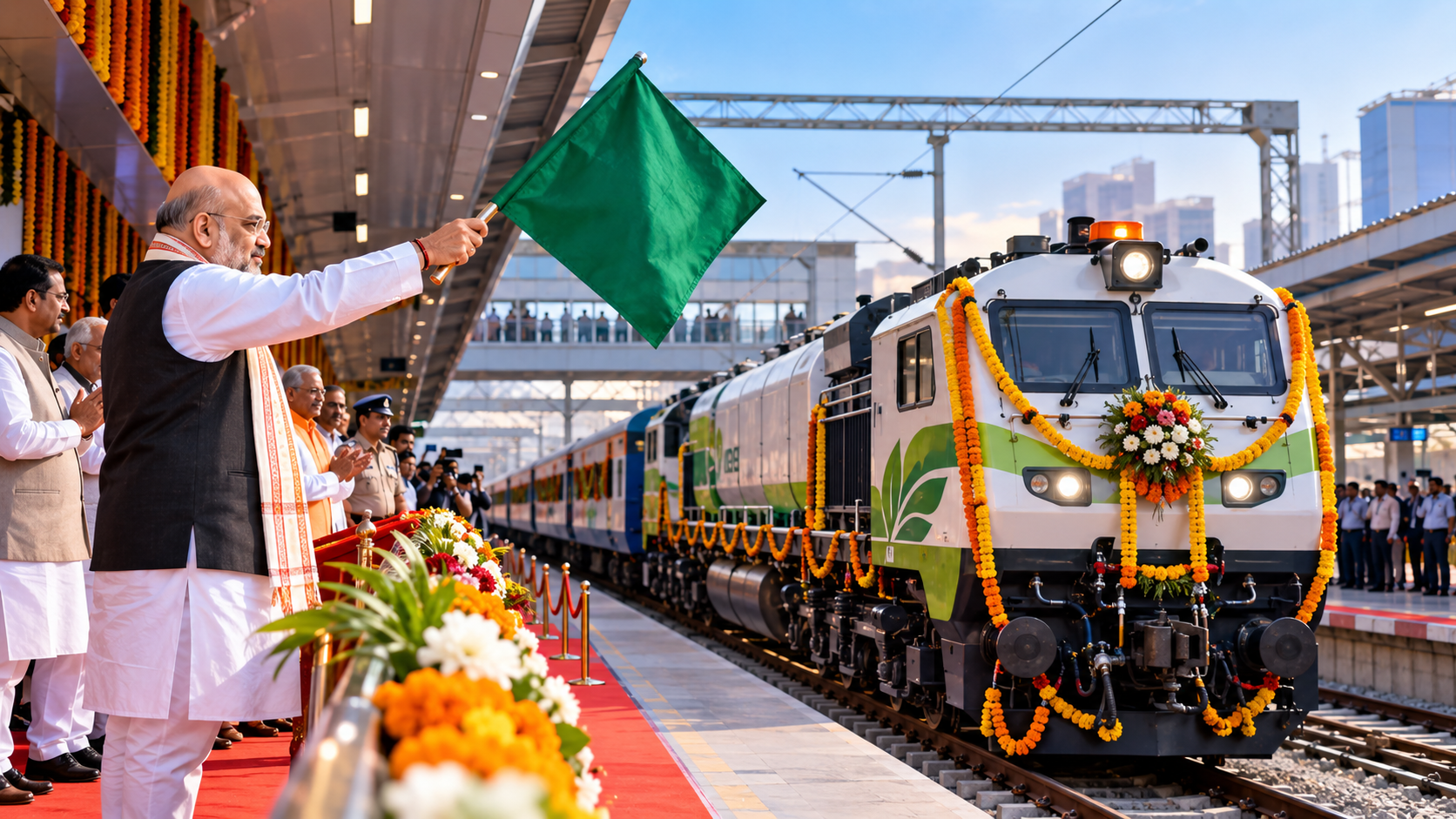
₹1,472 crore railway projects inaugurated in Ahmedabad as India expands cleaner-fuel trials, locomotive maintenance capacity and rail safety infrastructure
Union Home Minister Amit Shah on Sunday flagged off India’s first LNG-powered train from Sabarmati Railway Station in Ahmedabad, alongside the inauguration and foundation-laying of railway projects valued at around ₹1,472 crore in Gujarat.
The programme included the inauguration of a WAG-12 Maintenance Shed at Sabarmati and the commissioning of the Kavach train protection system on the Sabarmati-Kalol-Sabarmati section. The projects are aimed at strengthening railway infrastructure, locomotive maintenance, passenger facilities and operational safety in the region.
The LNG-powered train is being presented as an important step in exploring alternatives to conventional diesel use in railway operations. According to reporting on the project, the train uses a diesel-LNG dual-fuel system, with two 1,400-horsepower driving power cars at the Sabarmati Integrated Coaching Depot converted to operate on both fuels. The system is designed to allow LNG to replace a portion of diesel consumption.
LNG-powered train marks a new experiment in railway fuel use
The introduction of LNG-powered rolling stock comes as Indian Railways continues to explore ways of reducing dependence on conventional fossil fuels in areas where full electrification or alternative propulsion technologies may be more difficult to deploy.
The Sabarmati train uses a dual-fuel configuration rather than relying exclusively on LNG. This allows the railway system to retain diesel capability while incorporating LNG into the propulsion mix.
The reported configuration uses two 1,400 HP driving power cars. According to project details reported by Energetica India, the system could replace nearly 40 per cent of diesel consumption with LNG.
The initiative is significant from an energy-efficiency perspective because LNG generally produces lower emissions of certain pollutants than conventional diesel when used under comparable operating conditions. The actual environmental benefit, however, will depend on fuel composition, operating patterns, methane leakage across the LNG supply chain and the efficiency of the dual-fuel system.
₹700 crore WAG-12 maintenance shed inaugurated
A major component of the Sabarmati programme was the inauguration of a WAG-12 locomotive maintenance shed, constructed at a reported cost of approximately ₹700 crore.
WAG-12 locomotives are among India's high-powered freight locomotives and are designed to haul heavy freight loads over the country's rail network.
Shah highlighted the capability of the 12,000-horsepower twin-section locomotive, stating that a single WAG-12 can haul a freight load comparable to hundreds of trucks. The shift towards high-capacity locomotives is part of the broader effort to improve freight movement and increase the efficiency of rail-based transportation.
Sabarmati is already an important railway and logistics location. It is also connected with the wider development of the Mumbai-Ahmedabad High Speed Rail corridor, for which Sabarmati is planned as a key terminal and maintenance location.
Kavach safety system introduced on Sabarmati-Kalol section
The programme also included the introduction of the Kavach automatic train protection system on the Sabarmati-Kalol-Sabarmati railway section.
The project reportedly involved an investment of around ₹48 crore.
Kavach is India's indigenous automatic train protection system designed to improve railway safety by assisting in preventing collisions and overspeed-related incidents. The technology is being progressively deployed across Indian Railways, with newer versions being introduced on additional sections. Indian Railways recently commissioned Kavach 4.0 over 108 route kilometres on the Malkajgiri-Kamareddi section of South Central Railway.
Work has also commenced for Kavach implementation on the Ahmedabad-Palanpur and Ahmedabad-Samakhiali sections, according to the details presented at the Sabarmati programme.
The development is particularly relevant for Gujarat because these routes connect important industrial, commercial and freight centres across the state.
Doubling of Sabarmati-Sarkhej line also underway
Alongside safety upgrades, work has started on the doubling of the Sabarmati-Sarkhej railway line.
Railway-line doubling can increase capacity by allowing trains to operate more efficiently in both directions, reducing dependence on single-track scheduling and potentially improving the movement of both passenger and freight services.
For an industrialised state such as Gujarat, strengthening rail capacity has wider implications for manufacturing, ports, logistics and commodity transportation.
The development comes amid broader railway investment in Gujarat. The Railway Ministry has also been expanding freight infrastructure through projects such as Gati Shakti Cargo Terminals, including five facilities inaugurated or initiated across the state earlier this month.
Focus on freight capacity and high-capacity locomotives
During his address, Shah highlighted the role of high-powered locomotives and freight corridors in increasing India's rail freight capacity.
He referred to the successful trial of a double-stack long-haul container train between Jawaharlal Nehru Port and Vadodara, saying that greater use of double-stack freight trains could increase the amount of cargo transported using existing rail infrastructure.
The broader freight strategy is important for India because shifting more long-distance cargo from roads to rail can potentially reduce logistics costs, improve fuel efficiency and ease pressure on highways.
Dedicated Freight Corridors are a central part of this strategy, with the Western and Eastern corridors designed to create higher-capacity routes for freight trains.
Railway electrification remains a major focus
Shah also highlighted India's expansion of railway electrification and the reduction in diesel consumption across the network.
According to figures cited by the Home Minister, railway electrification has expanded substantially over the past decade, while diesel consumption has declined. He said railway electrification had reached 99.6 per cent of the network, with the remaining portion expected to be covered subsequently.
The Railway Ministry has separately continued to report rapid progress in electrification, freight infrastructure and modernisation.
The LNG-powered train therefore represents a different component of the broader transition in railway energy use: while electrification remains the primary direction for the main railway network, dual-fuel technology can provide an alternative pathway for selected applications.
Ahmedabad and Sabarmati gain strategic importance
The Sabarmati area is becoming an increasingly important transportation hub for Ahmedabad.
Alongside the conventional railway network, the location is associated with the Mumbai-Ahmedabad High Speed Rail project, with Sabarmati planned as one of the corridor's key stations and maintenance locations. Government updates have reported substantial construction progress on the 508-km high-speed rail project.
The combination of conventional railway infrastructure, freight facilities, high-speed rail infrastructure and urban connectivity is gradually increasing the strategic importance of the Sabarmati transportation zone.
Gujarat's railway investment gets a major boost
Shah also highlighted the increase in railway investment in Gujarat. He compared the railway allocation for the state during 2009-14 with the allocation for 2026-27, citing a substantial increase.
The figures were presented by Shah during his address as evidence of the expansion in railway infrastructure investment in Gujarat. Such comparisons are political claims about government performance and should be understood in that context.
Beyond the political debate, the scale of current railway construction in Gujarat is visible across several areas, including freight terminals, railway doubling, safety systems, electrification, maintenance facilities and the Mumbai-Ahmedabad high-speed rail corridor.
Cleaner fuels and railway modernisation
The Sabarmati LNG initiative comes against the backdrop of a broader shift in India's railway technology strategy.
Indian Railways is simultaneously pursuing multiple propulsion and efficiency technologies, including extensive electrification, LNG-based dual-fuel systems and hydrogen-powered train development.
Shah referred to India's hydrogen-powered train programme during the event, while the LNG project demonstrates another approach to reducing conventional diesel consumption.
These technologies are at different stages of development and have different infrastructure requirements. Their long-term contribution will depend on operating costs, fuel availability, reliability, emissions performance and the economics of deploying supporting infrastructure.
What the Sabarmati projects mean for the region
The combined projects have implications beyond the railway station itself.
Improved locomotive maintenance capacity can support freight operations, while Kavach deployment strengthens railway safety. Line doubling can increase network capacity, and alternative-fuel technology could provide additional options for reducing diesel dependence.
For Gujarat's industrial and logistics ecosystem, improved rail infrastructure can also support the movement of raw materials and finished goods between manufacturing centres, ports, logistics hubs and major consumption markets.
The state's existing position as a major industrial and port-linked economy makes railway capacity particularly important for freight movement.
Market Outlook
The Sabarmati developments underline the continuing investment in railway infrastructure, freight capacity, safety technology and alternative propulsion systems.
For investors and businesses, the key areas to monitor include railway equipment manufacturing, locomotive maintenance, freight logistics, signalling and safety systems, electrification, energy infrastructure and companies involved in railway modernisation.
The LNG-powered train is an early step in testing dual-fuel technology, while electrification remains the dominant long-term direction for India's railway network. The commercial significance of LNG-based propulsion will depend on operating performance, fuel economics and whether the technology is subsequently expanded.
Meanwhile, the WAG-12 maintenance facility, Kavach deployment and railway-line doubling represent more immediate infrastructure developments with potential implications for freight efficiency and regional connectivity.
Taken together, the projects at Sabarmati reflect the broader transformation of Ahmedabad and Gujarat into an increasingly important hub for passenger mobility, freight transportation, railway technology and multimodal infrastructure.