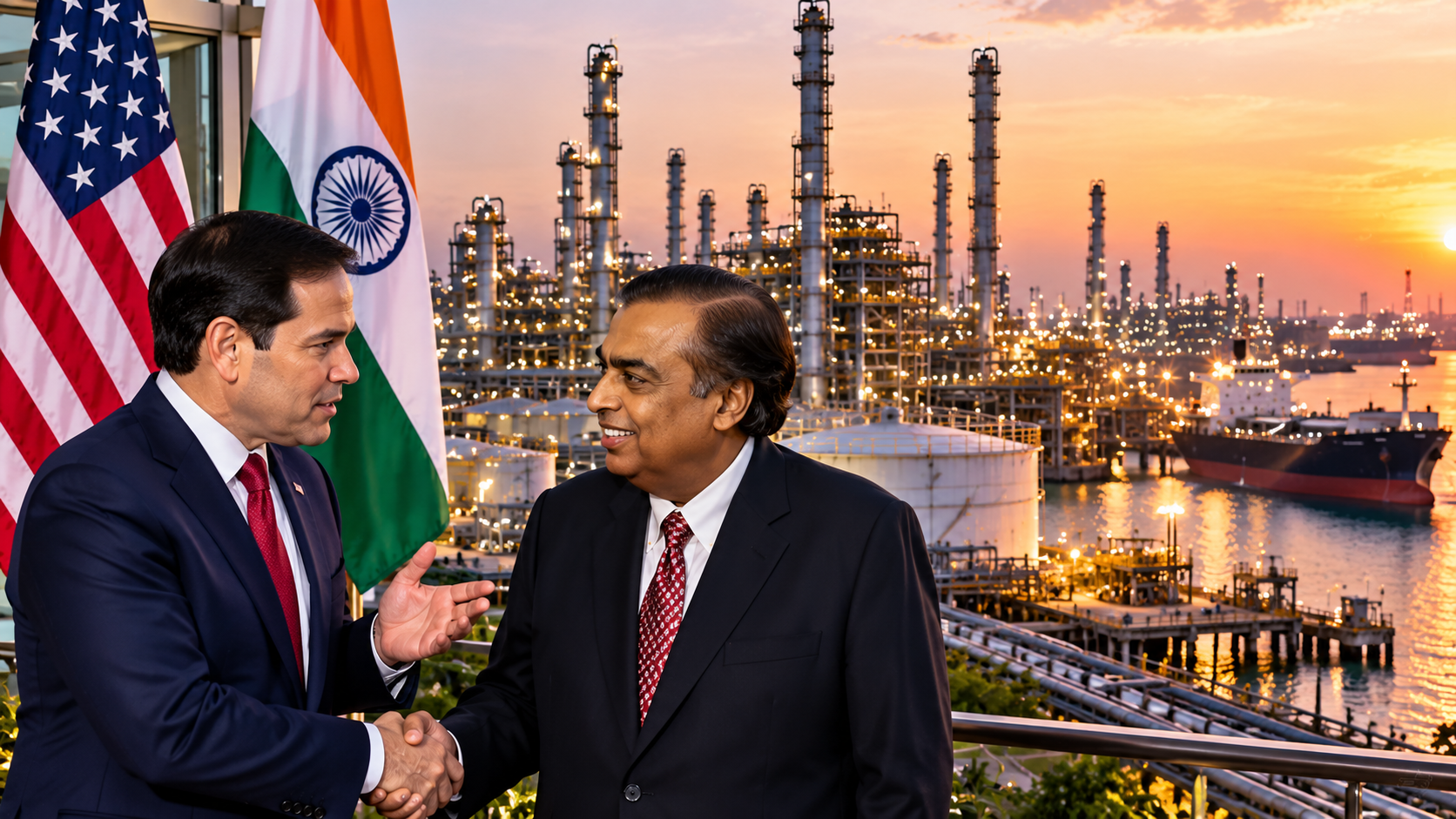
US Secretary of State Marco Rubio’s meeting with Reliance Industries chairman Mukesh Ambani could open new avenues for India-US energy cooperation, as Washington seeks to expand Venezuelan crude production and encourage diversification of India’s oil supplies
US Secretary of State Marco Rubio is scheduled to visit Reliance Industries’ Jamnagar refinery complex in Gujarat and meet chairman Mukesh Ambani as part of a three-day official visit to India. Energy cooperation, Venezuelan crude oil, investment opportunities and broader commercial ties are expected to feature prominently in the discussions.
The meeting comes at a time when India and the United States are seeking to strengthen economic relations while navigating differences over trade tariffs, Russian oil purchases and immigration policies. With Jamnagar operating as one of the world’s most strategically significant refining hubs, the discussions could carry implications for energy supply chains, international crude trade and the future direction of bilateral business cooperation.
Venezuelan Crude Emerges as a Key Discussion Point
One of the major issues expected to feature in the meeting is the possibility of expanding the production and refining of Venezuelan crude oil. Rubio has indicated that India possesses the technical capability to process Venezuelan oil and that Indian companies already have interests in the country’s energy sector.
Reliance’s Jamnagar complex is particularly relevant because its refining infrastructure can process a broad range of crude grades, including heavier varieties. This capability could provide flexibility if additional Venezuelan supplies become commercially and legally available.
For Washington, encouraging greater Venezuelan oil production could help expand global supply options at a time when geopolitical tensions and disruptions in other producing regions are adding uncertainty to energy markets. India, meanwhile, has an interest in maintaining access to competitively priced crude from multiple sources.
However, any increase in Venezuelan oil purchases or production would depend on commercial terms, crude availability, transportation costs, payment arrangements and the applicable US sanctions framework. The meeting does not, by itself, establish that Reliance will increase its Venezuelan crude processing.
India’s Energy Diversification Strategy
India is among the world’s largest oil-consuming economies and relies substantially on imported crude to meet domestic demand. Diversifying suppliers can help reduce exposure to disruptions in any single country or region and improve the flexibility of refiners when global prices fluctuate.
Russian oil has become an important part of India’s import mix in recent years, supported by attractive pricing and established supply arrangements. This dependence has also become a source of friction with Washington, which has encouraged India to broaden its energy sourcing.
Rubio has described diversification as a sensible objective while acknowledging that changing established supply patterns cannot happen immediately. Alternative sources, including the United States and potentially Venezuela, could offer additional options, but their attractiveness would depend on delivered costs, refinery compatibility and the reliability of supply.
For Indian refiners, the objective is not simply to replace one supplier with another. It is to balance price, quality, logistics, geopolitical risk and long-term supply security.
Why Jamnagar Matters to Global Oil Markets
Reliance’s Jamnagar refining complex gives the company a significant position in international petroleum markets. Its ability to process different crude grades allows it to adjust its sourcing strategy according to refinery economics and product demand.
The complex is therefore a natural location for discussions involving crude availability, refining capacity and international energy partnerships. If commercial opportunities emerge around Venezuelan oil, Jamnagar’s technical capabilities could become relevant to the wider supply chain.
Nevertheless, additional crude availability does not automatically translate into higher profitability. Refining margins depend on the relationship between crude acquisition costs and the prices of products such as petrol, diesel, aviation fuel and petrochemical feedstocks. Freight, insurance, sanctions compliance and other operating expenses also influence returns.
Any potential expansion in Venezuelan crude processing would need to be assessed against these commercial considerations.
Reliance’s US Investment Interests Add Another Dimension
The meeting is also expected to provide an opportunity to discuss Reliance’s commercial interests in the United States. The company has been associated with plans for a refinery project in Brownsville, Texas, adding an investment dimension to its energy relationship with the country.
Such projects can connect upstream crude supply, refining infrastructure and downstream fuel markets across borders. They may also create opportunities for technology partnerships, equipment suppliers, engineering companies and other businesses involved in energy infrastructure.
For the United States, attracting investment from major Indian companies would support its broader objective of strengthening commercial ties with India. For Reliance, overseas projects could provide strategic access to energy markets and diversify its international business interests.
The scale, timing and final structure of any investment-related initiatives would remain subject to project approvals, financing, commercial viability and regulatory requirements.
India-US Trade Agreement Remains a Broader Priority
Rubio’s engagement with Ambani comes amid ongoing negotiations between New Delhi and Washington over a proposed bilateral trade agreement. The two countries have been working to address differences involving tariffs, market access and non-tariff barriers.
The proposed agreement could influence trade flows across manufacturing, technology, energy and other industries. Indian exporters are seeking competitive access to the US market, while Washington has pressed for improved access for American goods and businesses in India.
Rubio has indicated that negotiations have made progress, with some issues still requiring resolution. However, until the terms are formally agreed and announced, the timing and final scope of the arrangement remain uncertain.
Energy cooperation could form one component of a wider commercial relationship, but progress on crude supplies or individual investment projects should not be interpreted as confirmation that all outstanding trade issues have been resolved.
Geopolitical Tensions Add Complexity to Energy Cooperation
Global energy markets remain sensitive to developments in major producing regions, shipping routes and international sanctions. Disruptions linked to geopolitical tensions can increase crude prices, raise freight costs and make supply planning more difficult for import-dependent economies.
Venezuelan oil could provide an additional source of supply, but it cannot independently eliminate the risks associated with global disruptions. Production capacity, infrastructure constraints, export logistics and the regulatory environment will determine how quickly additional barrels can reach international markets.
India must also weigh its strategic relationships and commercial interests when making energy decisions. A diversified supply portfolio can improve resilience, but the economic case for each source depends on its overall cost and reliability.
What the Meeting Could Mean for Businesses and Investors
The outcome of the Rubio–Ambani discussions could be relevant to several areas of the market, including oil refining, fuel marketing, petrochemicals, energy infrastructure and international trade. Any confirmed agreement involving crude supplies or investment could provide additional information about future business opportunities.
For Reliance Industries, the potential significance would depend on whether the discussions lead to concrete commercial arrangements, improved access to crude supplies or investment commitments. For the wider energy sector, changes in sourcing patterns could influence competition for crude grades and affect regional refining economics.
Investors should distinguish between diplomatic discussions and binding commercial decisions. The meeting may indicate areas of strategic alignment, but the financial implications will depend on the details of any subsequent agreements, their implementation and the resulting impact on costs, margins and capital expenditure.
Market Outlook
The Rubio–Ambani meeting places India’s energy security and international refining capabilities at the centre of a broader discussion about US-India economic relations. Potential cooperation involving Venezuelan crude could create additional supply options, while Reliance’s US investment interests may offer another channel for commercial engagement.
For energy markets, the immediate focus will be on whether the discussions produce concrete announcements regarding crude purchases, production, refining or investment. Any sustained benefit would depend on commercial viability, regulatory clarity and the availability of reliable supplies.
Until formal agreements or detailed commitments are announced, the meeting should be viewed as an important diplomatic and commercial engagement rather than a confirmed change in India’s oil procurement strategy. The broader implications will become clearer as negotiations progress and any proposed initiatives move towards implementation.