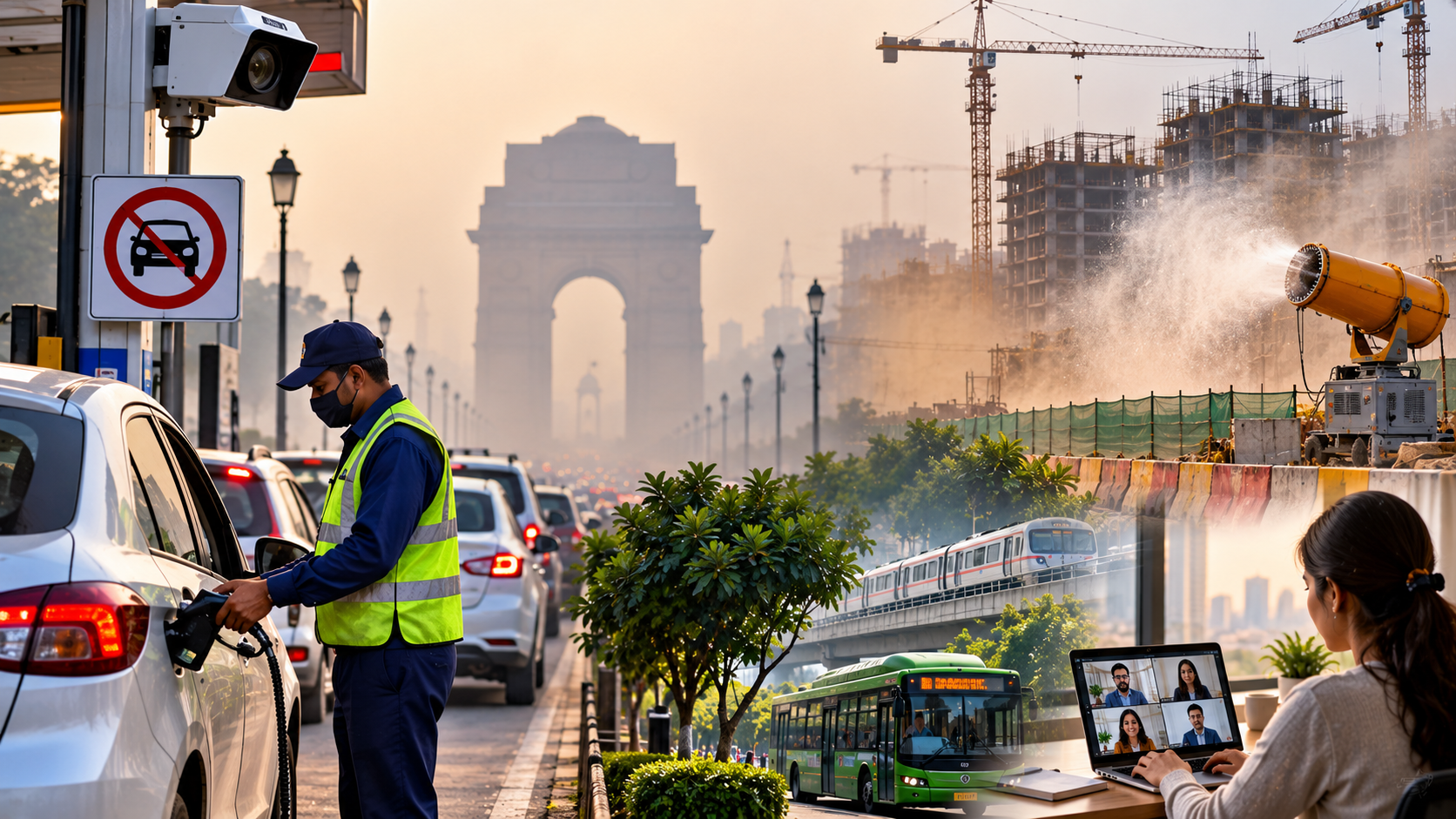
Delhi is preparing to tighten its winter pollution-control measures from November 1, 2026, with changes affecting private vehicle owners, commuters, offices and construction activity. Electric vehicles, essential services and specified infrastructure projects will receive exemptions under the reported rules.
Delhi Prepares for Stricter Winter Pollution Controls
Delhi is set to introduce a series of pollution-control measures from November 1 as authorities seek to limit emissions during the winter season, when stagnant air and unfavourable weather conditions can trap pollutants close to the ground.
The proposed measures cover vehicle emissions, parking charges, workplace attendance, construction activity and dust management. They form part of the broader winter action plan and the Commission for Air Quality Management's (CAQM) Graded Response Action Plan (GRAP), which provides a framework for responding to deteriorating air quality.
The restrictions could affect daily travel, office schedules, construction projects and business operations across the National Capital Region (NCR). Residents and commuters should check the applicable government notifications before making travel or workplace arrangements, as exemptions and enforcement conditions may vary by category.
1. Parking Charges to Double for Four Months
Parking charges at authorised parking facilities across Delhi are scheduled to double from November 1, 2026, through February 28, 2027. The measure is intended to discourage private vehicle use and encourage commuters to consider public transport and shared mobility.
Electric vehicles will be exempt from the additional parking charges. Parking facilities owned and managed by the Delhi Metro Rail Corporation (DMRC) will also be exempt.
For motorists who regularly use paid parking, the increase could raise commuting expenses over the winter period. Commuters may consider using metro services, buses, carpooling or park-and-ride facilities where practical.
2. No Valid PUC Certificate, No Fuel
Under the reported “No PUC, No Fuel” rule, vehicles without a valid Pollution Under Control (PUC) certificate will not be supplied fuel at petrol pumps, CNG stations and LPG outlets across Delhi.
The measure is designed to improve compliance with prescribed vehicle-emission standards. A valid PUC certificate indicates that a vehicle has undergone the relevant emissions test and meets the applicable requirements at the time of testing.
Vehicle owners should check the validity of their certificates and arrange testing before they expire. They should also ensure that their vehicles are properly maintained, as failure to meet emission requirements could lead to disruption during routine refuelling.
3. Restrictions on Older Vehicles Registered Outside Delhi
From November 1, 2026, to January 31, 2027, vehicles registered outside Delhi that do not meet Bharat Stage VI (BS-VI) emission standards are reported to be barred from entering the capital.
The stated exemptions include CNG and electric vehicles, ambulances, fire services and other specified essential vehicles.
The restriction could affect people travelling into Delhi from neighbouring states for work, education, business or personal reasons. Owners of vehicles registered outside the capital should verify their vehicle's emission classification and the precise eligibility requirements before travelling.
The rule's applicability should not be assumed to cover every vehicle registered outside Delhi. Motorists should consult the latest official directions for the exact vehicle categories, exemptions and enforcement arrangements.
4. Work-From-Home and Staggered Office Timings
Government and private offices are reported to be required to limit physical attendance to 50% from November 1, 2026, to January 31, 2027, with the remaining employees working from home under the prescribed arrangements.
Essential services, including healthcare, public transport, power, water supply, sanitation and emergency services, are exempt from the attendance restrictions.
Staggered office timings are also planned to reduce traffic congestion during peak commuting hours. Under the reported schedule, Municipal Corporation of Delhi offices will operate from 8:30 AM to 5 PM, while Delhi government offices will function from 10 AM to 6:30 PM.
Private employers are being encouraged to promote carpooling and shared transport. Businesses may need to review staffing arrangements, employee transport and remote-working systems to ensure continuity while complying with applicable directions.
5. Construction and Demolition Activities Face Curbs
Dust-generating demolition work and open civil construction activities are scheduled to face restrictions from November 1, 2026, to January 31, 2027, except for specified essential public infrastructure projects.
The restrictions are reported to become stricter from December 10, 2026, to January 20, 2027, when construction and demolition activities will be completely prohibited apart from permitted urgent government and emergency works.
Vehicles transporting construction materials such as sand, gravel, bricks, cement and construction debris may also face entry restrictions during this period, subject to specified exemptions.
These measures could affect construction schedules, material deliveries, labour deployment and project costs. Contractors and developers should review the applicable orders and plan work accordingly rather than assume that all projects qualify for an exemption.
6. Anti-Smog Systems and Dust-Control Measures
Large commercial buildings and eligible construction sites are reported to be required to deploy anti-smog guns or mist systems to control airborne dust.
Authorities are also expected to intensify inspections and enforcement against industrial pollution, open waste burning and other emission sources.
Dust-control systems can help reduce airborne particles when properly installed and operated, but their effectiveness depends on site conditions, maintenance and the nature of the pollution source. They should therefore be viewed as one part of a broader strategy that also includes emission control, waste management and compliance monitoring.
Who Is Exempt From the Reported Restrictions?
The exemptions described in the proposed measures include:
-
Electric vehicles: Exempt from the additional parking charges and from the stated restrictions on non-BS-VI vehicles registered outside Delhi.
-
CNG vehicles: Included among the stated exemptions from the outside-Delhi vehicle-entry restriction.
-
Emergency services: Ambulances, fire services and other specified essential vehicles are exempt from the relevant vehicle restrictions.
-
Essential public services: Healthcare, public transport, electricity, water supply, sanitation and emergency services are exempt from the reported 50% office-attendance requirement.
-
Specified infrastructure and emergency works: Certain essential public infrastructure projects and permitted urgent government or emergency works may continue under the applicable construction exemptions.
-
DMRC parking facilities: Parking facilities owned and managed by the Delhi Metro Rail Corporation are exempt from the additional parking charges.
These exemptions are specific to particular measures and should not be treated as blanket exemptions from every pollution-control requirement. Residents and businesses should verify the relevant official notification for their circumstances.
How Delhi Residents and Businesses Can Prepare
Motorists should check their PUC certificates and vehicle emission classifications before November 1. People travelling into Delhi from neighbouring states should verify whether their vehicles are permitted to enter during the restricted period.
Regular commuters can review metro and bus connections, consider carpooling and account for possible changes in parking costs. Employers should confirm the attendance rules applicable to their offices and communicate revised working arrangements to employees.
Construction companies and commercial property managers should assess whether their activities fall under the restrictions, arrange any required dust-control equipment and review exemptions before scheduling work.
Market Outlook
Delhi's winter pollution-control measures could have implications for several business sectors, including public transport, electric mobility, parking operators, construction, building management and pollution-control equipment providers.
Demand for shared transport and compliant vehicles could receive support as commuters adjust to the restrictions. At the same time, tighter construction rules may disrupt project schedules and material movement, while employers could face additional coordination costs associated with remote working and staggered shifts.
The actual economic impact will depend on the final rules, enforcement intensity, duration of restrictions and the availability of exemptions. For residents and businesses, the immediate priority is to confirm the applicable official directions and prepare for changes in travel, workplace operations and construction schedules before November 1.