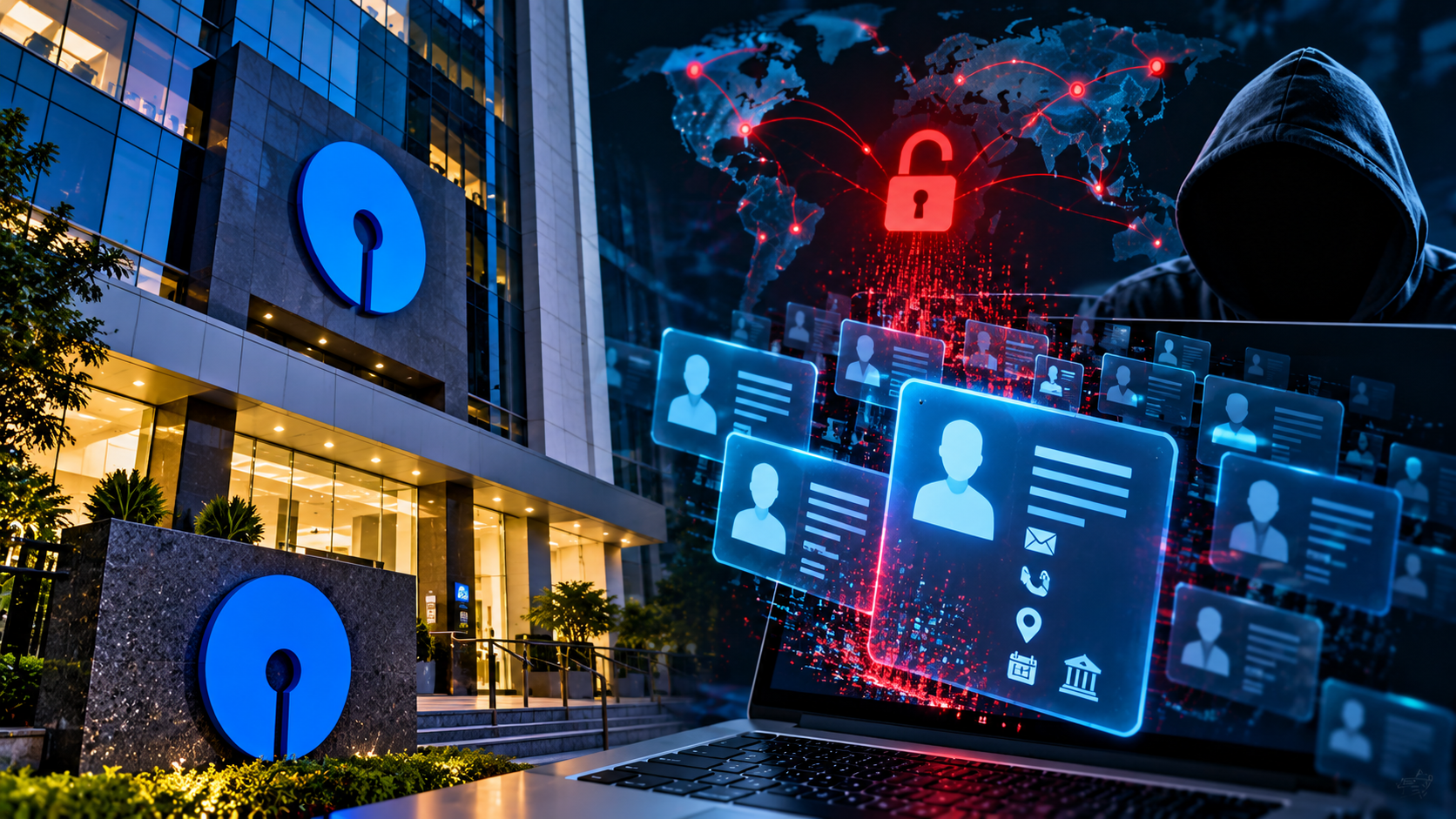
Preliminary review identifies personal information linked to thousands of customers, prompting a detailed cybersecurity investigation as India’s largest lender activates containment and preventive measures
State Bank of India (SBI) is investigating a suspected exposure of customer information on the dark web after a preliminary review identified 3,897 records containing personally identifiable information. The lender has initiated its cyber incident response procedures and appointed an independent cybersecurity agency to determine the authenticity, origin and potential consequences of the suspected data leak.
The development has renewed attention on cybersecurity risks in the banking sector, where the protection of customer information is critical to maintaining trust, safeguarding digital transactions and preventing financial fraud.
Preliminary Analysis Flags Thousands of Customer Records
SBI received alerts on October 16 from its threat intelligence service provider, the Defence Cyber Agency and the Indian Computer Emergency Response Team (CERT-In) regarding the suspected availability of customer information on the dark web.
According to the bank’s preliminary analysis, approximately 375,000 records found on the dark web were examined, of which 3,897 were identified as customer records containing personal information. The initial findings do not, by themselves, establish whether every identified record is authentic, complete or linked to a confirmed breach of the bank’s systems.
SBI has stated that a more comprehensive investigation is necessary to establish the extent of the exposure, identify the possible source and assess the risks to affected customers and the institution.
What Information May Have Been Exposed?
The information identified during the preliminary review reportedly includes several categories of personal and customer-related data:
-
Customer names, registered mobile numbers and email addresses
-
Dates of birth and gender details
-
Residential addresses
-
Branch information and customer information file (CIF) identifiers
-
Lead identification numbers and metadata associated with loan and lead records
Although the preliminary disclosure does not establish that banking credentials, passwords or transaction details were exposed, the reported categories of information could still create risks if accessed or misused by fraudsters.
Personal details can be combined to make fraudulent communications appear credible. Criminals may use such information to impersonate bank officials, create convincing phishing messages, target customers with loan-related scams or attempt identity-based fraud.
SBI Activates Cybersecurity Response Measures
The bank has activated its cyber incident response and containment protocols to investigate the suspected exposure. It has also engaged an independent cybersecurity agency empanelled by CERT-In to carry out a comprehensive assessment.
The investigation is expected to examine the authenticity and completeness of the identified records, determine how the information may have become accessible and evaluate the potential impact on customers and the bank. SBI has said it is implementing appropriate remedial and preventive measures as required.
The outcome of the investigation will be important in determining whether the information originated from the bank’s systems, a third-party service provider or another source. The preliminary findings alone do not establish the precise route through which the data may have been exposed.
No Material Impact on Core Operations Reported
SBI has stated that the suspected incident has not had a material impact on its core business operations, financial performance or business continuity. The bank’s core functions continue to operate normally, according to its disclosure.
This distinction is important because a suspected data exposure does not automatically mean that banking systems or payment infrastructure have been disrupted. However, the absence of a reported operational impact does not eliminate the need to investigate possible customer-level risks.
The bank’s assessment will need to establish whether the exposed information can be linked to specific customers and whether additional safeguards or customer notifications are necessary.
What Customers Should Do
Customers should remain alert to communications claiming to originate from SBI, particularly messages that refer to personal details, loan applications or account-related matters.
Customers should never share passwords, PINs, one-time passwords (OTPs) or other authentication credentials in response to unsolicited calls or messages. Suspicious links and unexpected requests for personal or financial information should be avoided, and any suspected fraudulent activity should be reported promptly through official banking channels.
Customers should also be cautious of callers who use genuine personal information to establish credibility. The presence of accurate details in a message or phone call does not prove that the communication is legitimate.
Broader Implications for Banking Cybersecurity
The incident highlights the growing challenge financial institutions face in protecting large volumes of sensitive customer information. Banks increasingly depend on interconnected digital platforms, service providers and data-processing systems, creating a need for continuous monitoring and strong controls across the entire technology ecosystem.
Effective protection requires more than securing core banking infrastructure. Access management, third-party risk assessments, data minimisation, encryption, threat intelligence and timely incident response all play important roles in limiting the consequences of a potential exposure.
For large lenders, cybersecurity incidents can also create reputational risks even when there is no immediate disruption to operations. The speed and transparency of the investigation, the quality of remedial measures and the handling of any customer impact will therefore be important.
Market Outlook
The suspected exposure is primarily a cybersecurity and customer-protection issue at this stage, rather than a confirmed disruption to SBI’s financial performance. The bank has reported no material impact on its core operations, finances or business continuity, but the investigation remains ongoing.
For investors, the key factors to monitor will be the final assessment of the incident, any confirmation of the source and extent of the exposure, and the adequacy of the bank’s corrective measures. A material change in the findings, regulatory developments or evidence of wider customer harm could influence perceptions of operational and reputational risk.
Until further details emerge, the number of records identified in the preliminary review should not be treated as confirmation that all affected information was obtained directly from SBI’s systems or that financial fraud has occurred.