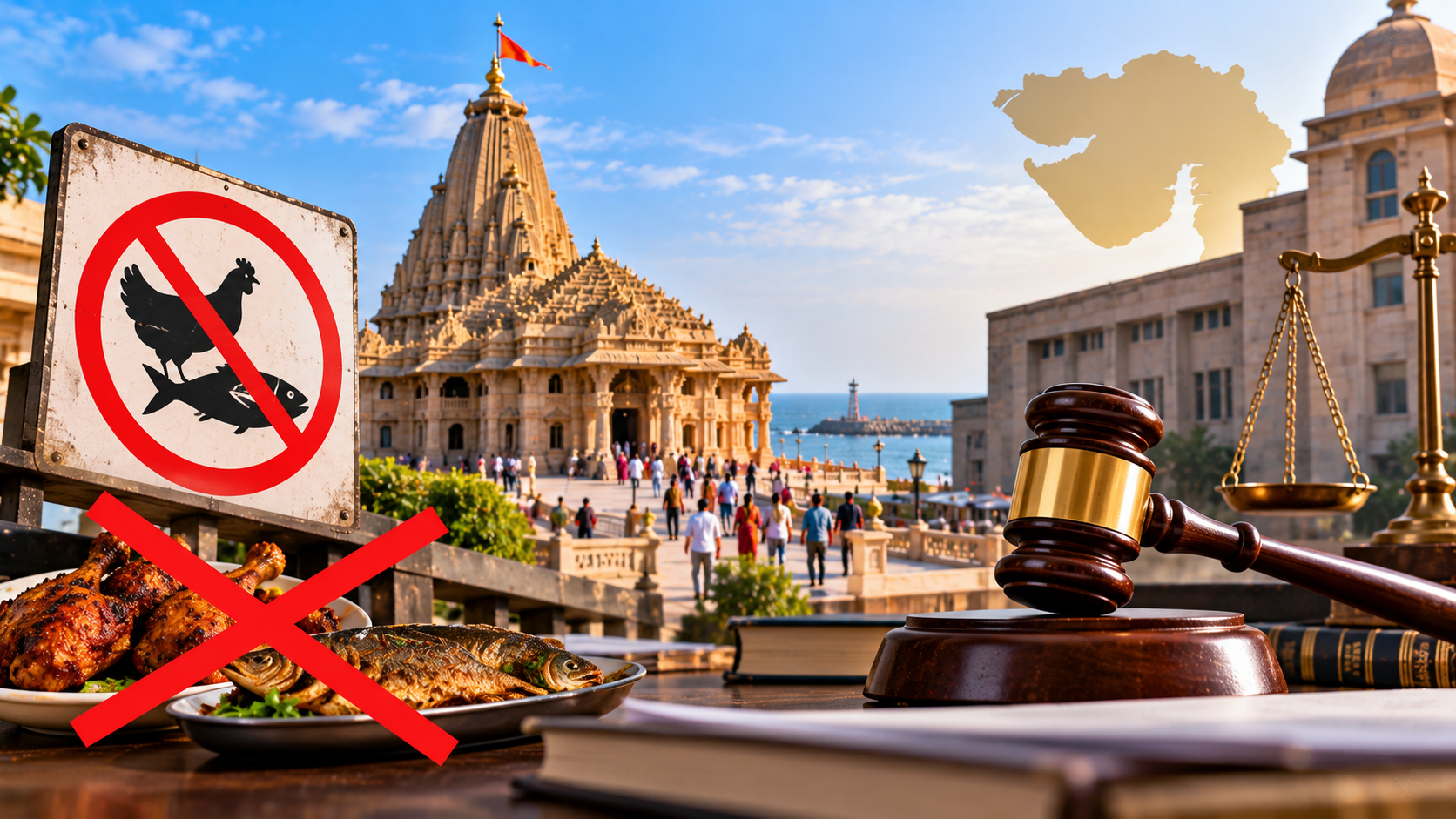
The state has told the Gujarat High Court that commercial rights cannot override the religious character of a major pilgrimage centre, as six restaurant owners challenge restrictions on non-vegetarian food sales within 500 metres of the temple.
Gujarat Government Defends Restrictions Around Somnath Temple
The Gujarat government has defended its decision to prohibit the sale and storage of non-vegetarian food within a 500-metre radius of the Somnath Temple, arguing that the religious, historical and cultural significance of the pilgrimage destination must be taken into account.
During a hearing before the Gujarat High Court, the state maintained that the right to conduct a business cannot be interpreted as an unrestricted right to sell non-vegetarian food near a prominent religious site. Somnath Temple, dedicated to Lord Shiva and located in Gir Somnath district, attracts devotees from across India.
The government’s submission came in response to a petition filed by six restaurant owners challenging the restrictions. The dispute centres on the balance between the fundamental right to conduct a lawful business and the state’s authority to regulate commercial activities in areas considered religiously significant.
State Highlights Religious and Cultural Importance
Representing the government, government pleader G. H. Virk argued that Somnath should not be treated merely as a commercial town without regard to its spiritual importance. The state maintained that the presence of millions of pilgrims gives the area a distinct religious character that warrants consideration when regulating activities around the temple.
According to the government, the right to conduct business does not automatically guarantee permission to sell every category of food at the entrance to a temple or along routes used by devotees.
The state also cited the large number of visitors to Somnath, stating that more than 1.16 crore devotees had visited the temple during the preceding nine months. It referred to restrictions in other pilgrimage destinations, including Rishikesh, Haridwar, Amritsar and Mathura-Vrindavan, to support its position that food-related restrictions are not unique to Somnath.
Six Restaurant Owners Challenge the Ban
The petitioners have argued that their establishments have operated legally for decades and possess valid licences. They contend that the authorities ordered their eateries to shut despite their claims that the businesses were situated beyond the immediate temple premises.
The restaurant owners have also questioned the district administration’s authority to impose what they describe as a permanent prohibition on an otherwise lawful trade. They argue that restrictions affecting their livelihoods must be supported by appropriate legal authority and cannot be imposed without sufficient justification.
The disputed notification, issued in August 2026, identifies several prohibited zones and routes within the specified 500-metre area. The petitioners say their establishments fall within one of these notified zones and that enforcement of the restrictions has disrupted their operations.
The case therefore raises questions about the scope of administrative powers, the legal basis for regulating food businesses near religious sites and the impact of such restrictions on existing commercial establishments.
Constitutional Rights at the Centre of the Dispute
The restaurant owners have challenged the notification on the grounds that it infringes Article 19(1)(g) of the Indian Constitution. This provision guarantees citizens the fundamental right to practise a profession or carry on an occupation, trade or business.
However, the right is not absolute. Article 19(6) permits the state to impose reasonable restrictions on this freedom in the interests of the general public, subject to constitutional requirements.
The High Court will have to consider the competing arguments, including whether the restriction is legally authorised, appropriately justified and consistent with constitutional protections. The government’s emphasis on Somnath’s religious character forms a central part of its defence, while the petitioners are seeking protection for their established businesses and livelihoods.
The final outcome will depend on the legal arguments and the court’s assessment of the notification and the applicable law. The government’s submissions represent its position in the ongoing proceedings, not a final judicial determination.
Potential Impact on Local Businesses and Pilgrimage Tourism
The dispute could have implications for restaurant operators, food vendors and other businesses serving visitors to Somnath. Restrictions on particular food categories may require affected establishments to change their menus, adjust their business models or relocate outside the notified areas.
The government has maintained that restaurants can continue serving vegetarian food at their existing premises and that non-vegetarian food businesses may operate outside the specifically restricted zones, subject to applicable laws. The practical impact, however, may vary depending on each establishment’s location, customer base and ability to adapt.
For the wider tourism economy, the case highlights the challenge of balancing the religious expectations associated with pilgrimage destinations with the commercial needs of local communities. Restaurants, accommodation providers, transport operators and retailers all depend to some extent on the flow of visitors to the temple.
What Happens Next?
The legal challenge places the notification under judicial scrutiny. The High Court’s consideration of the petition could help clarify the limits of local administrative authority when regulating lawful businesses in the vicinity of religious landmarks.
Until the court reaches a determination or issues further directions, the government’s defence and the restaurant owners’ objections remain competing positions in the case.
The broader issue extends beyond food restrictions: it concerns how public authorities can preserve the character of religious destinations while respecting constitutional freedoms and the economic interests of people who depend on pilgrimage-related commerce.