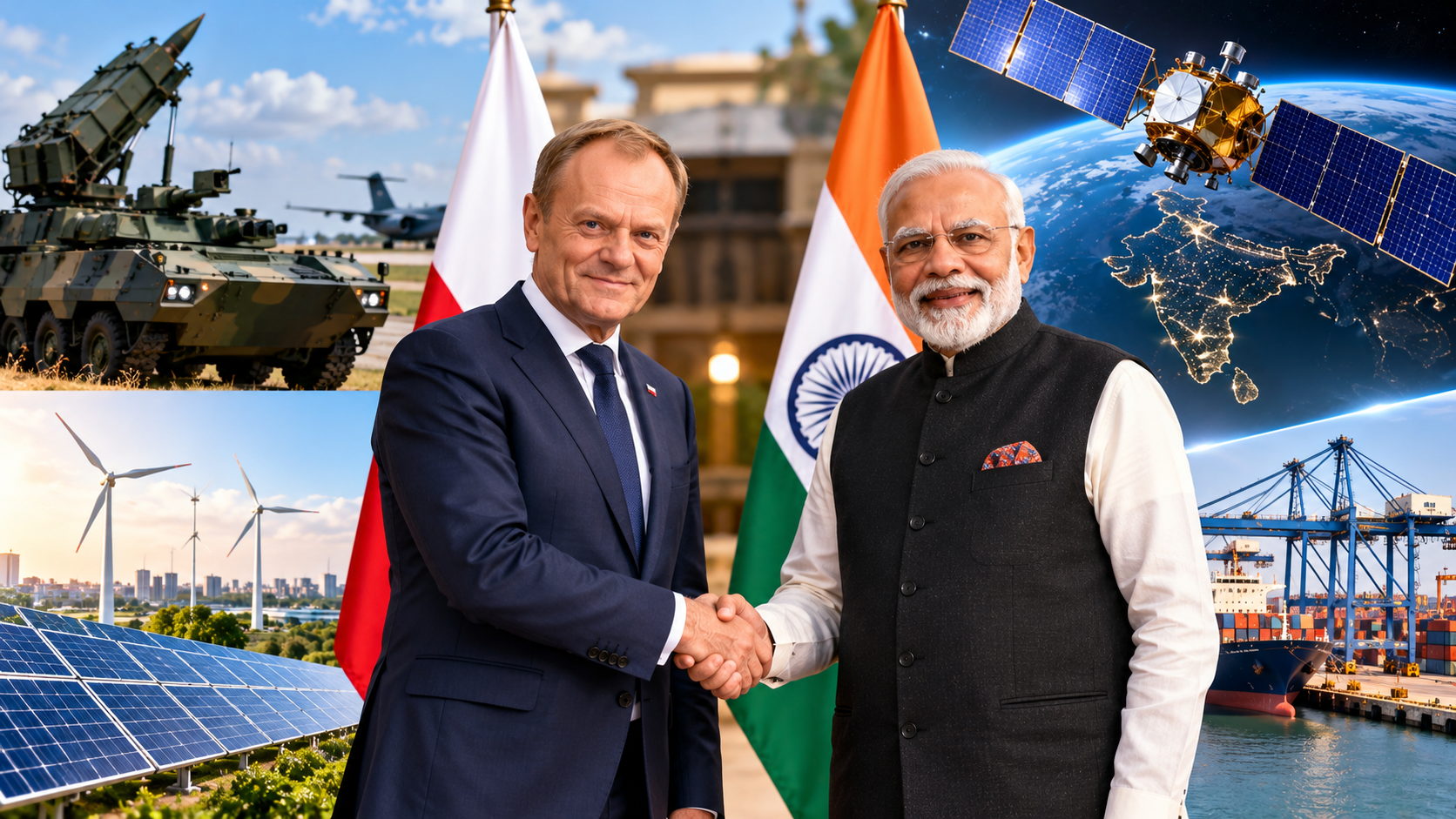
India and Poland are expected to strengthen their strategic partnership through cooperation in defence manufacturing, satellite technology, clean energy, port infrastructure and investment, while also reviewing regional security and India-European Union relations.
India-Poland Talks Aim to Deepen Strategic Partnership
Indian Prime Minister Narendra Modi and Polish Prime Minister Donald Tusk are scheduled to meet in New Delhi on October 22, 2026, to review bilateral relations and explore opportunities for expanded economic and strategic cooperation.
The meeting follows Modi’s visit to Poland in August 2024, when the two countries established a renewed framework for their strategic partnership. The current discussions are expected to focus on translating that framework into practical cooperation across defence production, space research, clean-energy investment, infrastructure and emerging technologies.
The leaders are also expected to exchange views on regional and international developments, including the Russia-Ukraine conflict and relations between India and the European Union.
The visit comes as both countries seek to strengthen economic links and diversify their strategic partnerships amid shifting global supply chains and heightened geopolitical uncertainty.
Defence Manufacturing Emerges as a Key Priority
Defence cooperation is expected to be one of the most important areas of discussion. India has been seeking to expand domestic defence manufacturing, develop specialised technologies and reduce dependence on imports, while Poland is looking for opportunities to broaden industrial cooperation and strengthen supply-chain resilience.
Polish Finance Minister Andrzej Domanski has indicated that the two countries are exploring possibilities for joint production and common platforms for defence equipment. Such arrangements could create opportunities for technology collaboration, industrial partnerships and local manufacturing in India.
The two countries have a history of defence-industry cooperation. One example is the partnership between Poland’s Bumar and India’s BEML involving WZT-3M armoured recovery vehicles, with cooperation dating back to 1999.
Building on this experience could help businesses explore additional areas of collaboration, subject to negotiations, technical requirements and government approvals.
For India, partnerships with European manufacturers could support domestic industrial capabilities and create opportunities for local suppliers. For Poland, cooperation with India could provide access to a large industrial market and potential opportunities to participate in a wider Asian supply chain.
Space Technology Opens New Opportunities
Space research and satellite technology are also expected to feature prominently in the discussions, reflecting India’s expanding space industry and Poland’s interest in strengthening its presence in international space markets.
Polish satellite company ICEYE, known for its synthetic aperture radar technology, is seeking deeper engagement with India. Its radar satellites can capture images through cloud cover and in darkness, making them useful for applications such as disaster monitoring, infrastructure observation and security-related activities.
ICEYE has signed memorandums of understanding with Indian space companies Dhruva Aerospace and AgniKul Cosmos. These agreements illustrate the potential for cooperation between Polish technology providers and India’s growing network of private space businesses.
Further collaboration could cover satellite development, data applications, scientific research and specialised space technologies. However, the commercial significance of any new partnership will depend on the terms agreed, project execution and future demand.
Clean Energy and Green Investment on the Agenda
Clean energy is another potential area for closer cooperation. Poland is interested in expanding investment in Indian projects connected with the energy transition, while India continues to seek technologies and capital that can support cleaner industrial processes and more efficient energy systems.
Potential areas of cooperation include renewable-energy technologies, industrial energy efficiency and solutions that help businesses manage their environmental impact.
Cross-border partnerships could give Indian companies access to specialised European technologies while providing Polish businesses with opportunities in India's expanding energy and infrastructure markets.
The extent of future investment will depend on project economics, regulatory approvals, financing arrangements and the commercial priorities of participating companies.
Port Infrastructure and Industrial Cooperation
Port infrastructure is also among the areas identified for potential cooperation. Ports play a crucial role in international trade by supporting the movement of raw materials, manufactured goods and energy supplies.
Greater engagement in port-related infrastructure and technology could help businesses explore opportunities involving logistics, modernisation and industrial connectivity. Such cooperation could become increasingly relevant as companies seek more resilient supply chains and improved access to international markets.
Specific projects and investment commitments would need to be established through subsequent discussions and agreements. The leaders’ meeting provides an opportunity to identify priorities and encourage businesses to pursue commercially viable partnerships.
India-Poland Business Forums to Connect Companies
The diplomatic engagement is accompanied by India-Poland business forums scheduled in New Delhi on October 22 and Bengaluru on October 23.
The forums are expected to bring companies from both countries together to explore commercial opportunities, particularly in technology and space-related industries.
Business-to-business engagement can help translate government-level discussions into practical projects by allowing companies to identify partners, assess market demand and evaluate potential investments.
For Indian businesses, Poland may provide a route to wider European markets and specialised industrial expertise. Polish companies, meanwhile, could benefit from India's large domestic market, expanding technology ecosystem and growing demand for infrastructure and advanced manufacturing.
The commercial outcome will depend on whether discussions lead to concrete contracts, joint ventures, research arrangements or investment commitments.
Russia-Ukraine Conflict and EU Relations Also Matter
The leaders are expected to discuss the Russia-Ukraine conflict and broader international developments. Poland's geographical position and security concerns make the conflict an important issue for Warsaw, while India has maintained diplomatic engagement with multiple parties and continued to call for dialogue and a peaceful resolution.
India-European Union relations are another relevant topic. Stronger India-Poland ties could contribute to broader engagement between India and European economies, particularly in trade, technology, investment and security-related industries.
Progress in these areas may depend on the wider geopolitical environment, regulatory frameworks and the ability of both governments to align their economic and strategic priorities.
What the Meeting Could Mean for Businesses and Investors
The discussions could create opportunities for companies operating in defence manufacturing, aerospace, satellite services, renewable energy, infrastructure and advanced technology.
For investors, the key factor will be whether the diplomatic engagement produces measurable commercial outcomes. Announcements of cooperation can improve visibility for an industry, but they do not automatically translate into revenue, profits or new orders for individual companies.
Businesses linked to defence production and space technology may benefit if discussions eventually lead to procurement agreements, technology transfers or joint manufacturing arrangements. Clean-energy and infrastructure firms could also gain opportunities if investment proposals advance into funded projects.
Investors should distinguish between preliminary discussions, memorandums of understanding and binding commercial contracts. They should also assess company valuations, execution capabilities, regulatory risks and the financial implications of any announced partnership.
Market Outlook: Strategic Cooperation Could Support Long-Term Growth
The Modi-Tusk meeting highlights the potential for India and Poland to expand economic cooperation at a time when countries are reassessing supply chains, defence requirements and investment priorities.
Defence manufacturing, satellite technology, clean energy and infrastructure could offer areas for sustained collaboration if both governments and private companies convert their discussions into implementable projects.
For India, the partnership could support domestic manufacturing, technology development and access to European industrial expertise. For Poland, closer engagement could open additional commercial opportunities in one of the world's major growth markets.
The immediate market impact, however, will depend on the announcements made and whether they lead to specific contracts or investment commitments. For investors, the most important indicators to monitor will be confirmed agreements, project funding, order inflows and evidence of commercial execution rather than diplomatic statements alone.