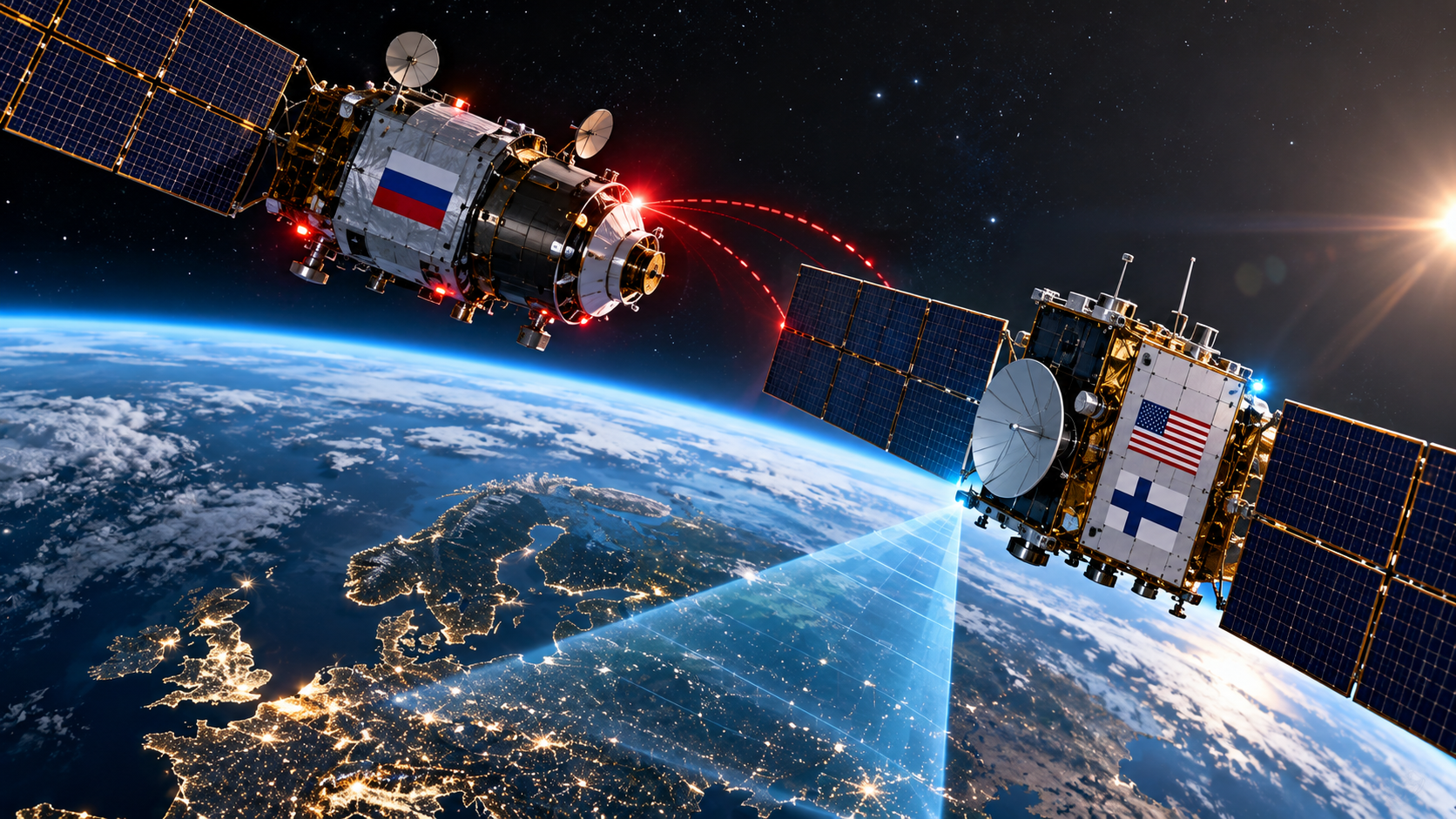
The Trump administration alleges that Russia’s Cosmos 2612 military satellite manoeuvred dangerously close to a US-Finnish radar satellite reportedly supporting intelligence operations linked to Ukraine, raising fresh concerns over military activity in low Earth orbit.
US Raises Alarm Over Russian Military Satellite
The United States has accused Russia of engaging in potentially threatening behaviour in space after its Cosmos 2612 military satellite allegedly manoeuvred unusually close to a commercial radar satellite associated with US and Finnish interests.
The allegation was announced by Thomas G. DiNanno, the US Under Secretary of State for Arms Control and International Security, in remarks shared on social media and at the United Nations First Committee. He said the Russian satellite’s movements were consistent with activities that could indicate on-orbit weapons operations.
According to a report cited by US media, Cosmos 2612 came within approximately 100 feet of a US-Finnish radar satellite reportedly providing intelligence relevant to Ukraine. The proximity has raised concerns about the safety of satellites that support surveillance, communications and national security operations.
The allegations have not, by themselves, established that Russia attempted to damage or disable the other satellite. However, Washington has described the reported manoeuvres as a serious concern amid heightened geopolitical tensions over the war in Ukraine.
Washington Warns of Risks to Space-Based Assets
The US administration said the reported activity violated long-established safety expectations for operations in low Earth orbit. American officials also reiterated that Washington would protect its national security interests in space.
Low Earth orbit contains a growing number of commercial, scientific and military satellites. These spacecraft support a wide range of functions, including weather monitoring, navigation-related services, communications, Earth observation and intelligence gathering.
Close-proximity manoeuvres between satellites can be particularly sensitive when one spacecraft is believed to have military or intelligence value. Such activity may raise questions about surveillance, interference, collision risks or the potential use of technologies designed to approach and inspect another satellite.
Nevertheless, proximity alone does not prove hostile intent. Determining whether a manoeuvre constitutes a threat requires information about the spacecraft’s trajectory, capabilities, mission and operational context. Publicly available details in this case remain limited, and the US allegations should be distinguished from independently established findings.
Why the Reported Satellite Encounter Matters for Ukraine
The incident comes as Ukraine continues to rely on intelligence and technology support from Western partners in its conflict with Russia. Satellite-based radar systems can provide information about terrain and activity on the ground, including observations that may be useful when cloud cover or darkness limits conventional imaging.
If a satellite is providing information relevant to Ukraine, Russian military planners could regard its activities as strategically significant. An attempt to approach or observe such a spacecraft could therefore carry implications beyond the immediate safety of the satellites involved.
However, the precise mission and operational details of the satellite identified in the reports have not been fully established publicly. The allegation that it supports intelligence operations linked to Ukraine should not be interpreted as confirmation of every reported detail about its use.
The episode highlights how the war is increasingly connected to space-based infrastructure, where commercial systems can support civilian services while also providing information with potential military applications.
Growing Concerns Over Anti-Satellite Capabilities
The US allegations have renewed attention on the development and deployment of technologies that could threaten satellites in orbit.
Anti-satellite capabilities can take different forms, including systems designed to physically destroy a spacecraft, interfere with its communications, disrupt its operations or approach it closely for inspection or other purposes. Not every close-proximity manoeuvre involves a weapon, but unusual movements by military satellites can prompt concerns about their intended purpose.
The United States has also acknowledged possessing defensive space-control capabilities. This reflects the broader strategic competition among major powers as governments seek to protect their satellites and preserve their ability to operate in an increasingly contested environment.
Any escalation in this area could have consequences for both military and civilian users. Satellite disruptions could affect communications, navigation, weather forecasting, financial timing systems and other services that depend on reliable space infrastructure.
Incident Unfolds Amid US-Russia Diplomatic Contacts
The satellite dispute emerged as diplomatic efforts continued to explore possible pathways towards ending the war in Ukraine.
US special envoy Steve Witkoff reportedly met Russian President Vladimir Putin in St. Petersburg as part of discussions concerning a potential peace framework. The diplomatic engagement followed talks with Ukrainian President Volodymyr Zelensky in Norway.
The timing places the satellite allegations against a backdrop of simultaneous diplomatic outreach and strategic competition. While negotiations may seek to reduce tensions on the ground, military and intelligence activities in space remain a separate source of concern.
There is no established evidence that the reported satellite encounter directly affected the diplomatic discussions. Nevertheless, incidents involving strategic infrastructure can complicate efforts to build confidence between countries already involved in a wider confrontation.
Implications for Global Space Security
The growing use of satellites for military and commercial purposes is increasing the importance of clear operating practices and mechanisms for managing potentially dangerous encounters.
Unlike terrestrial infrastructure, satellites operate in an environment where rapid physical intervention is difficult and the consequences of a collision can extend beyond the spacecraft directly involved. Debris from a destructive event could threaten other satellites and remain in orbit for an extended period, depending on the altitude and circumstances.
Governments and space operators therefore have strong incentives to improve space-domain awareness, share relevant safety information where possible and develop procedures for reducing the risk of miscalculation.
The incident also illustrates the difficulty of separating civilian and military interests in space. Commercial satellite operators may provide services that governments rely on for security purposes, potentially making privately operated infrastructure a focus of geopolitical competition.
Market Outlook: Space Security Becomes a Strategic Investment Theme
The latest allegations underscore the growing strategic importance of the space industry, including satellite manufacturing, radar imaging, secure communications, tracking systems and space-domain awareness technologies.
Governments may continue to prioritise investment in satellite resilience, surveillance capabilities and systems designed to protect critical orbital infrastructure. This could create opportunities for companies involved in aerospace, defence electronics, satellite communications and space monitoring, although commercial outcomes will depend on government budgets, procurement decisions and regulatory developments.
For investors, the reported incident is a reminder that geopolitical tensions can influence defence and space-sector sentiment. However, a single allegation does not guarantee additional contracts or higher company earnings, and investment decisions should be based on verified company fundamentals, order books, valuations and execution risks.
The broader challenge is to prevent strategic competition from turning low Earth orbit into a more dangerous operating environment. As dependence on satellites grows, maintaining safe operations and reducing the risk of miscalculation will become increasingly important for national security, commercial activity and the global economy.