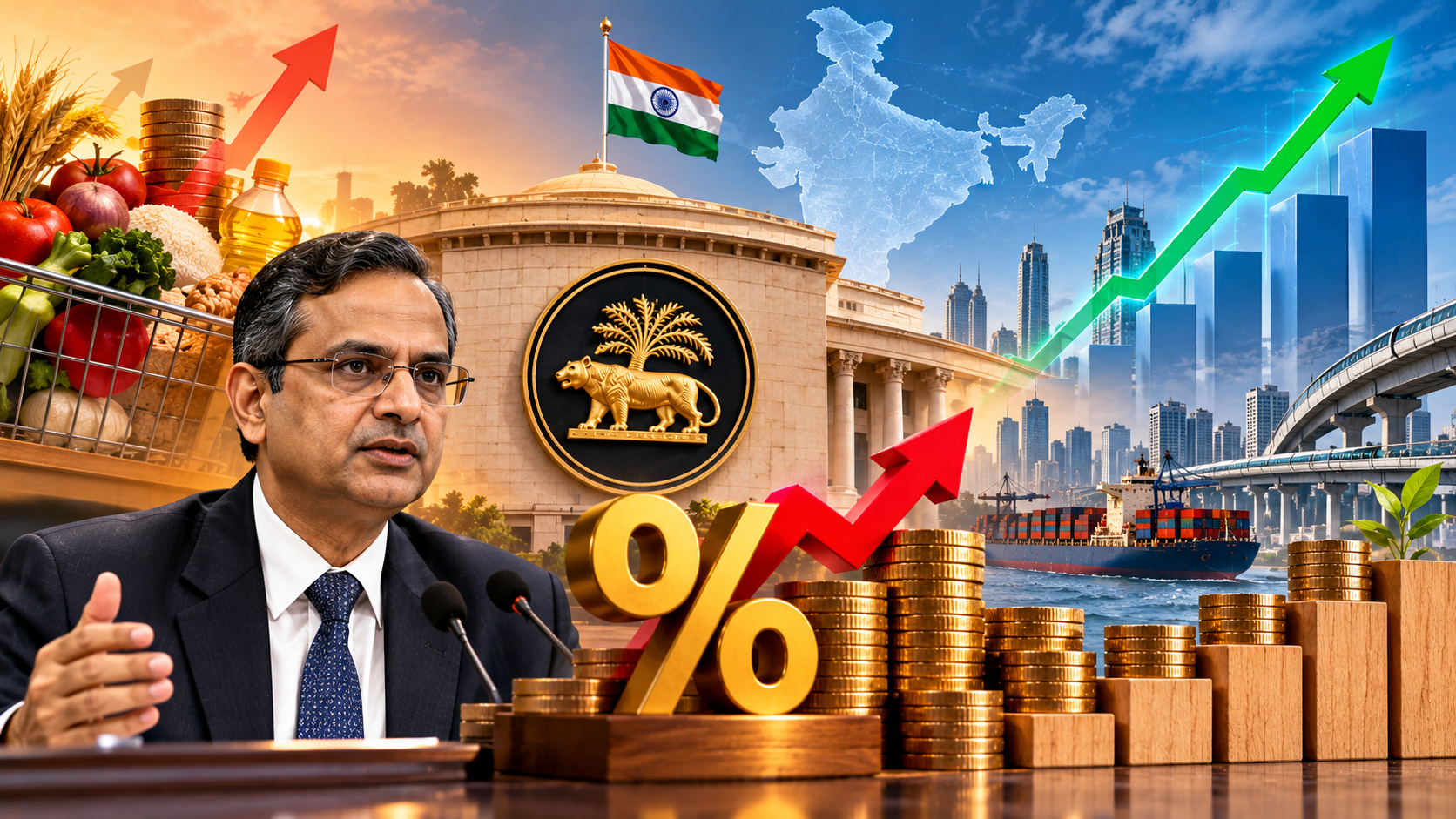
MPC Hikes Repo Rate to 5.5% and Shifts Stance to Calibrated Tightening as Inflation Risks Re-emerge
The Reserve Bank of India (RBI) raised its FY27 inflation forecast while significantly upgrading its economic growth outlook in the October monetary policy review, balancing renewed price pressures against the resilience of domestic economic activity.
The Monetary Policy Committee (MPC) unanimously increased the policy repo rate by 25 basis points to 5.5 per cent from 5.25 per cent and changed its monetary policy stance to “calibrated tightening.” The move marks a significant shift in policy direction as the central bank responds to rising inflation risks, elevated energy prices and heightened global uncertainty.
Alongside the rate hike, the RBI raised its FY27 real GDP growth projection by 40 basis points to 7.1 per cent from 6.7 per cent, signalling confidence in the underlying strength of the Indian economy.
RBI Raises Inflation Forecast
The central bank raised its FY27 consumer price index (CPI) inflation forecast to 5.2 per cent from 5 per cent, reflecting increasing concerns over food, fuel and broader supply-side pressures.
RBI Governor Sanjay Malhotra said inflation and its outlook were no longer as benign as they had been during the previous year.
CPI inflation rose to 4.8 per cent in August from 4.5 per cent in July. While food and fuel remained the primary contributors, the RBI also noted signs of broader price pressures in core inflation.
Core inflation increased to 4.2 per cent in August, while core inflation excluding precious metals stood at 2.9 per cent. The proportion of items in the CPI basket registering inflation above 4 per cent also increased to around 37 per cent.
Inflation Expected to Remain Elevated
The RBI's quarterly inflation projections point towards continued price pressures through FY27.
-
Q2 FY27: 4.9 per cent
-
Q3 FY27: 6.0 per cent
-
Q4 FY27: 5.7 per cent
-
Q1 FY28: 5.6 per cent
The projections suggest that inflation could remain above the RBI's medium-term comfort level for an extended period.
The central bank attributed part of the pressure to deficient monsoon conditions, ongoing El Nino conditions and elevated energy and commodity prices. The pass-through from higher input costs is also continuing to work through the economy.
Food inflation has become more broad-based, with sharp increases in commodities such as sugar and onions adding to headline price pressures. Fuel inflation also increased in August, although the RBI noted that unfavourable base effects played an important role.
Repo Rate Raised to 5.5%
The MPC unanimously voted for a 25-basis-point increase in the repo rate to 5.5 per cent.
The Standing Deposit Facility rate was adjusted to 5.25 per cent, while the Marginal Standing Facility and Bank Rate were raised to 5.75 per cent.
The shift to a calibrated tightening stance indicates that the RBI is becoming more focused on preventing inflationary pressures from becoming entrenched.
Higher interest rates could help contain demand-side inflation and support financial stability, although they also increase borrowing costs for households and businesses.
GDP Growth Outlook Strengthens
Despite the inflation concerns, the RBI significantly upgraded its economic growth outlook.
FY27 real GDP growth is now projected at 7.1 per cent, compared with the earlier estimate of 6.7 per cent.
The quarterly projections are:
-
Q2 FY27: 7.2 per cent
-
Q3 FY27: 6.9 per cent
-
Q4 FY27: 6.8 per cent
The RBI's improved growth outlook reflects strong private consumption, resilient investment activity, a rebound in merchandise exports and continued strength in services exports.
Manufacturing activity has remained robust, while services have benefited from healthy domestic and international demand.
Consumption and Investment Provide Support
Private consumption remains an important driver of India's economic expansion. The RBI expects relatively stable employment conditions and continued momentum in services to support urban demand.
Investment activity is also receiving support from strong capacity utilisation, robust credit growth and the government's continued focus on infrastructure spending.
Higher capacity utilisation could encourage companies to increase capital expenditure, while healthy credit flows provide financing support for businesses across sectors.
The combination of consumption, investment and services exports is therefore expected to cushion the economy against external shocks.
West Asia Conflict Remains a Major Risk
The RBI highlighted the escalation of the West Asia conflict as an important source of uncertainty for the global and Indian economies.
The conflict has contributed to sharp volatility in crude oil prices, creating risks for an oil-importing economy such as India. Higher energy prices can increase the import bill, put pressure on the current account and raise input costs across several industries.
Supply-chain disruptions could further add to inflationary pressures.
However, the RBI noted that India has been actively diversifying its sources of supply, which could help contain the impact of external disruptions.
Monsoon and El Nino Pose Risks to Rural Demand
The agricultural outlook remains another area of concern.
Deficient south-west monsoon conditions and strong El Nino conditions could affect agricultural output and rural incomes, potentially weakening rural consumption.
The RBI, however, expects healthy foodgrain buffers and proactive government measures to help reduce the impact of supply disruptions.
The performance of food prices in the coming months will be particularly important because food inflation has a significant influence on headline CPI and household inflation expectations.
Services Exports Remain a Bright Spot
The RBI remains positive about India's services export performance.
Technology, business services and other digitally delivered exports continue to provide support to external earnings. Sustained demand from global customers could help offset some of the pressure created by elevated energy imports.
The central bank also expects bilateral trade agreements to support merchandise exports, potentially strengthening India's external sector over the medium term.
What the Policy Means for Markets
The combination of a rate hike and a higher growth forecast creates a mixed environment for financial markets.
Banks and financial institutions could benefit from strong credit growth and a resilient economy, although higher rates could eventually affect loan demand and borrowing costs.
Rate-sensitive sectors such as real estate and consumer durables could face some pressure from higher financing costs, while companies with strong cash flows and lower leverage may be relatively better positioned.
The bond market will remain particularly sensitive to the RBI's tightening stance, inflation trajectory and government borrowing requirements.
For the rupee, higher domestic rates could offer some support, although elevated crude prices, foreign portfolio outflows and a strong US dollar remain significant external headwinds.
Market Outlook
The RBI's October policy presents a mixed but fundamentally resilient outlook for Indian markets. The 25-basis-point repo rate hike and shift to calibrated tightening are negative for rate-sensitive segments in the near term, but the sharp upgrade in the FY27 GDP forecast to 7.1 per cent reinforces confidence in India's underlying economic momentum.
Equity markets are likely to focus on the trade-off between higher inflation and stronger growth. Financials could remain relatively supported by robust credit demand, while infrastructure, capital goods and companies linked to domestic investment may benefit from the strong growth outlook.
The key risks remain elevated crude prices, West Asia tensions, food inflation, global bond yields and foreign capital outflows. If inflation remains elevated for longer, the RBI could maintain a tighter policy stance, limiting the scope for near-term rate cuts.
Overall, the policy signals that growth remains strong, but inflation risks are back on the RBI's radar, making the trajectory of crude oil, food prices and global financial conditions critical for the next phase of Indian markets.