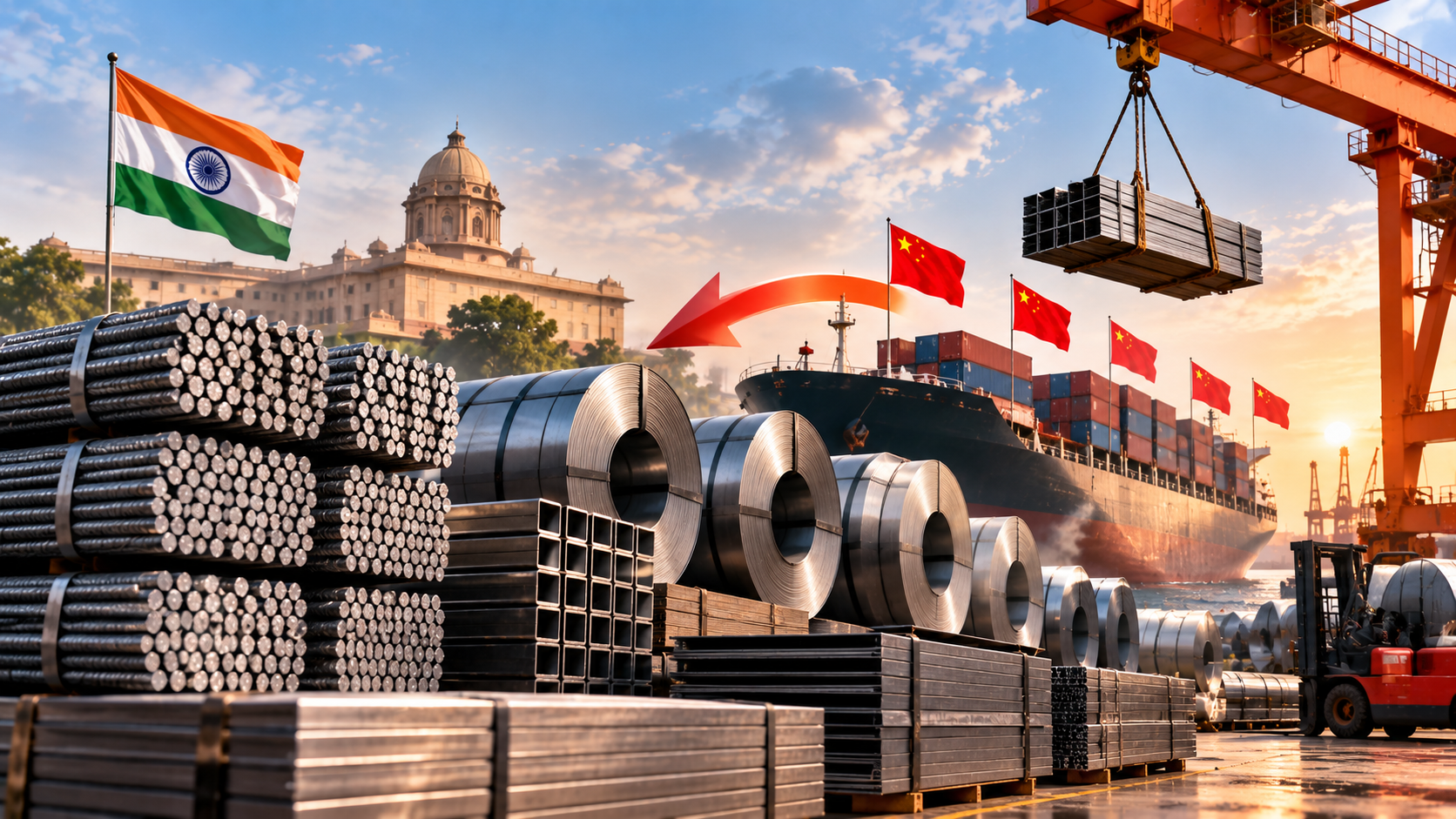
Rising Imports Put Pressure on Indian Steelmakers as Government Weighs Higher Prices and Industry Protection
India's steel ministry is unlikely to introduce additional measures to curb low-priced steel imports in the near term, despite growing concerns among domestic producers over a sharp rise in overseas shipments.
The development comes at a time when Indian steelmakers are seeking stronger protection against cheaper imports, particularly from China, which has emerged as the country's largest supplier of finished steel. While domestic mills have pushed for a higher safeguard duty, the government is understood to be reluctant to raise import barriers immediately because domestic steel prices have already increased significantly.
Finished Steel Imports Rise Sharply
India remained a net importer of finished steel during the April-August period, with imports reaching around 3.5 million tonnes, an increase of nearly 30 per cent from the corresponding period a year earlier.
China accounted for roughly 31.8 per cent of India's finished steel imports during the period, making it the largest overseas supplier. The increase has raised concerns among Indian producers that a sustained inflow of competitively priced steel could restrict their ability to pass on higher production costs to customers.
The issue has become more important as global steel markets continue to face excess capacity and uneven demand. Chinese producers, in particular, have remained a major source of export competition for steelmakers across Asia and other markets.
Mills Seek Higher Safeguard Duty
Domestic steel producers have been pressing the government to strengthen import protection. A steel industry analyst said one mill had petitioned authorities to raise the safeguard duty to more than 20 per cent from the current 11.5 per cent.
India had introduced a safeguard duty on certain steel grades in December last year for a three-year period. The measure was intended to provide temporary protection to domestic producers from a surge in imports.
However, the continued increase in shipments suggests that the existing duty has not completely eliminated competitive pressure on Indian mills.
The government is currently unlikely to increase the duty, with officials also considering the impact that higher protection could have on downstream industries that rely on steel as a key raw material.
Steel Prices and Raw Material Costs Rise
The government's reluctance to impose another round of restrictions is partly linked to the recent increase in domestic steel prices.
Indian steel mills have raised prices in recent weeks as coking coal costs have increased and demand has strengthened following the monsoon season. Coking coal is a critical input for blast-furnace-based steel production, making changes in its price directly relevant to steelmakers' margins.
Demand conditions have also improved across important consuming sectors. Infrastructure activity has remained supportive, while automobile demand has strengthened considerably.
India's automobile sales increased 31.82 per cent year-on-year in September, according to industry data, led by strong demand for passenger vehicles and two-wheelers. A sustained recovery in automotive demand could provide additional support to flat steel consumption in the coming quarters.
Anti-Dumping Probe Adds Another Layer
India has also initiated an anti-dumping investigation into hot-rolled steel imports from China, Japan and Russia.
The investigation could eventually lead to additional trade measures if authorities determine that imported steel is being sold below fair value and causing material injury to domestic producers.
For Indian steel companies, the outcome of this investigation could be more important than any immediate change in the safeguard duty. Anti-dumping measures, if imposed, could alter the competitive landscape for specific steel products and potentially improve domestic pricing power.
Imports Remain a Key Margin Risk
Despite improving domestic demand, higher imports remain a significant risk for Indian steel producers.
If imported steel continues to enter the country at competitive prices, domestic mills could face pressure to limit price increases even as their raw material expenses rise. This could squeeze operating margins, particularly for companies with higher exposure to commodity-grade products.
Fitch Ratings has also highlighted rising imports as a key risk for Indian steel producers, warning that renewed competitive pressure could affect margins if overseas supplies continue to increase.
The impact, however, will vary across producers depending on their product mix, cost structure, captive raw-material access and ability to sell value-added steel.
Policy Balancing Act for Government
The government faces a delicate balancing act between protecting domestic steelmakers and ensuring affordable raw materials for downstream industries.
A sharp increase in safeguard duties could benefit steel producers by limiting cheaper imports, but it could simultaneously increase costs for automobile manufacturers, engineering companies, construction firms and other steel-consuming businesses.
With domestic steel prices already elevated, policymakers appear to be prioritising price stability and downstream competitiveness over immediately providing additional protection to producers.
At the same time, authorities are likely to closely monitor import volumes and pricing before deciding whether further action is warranted.
Outlook for Indian Steel Stocks
The near-term outlook for Indian steel producers remains mixed. Strong infrastructure and automobile demand provide a favourable backdrop for volumes, while higher coking coal prices could keep cost pressures elevated.
Companies with captive iron ore and coal resources, efficient operations and a higher proportion of value-added products are likely to be better positioned to defend margins.
For the sector as a whole, the direction of Chinese exports, domestic steel prices, coking coal costs and the government's trade-policy response will remain key variables.
Market Outlook
Indian steel stocks could remain sensitive to developments around import duties and the government's response to rising overseas shipments. A continuation of strong domestic demand would support volumes, but the surge in imports could cap pricing power and margins if supply pressure persists.
In the near term, investors are likely to focus on the anti-dumping investigation, safeguard-duty policy, Chinese export trends and the trajectory of domestic steel prices. A further tightening of import restrictions could provide a positive trigger for domestic steelmakers, while any acceleration in imports without corresponding demand growth could weigh on sector sentiment.
The broader sector outlook remains constructive on demand, but margin expansion will depend increasingly on the balance between domestic consumption, imported steel availability and raw-material costs.