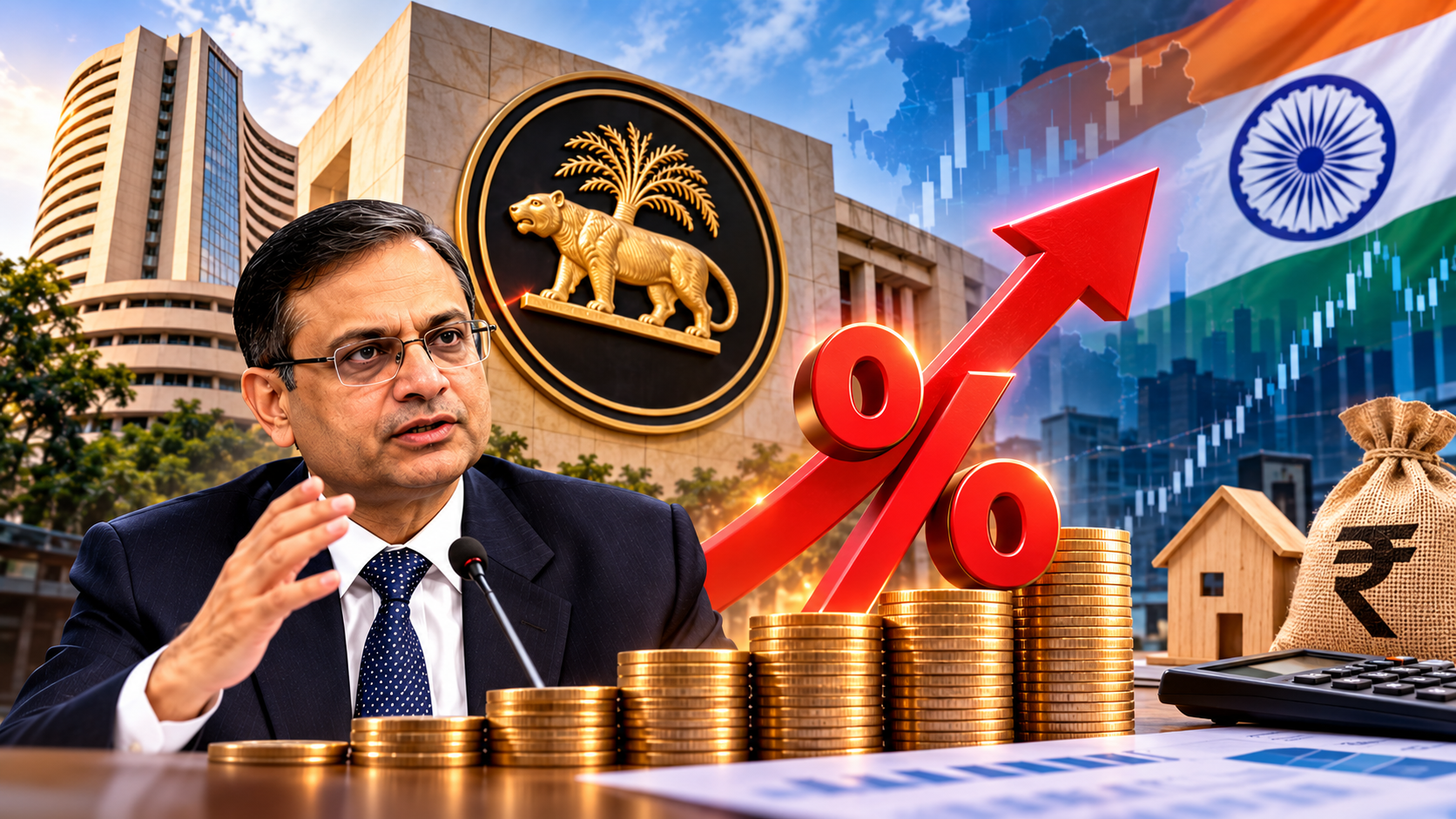
RBI shifts stance to calibrated tightening as food and core inflation accelerate, while retaining a firm FY27 growth outlook of 7.1%
The Reserve Bank of India (RBI) on Wednesday raised the benchmark repo rate by 25 basis points to 5.5 per cent, marking its first rate increase since February 2023. The six-member Monetary Policy Committee (MPC) unanimously supported the rate hike as inflationary pressures broadened and global financial conditions remained challenging.
The central bank also shifted its monetary policy stance to calibrated tightening, signalling that near-term rate cuts are unlikely and future policy decisions will depend closely on inflation, economic growth and evolving global risks.
Repo Rate Raised to 5.5%
With the latest increase, the repo rate now stands at 5.5 per cent. The Standing Deposit Facility rate has been raised to 5.25 per cent, while the Marginal Standing Facility rate and Bank Rate stand at 5.75 per cent.
The MPC voted unanimously in favour of the rate hike, while four members supported the change in the policy stance.
The decision reflects the RBI's growing concern that inflationary pressures could become more persistent and spread beyond a limited number of commodities.
RBI Adopts Calibrated Tightening
The shift towards calibrated tightening represents a significant change in the central bank's policy approach.
The RBI indicated that the extent and duration of any further rate action will depend on underlying inflation, the widening of price pressures, second-round effects from supply shocks and the strength of domestic demand.
The stance effectively places further rate cuts off the immediate policy agenda, while leaving room for the central bank to pause or undertake additional measured hikes depending on incoming economic data.
Inflation Outlook Turns More Challenging
The RBI said the inflation environment is no longer as benign as it appeared last year.
Headline consumer price inflation is expected to average nearly 5.8 per cent over the coming three quarters, including the current quarter. Core inflation for FY27 is projected at around 4.4 per cent.
The change in the inflation outlook was a key factor behind the decision to tighten monetary policy.
Food Prices Become a Major Concern
Consumer inflation increased to 4.8 per cent in August from 4.5 per cent in July, driven partly by higher food and fuel prices.
The RBI noted that food-price increases have become more broad-based, with commodities such as sugar and onions recording notable price increases.
Core inflation also accelerated to 4.2 per cent in August after remaining at around 3.9 per cent for three consecutive months.
The proportion of CPI components recording inflation above 4 per cent increased to around 37 per cent in August, suggesting that price pressures are becoming more widespread across the consumption basket.
Growth Remains Resilient
Despite the more challenging inflation environment, the RBI maintained a positive assessment of India's economic growth.
Real GDP expanded 7.8 per cent in the first quarter, supported by resilient private consumption and strong investment activity. Investment growth was close to 12 per cent during the quarter, according to Governor Sanjay Malhotra.
High-frequency indicators also suggest that economic activity remained strong during the second quarter, although the pace of expansion moderated from the previous quarter.
Manufacturing and services activity continued to remain in expansion territory, while private consumption and fixed investment provided support to overall economic momentum.
FY27 GDP Growth Forecast at 7.1%
The RBI retained a firm growth projection for FY27, forecasting real GDP growth at 7.1 per cent.
The quarterly projections are:
-
Q2 FY27: 7.2 per cent
-
Q3 FY27: 6.9 per cent
-
Q4 FY27: 6.8 per cent
-
Q1 FY28: 7.1 per cent
The central bank assessed the risks to its growth forecast as broadly balanced.
The combination of strong domestic demand, investment activity and continued expansion in manufacturing and services is expected to support economic growth despite tighter monetary conditions.
Global Economic Risks Remain Elevated
The RBI highlighted several external risks that could affect India's inflation and growth outlook.
Global growth is expected to slow compared with the previous year, while higher energy and food prices could keep inflation elevated across major economies.
Bond yields in advanced economies have increased significantly, while a stronger US dollar and tighter global financial conditions are adding pressure to emerging-market currencies and financial markets.
The RBI also flagged uncertainty surrounding elevated valuations of artificial-intelligence-related stocks and the unresolved West Asia conflict as important risks to the global economic outlook.
Energy Prices Remain a Key Risk
Higher energy prices represent a particularly important risk for India because of the country's dependence on imported crude oil.
A sustained increase in global oil prices could raise transportation and production costs, widen inflationary pressures and put pressure on India's external balances.
Any prolonged geopolitical disruption in West Asia could further complicate the inflation outlook and influence the RBI's future policy decisions.
What the Policy Means for Borrowers
The repo-rate increase is likely to translate into higher borrowing costs for some consumers and businesses, particularly where loans are linked to external or repo-linked benchmarks.
Home-loan and other floating-rate borrowers could see their interest burden increase as banks transmit the policy hike to lending rates.
Companies with significant borrowing requirements may also face higher financing costs, potentially affecting investment decisions and profit margins in interest-sensitive sectors.
Impact on Banks and Financial Stocks
For banks, the impact of the rate hike is likely to be mixed.
Higher lending rates can support interest income and margins on floating-rate loans. However, banks could also face higher deposit costs as they compete for funds in a tighter liquidity environment.
The RBI's expectation of robust and broad-based credit growth remains a positive factor for the banking sector.
Investors will therefore track loan growth, deposit mobilisation, net interest margins and asset quality to assess the longer-term impact of the new policy stance.
Bond Market in Focus
The policy decision is also important for India's bond market.
A higher policy rate and the shift towards calibrated tightening could keep government bond yields elevated, particularly if investors expect additional rate increases.
However, the RBI's firm growth outlook and clarity on the policy framework could provide some stability to financial markets if inflation expectations remain contained.
The direction of US Treasury yields and global capital flows will also remain important for Indian bond yields and the rupee.
Equity Markets Face Mixed Signals
For equities, the RBI's decision presents a mixed picture.
Higher interest rates can put pressure on valuations, particularly for companies whose earnings are sensitive to borrowing costs. At the same time, the RBI's 7.1 per cent growth forecast indicates that policymakers remain confident about India's underlying economic momentum.
Financial stocks could remain relatively resilient if credit growth continues strongly, while sectors dependent on cheap financing could face greater pressure.
Investors are likely to focus increasingly on earnings visibility and balance-sheet strength as the market adjusts to a higher-rate environment.
Market Outlook
The RBI's latest policy decision marks an important shift in India's monetary-policy cycle. The 25-basis-point repo-rate hike to 5.5 per cent and move to calibrated tightening indicate that controlling inflation has become a higher priority, even as domestic economic growth remains robust.
The key risks for markets will be crude oil prices, food inflation, global bond yields, the rupee and developments in West Asia. At the same time, the RBI's 7.1 per cent FY27 GDP forecast provides a strong fundamental cushion for the economy.
In the near term, markets are likely to remain volatile as investors reassess interest-rate expectations. Banking stocks may remain relatively supported by healthy credit growth, while rate-sensitive sectors could face pressure. The next major market triggers will be inflation data, global bond yields, crude prices and evidence of how quickly the latest rate hike is transmitted through the financial system.