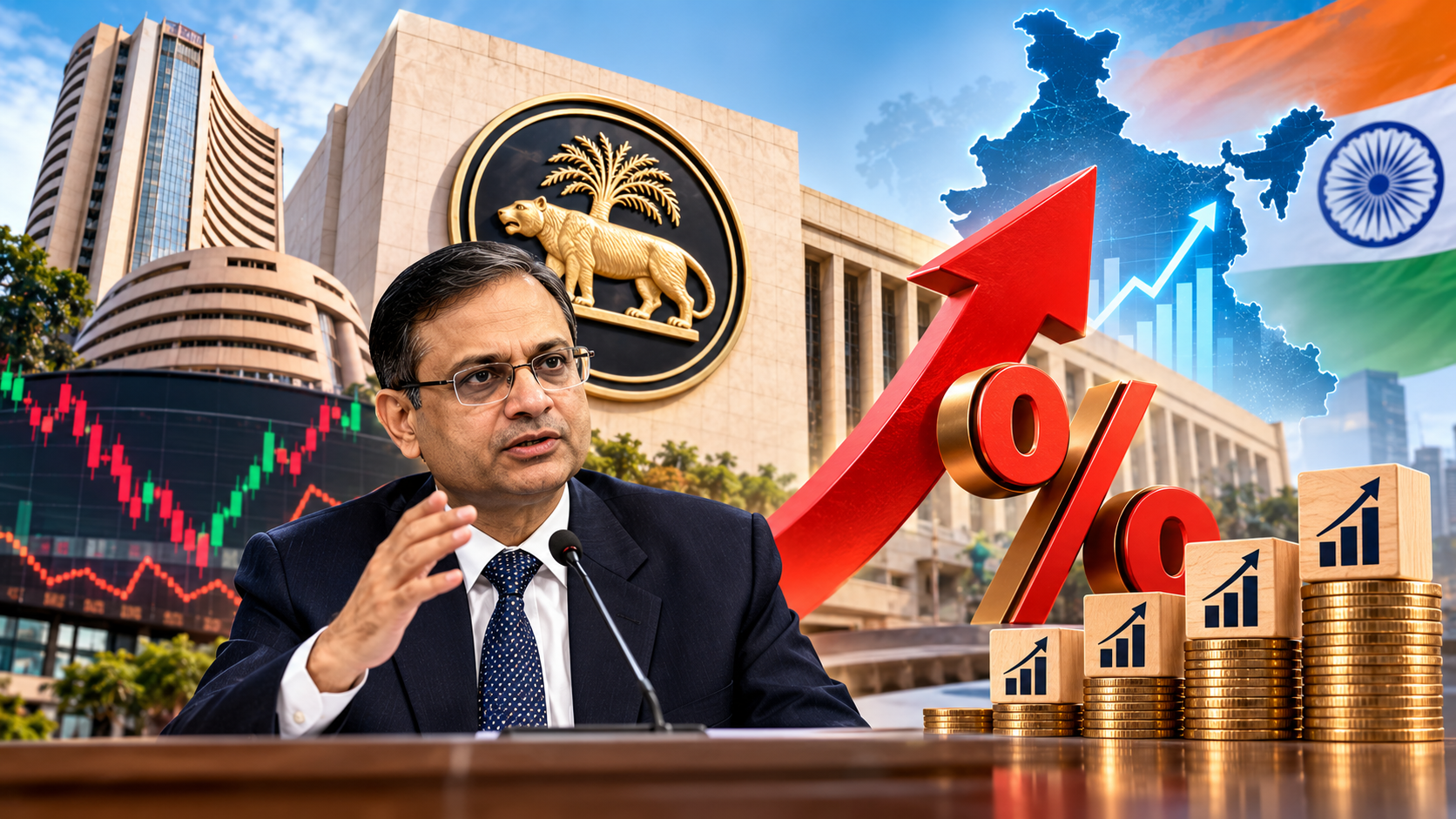
Central bank raises repo rate by 25 basis points and shifts stance to calibrated tightening, while higher inflation projections keep markets cautious
The Reserve Bank of India (RBI) raised its benchmark repo rate by 25 basis points to 5.5 per cent on Wednesday, marking its first rate hike in four years as the central bank responded to rising inflationary pressures and tighter global financial conditions.
Alongside the rate increase, the RBI raised its real GDP growth projection for FY27 by 40 basis points to 7.1 per cent, signalling confidence in the resilience of domestic economic activity despite heightened global uncertainty.
The central bank also changed its monetary-policy stance to calibrated tightening, indicating a greater focus on containing inflation and managing emerging macroeconomic risks.
RBI Raises FY27 Growth Forecast
Governor Sanjay Malhotra said domestic economic activity has remained resilient despite global volatility.
The RBI now expects real GDP growth of 7.1 per cent in FY27. Growth is projected at 7.2 per cent in the second quarter, 6.9 per cent in the third quarter and 6.8 per cent in the fourth quarter.
For the first quarter of FY28, the central bank has projected economic growth at 7.1 per cent.
The upward revision to the annual growth forecast provides a positive signal for India's economic outlook and suggests that policymakers believe domestic demand and investment can withstand tighter financial conditions.
Inflation Forecast Raised to 5.2%
The RBI simultaneously raised its inflation projection for FY27 to 5.2 per cent.
According to Governor Malhotra, CPI inflation is projected at 4.9 per cent in Q2, 6 per cent in Q3 and 5.7 per cent in Q4. Inflation for the first quarter of the next financial year is projected at 5.6 per cent.
The central bank's decision reflects growing concerns over price pressures, particularly as higher commodity prices and global uncertainty threaten to feed into domestic inflation.
Core inflation also increased to 4.2 per cent in August after remaining unchanged for three consecutive months.
First Rate Hike in Four Years
The 25-basis-point repo rate increase marks a significant shift in the RBI's policy direction.
The move comes against a backdrop of elevated global bond yields, higher crude oil prices and currency-market pressure. With several major central banks also adjusting policy settings, the RBI is seeking to maintain macroeconomic stability while preventing inflation expectations from becoming entrenched.
The change to a calibrated tightening stance suggests that the central bank could remain alert to further inflationary risks and respond if price pressures intensify.
Markets Remain Volatile After Policy Decision
Indian equity markets initially reacted negatively to the rate hike, although benchmark indices recovered part of their losses after the RBI raised its growth forecast.
At around 10:22 AM, the Sensex was down 196.72 points, or 0.27 per cent, at 72,871.09, while the Nifty 50 declined 114.30 points, or 0.5 per cent, to 22,661.80.
Earlier, the Sensex had fallen around 290 points before recovering some of the losses.
The market reaction reflects the competing impact of the RBI's decision: higher interest rates are negative for liquidity and borrowing costs, while the stronger GDP forecast provides reassurance about India's underlying economic momentum.
Banking Stocks Outperform
Banking stocks showed relative resilience following the policy announcement.
The Nifty PSU Bank and Nifty Private Bank indices moved higher even as the broader benchmark indices remained under pressure.
A rate hike can have mixed implications for lenders. Higher lending rates can support interest income and margins on floating-rate loans, although rising deposit costs and weaker credit demand can offset some of these benefits.
The RBI's assessment that credit growth is expected to remain robust and broad-based across sectors provided additional support to banking stocks.
Metal Stocks Under Pressure
The Nifty Metal index emerged as the biggest sectoral laggard during the morning session.
Higher interest rates and concerns over global economic conditions can weigh on cyclical sectors, particularly when investors are reassessing commodity demand and growth prospects.
Among Nifty 50 stocks, Titan Company, SBI Life Insurance and Hindalco Industries were among the notable losers during the session.
Foreign Portfolio Outflows Remain a Concern
RBI Governor Sanjay Malhotra said foreign portfolio investors recorded a net outflow of $10.3 billion from the Indian market during the period up to October 5.
Persistent foreign selling has remained an important headwind for Indian equities, particularly amid higher US bond yields and uncertainty over global monetary policy.
The RBI's policy tightening could add to the pressure if higher domestic yields make financing conditions more restrictive, although stronger economic growth could help improve investor confidence over the medium term.
Forex Reserves Remain Comfortable
Despite external pressures, India's foreign exchange reserves remain adequate, according to the RBI.
The central bank said reserves provide around 11 months of import cover, while the country's external debt is covered by reserves to the extent of 94.4 per cent.
The relatively strong reserve position provides policymakers with a buffer against external shocks and sudden movements in capital flows.
Current Account Deficit Remains Manageable
The RBI also highlighted India's external-sector resilience.
Governor Malhotra said the current account deficit remained well below sustainable levels during the first quarter of the financial year.
A manageable current account deficit reduces pressure on the rupee and provides greater flexibility for monetary authorities to respond to global economic developments.
RBI to Set Up Financial Markets Consultative Committee
The RBI announced plans to constitute a consultative committee for financial markets.
The proposed forum will provide a structured platform for engagement between the central bank and market participants, particularly on operational issues affecting financial markets.
The move is expected to improve communication between regulators and participants across bond, currency and other financial markets.
Credit Growth Expected to Stay Strong
Despite tighter monetary policy, the RBI expects credit growth to remain robust and broad-based across sectors.
This is an important positive signal for banks and the wider economy because sustained credit expansion can support consumption, corporate investment and infrastructure activity.
However, the impact of the rate hike on borrowing costs will need to be monitored closely in the coming quarters.
Market Outlook
The RBI's October policy decision presents a mixed picture for Indian markets. The 25-basis-point repo rate hike to 5.5 per cent and the shift towards calibrated tightening are negative from a liquidity and borrowing-cost perspective, while the 40-basis-point increase in the FY27 GDP forecast to 7.1 per cent provides a strong counterbalance.
The key market trigger from here will be the trajectory of inflation. With the RBI raising its FY27 inflation projection to 5.2 per cent, investors are likely to closely monitor crude oil prices, bond yields, the rupee and upcoming inflation data.
Banking stocks could remain relatively resilient if credit growth stays strong, while rate-sensitive and highly leveraged sectors may face greater pressure. Overall, volatility is likely to remain elevated as markets digest the RBI's more cautious monetary-policy stance alongside the stronger domestic growth outlook.