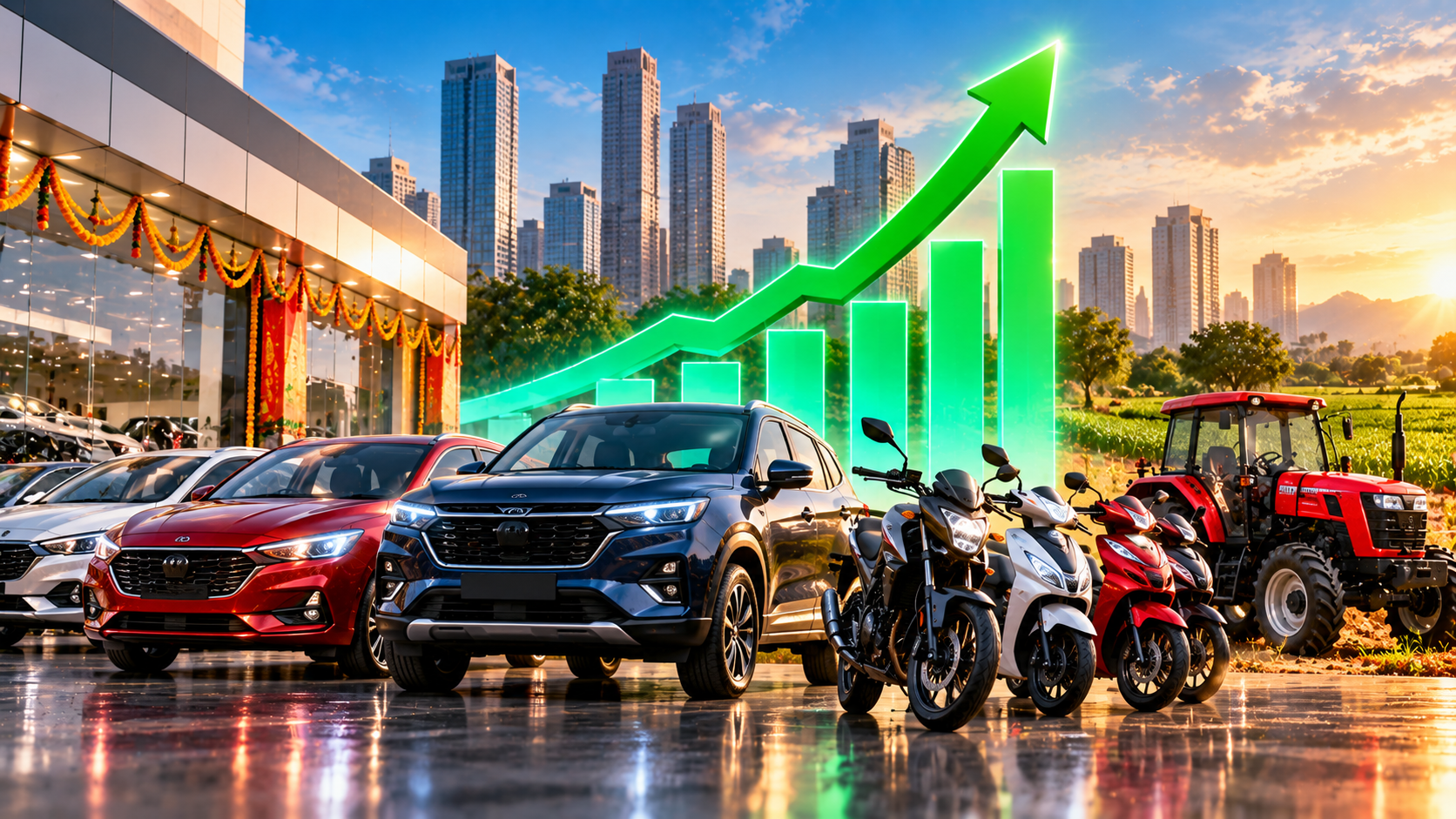
Dealers sold 2.54 million vehicles in September as passenger-vehicle demand and two-wheeler sales drove a sharp year-on-year recovery, although weak rural conditions continue to weigh on tractors
India’s automobile retail market recorded a strong recovery in September, with dealers selling 2.54 million vehicles, up 31.82% from around 1.92 million units a year earlier, according to data from the Federation of Automobile Dealers Associations (FADA).
The sharp year-on-year increase highlights resilient consumer demand across important parts of the automobile industry, particularly passenger vehicles and two-wheelers. The performance also comes ahead of the festive season, which is expected to provide an additional boost to vehicle purchases during October.
Passenger Vehicles and Two-Wheelers Drive Growth
Passenger vehicles and two-wheelers were the key contributors to the overall improvement in automobile retail sales.
Passenger-vehicle demand has remained relatively strong as consumers continue to spend on personal mobility, while manufacturers and dealers have been using new model launches, promotional offers and financing schemes to support sales.
Two-wheelers are also an important indicator of mass-market consumption. Stronger retail demand in this segment suggests that a significant section of consumers continues to spend on mobility despite concerns over inflation, interest rates and the broader economic environment.
The combination of urban demand and improved affordability has therefore helped the automobile sector maintain momentum.
Festive Season Could Provide Further Support
September's numbers are particularly important because the festive period began later this year compared with the previous year.
With major festivals falling in October, dealers are expecting stronger showroom activity and vehicle deliveries in the coming weeks. Festive purchases traditionally account for a significant share of annual automobile sales, particularly in passenger vehicles and two-wheelers.
The September performance could therefore represent the beginning of a stronger demand cycle rather than the peak of the current retail recovery.
However, the eventual strength of the festive season will depend on consumer confidence, financing costs, vehicle prices and rural purchasing power.
Rural Demand Remains a Concern
Despite the strong overall numbers, the automobile market is showing a clear divergence between urban and rural demand.
India experienced its weakest monsoon in more than a decade during the June-September season, with rainfall around 12.6% below normal. Since rural incomes and agricultural activity are closely linked to monsoon conditions, the shortfall has created pressure on farm incomes and discretionary spending.
The weakness is particularly visible in the tractor segment. Dealers sold 76,906 tractors in September, down from 87,977 units in August, representing a 12.6% sequential decline.
This indicates that while urban consumers are supporting passenger-vehicle demand, rural markets remain vulnerable to weather-related income pressures.
Tractor Sales Highlight Rural Stress
The tractor market is an important indicator of rural economic activity because purchases are closely connected to farm incomes, crop prospects and agricultural cash flows.
The decline in tractor sales during September suggests that farmers and rural households have become more cautious about large-ticket purchases following uneven rainfall and concerns over crop output.
The delayed festive season may have added to the weakness, as some purchases that would normally have taken place in September may have shifted into October.
A recovery in rural automobile demand will therefore depend heavily on agricultural income, crop conditions and the performance of the upcoming festive season.
Automakers Face a Pricing Challenge
Another factor that could influence demand in the coming quarters is the increase in vehicle prices.
Automakers have been raising prices to offset higher input and operating costs. While the industry has benefited from tax-related affordability gains, repeated price increases could gradually reduce some of the benefit enjoyed by consumers.
Dealers have therefore warned that additional price hikes could affect purchasing decisions, particularly among price-sensitive buyers.
For two-wheelers and entry-level passenger vehicles, where affordability plays a critical role in purchase decisions, even moderate increases in monthly financing costs or vehicle prices can influence demand.
Strong Retail Demand Supports Auto Industry
The September retail numbers nevertheless provide a positive signal for the automobile industry.
Higher dealer sales can improve inventory movement and reduce the risk of excessive stock accumulation. Strong retail demand can also encourage manufacturers to maintain production levels and increase dispatches during the festive period.
For automobile companies, suppliers, financing companies and component manufacturers, a sustained improvement in retail volumes could translate into stronger business activity across the broader automotive ecosystem.
The performance of passenger vehicles is particularly important because the segment has a significant contribution to the industry's overall revenue and profitability.
Electric Vehicles Remain an Important Growth Area
India’s automobile market is also undergoing a structural shift towards electric mobility.
While the September headline numbers are dominated by overall vehicle sales, increasing consumer interest in electric two-wheelers, passenger vehicles and commercial mobility is gradually changing the competitive landscape.
Manufacturers are expanding their EV portfolios while charging infrastructure and financing options continue to improve. The pace of EV adoption will remain an important factor for both traditional automobile manufacturers and newer electric-mobility companies.
October Sales Will Be Closely Watched
The October retail numbers could provide a clearer picture of whether the September momentum can be sustained.
The festive season, improved consumer sentiment and strong passenger-vehicle demand could support sales, while rural weakness and higher vehicle prices remain potential headwinds.
Investors will also track company-level sales announcements to determine which manufacturers are gaining market share and whether the industry's growth is broad-based.
Market Outlook
The September automobile retail data is broadly positive for the sector, with overall sales rising 31.82% year-on-year to 2.54 million vehicles. Strong passenger-vehicle and two-wheeler demand points to resilient consumer spending and creates a favourable setup for the festive season.
However, the sharp decline in tractor sales highlights an important weakness in rural demand. Poor monsoon conditions, lower farm incomes and higher vehicle prices could limit the pace of recovery outside urban markets.
The next key indicator will be October festive-season sales. If passenger vehicles and two-wheelers maintain their momentum while rural demand begins to recover, the automobile sector could enter the second half of the year with stronger growth visibility. On the other hand, continued weakness in tractors and rural-linked segments would indicate that the recovery remains uneven.