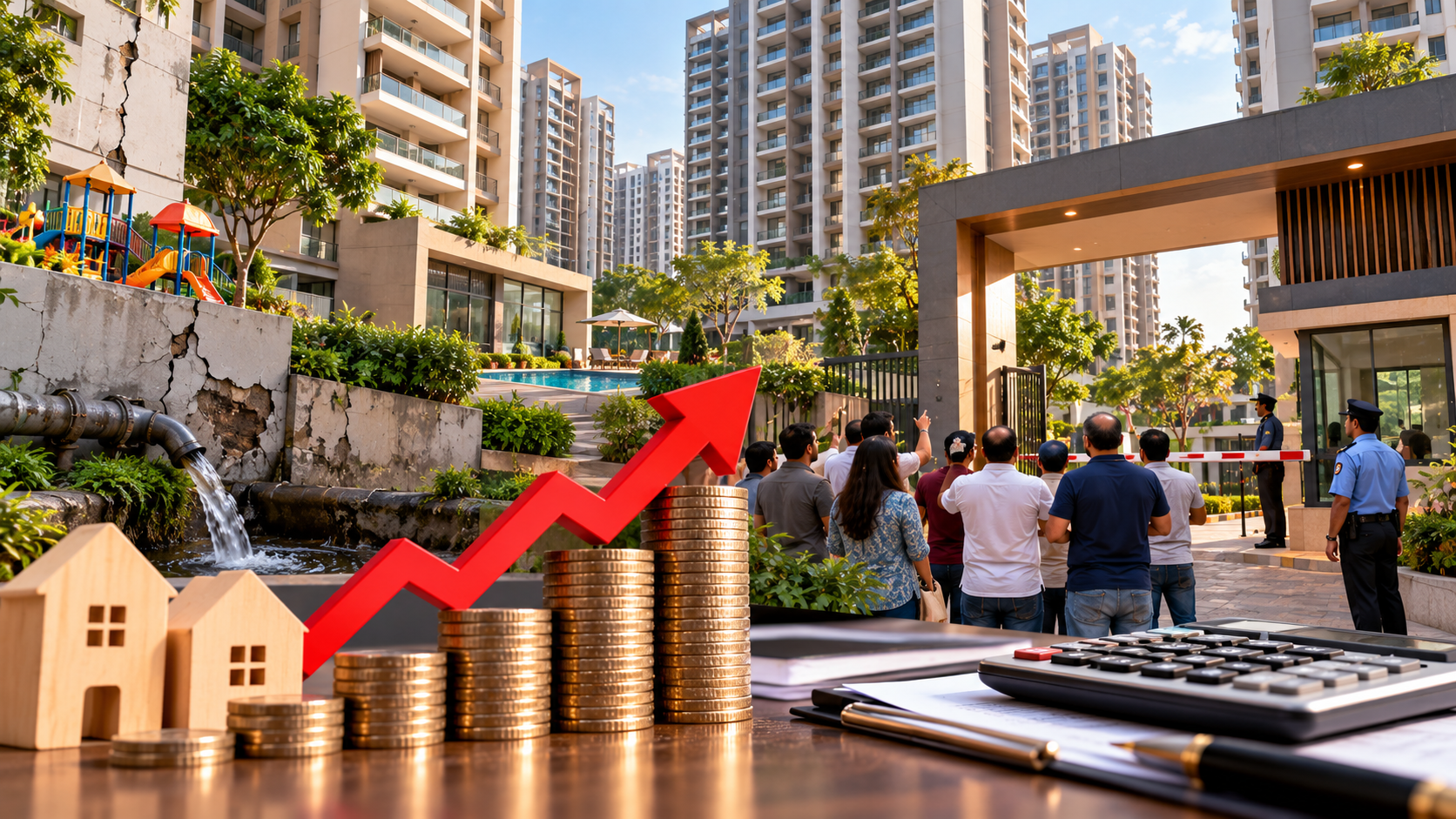
A sharp increase in common-area maintenance charges at a Gurugram township highlights why buyers must evaluate recurring costs, promised amenities and infrastructure before purchasing a property
A dispute over a nearly 90 per cent increase in common-area maintenance (CAM) charges at a Gurugram township has put the spotlight on an often-overlooked component of property ownership.
Residents of The Westerlies in Sector 108 have protested against the increase, alleging that several promised amenities and basic infrastructure facilities remain incomplete or inadequate. The Resident Welfare Association (RWA) has sought greater transparency from the developer and maintenance agency, including audited accounts and details of maintenance expenditure.
The dispute serves as a broader reminder for prospective homebuyers: the cost of purchasing a property does not end with the sale price, stamp duty, registration charges and home-loan EMI. Recurring maintenance expenses can materially affect the total cost of ownership, particularly in large gated townships.
CAM Charges Rise From ₹10 to ₹19 Per Square Yard
According to the RWA, monthly CAM charges at the township have increased from ₹10 to ₹19 per square yard over the past two years.
That represents an increase of around 90 per cent.
Residents have questioned the basis for the increase and are seeking information on how the maintenance charges are being utilised. They have also demanded greater transparency regarding vendors and expenditure on common facilities.
The RWA has sought a rollback to the last undisputed rate until the dispute is considered by the Haryana Real Estate Regulatory Authority (HRERA).
Why a 90% Increase Matters to Homeowners
Maintenance charges may appear relatively small when viewed on a per-square-yard basis, but the actual monthly amount can become significant for larger properties.
For example, a 300-square-yard property at ₹19 per square yard would attract a monthly CAM charge of ₹5,700, assuming the stated rate applies to the entire area. That translates into ₹68,400 a year.
This expense would be in addition to home-loan EMIs, property tax, insurance, electricity, water charges, repairs and other household expenses.
A significant increase in recurring charges can therefore affect the affordability of a property even after the purchase has been completed.
Dispute Goes Beyond Maintenance Bills
The concerns raised by residents are not limited to the increase in CAM charges.
According to the RWA, residents have also raised questions regarding the condition and availability of several common facilities and infrastructure services.
Among the issues cited are damaged sections of perimeter fencing and boundary walls, ineffective boom barriers and RFID-based entry systems, and the absence of a visitor-management system at one of the gates.
Residents have also raised concerns about sewage capacity, parks, the community club, power backup, roads and drainage.
The allegations reported by PTI have not been independently established, and the developer and maintenance agency had not responded to repeated attempts for comment, according to the report.
Sewage and Infrastructure Need Special Attention
Large townships require infrastructure capable of supporting their current population as well as future occupancy.
Residents at the Gurugram township have alleged that the existing trunk sewage line is inadequate for a development containing around 900 plots.
The RWA has sought an independent technical audit of the sewage network and its augmentation.
For buyers, this highlights the importance of checking infrastructure capacity rather than simply assessing the appearance of a township.
Roads, drainage, sewage, electricity backup, water supply and security systems can have a significant impact on the long-term living experience and future maintenance costs.
Promised Amenities Should Be Verified
A property brochure can list a large number of amenities, but buyers should verify whether those facilities are actually operational.
In the current dispute, residents have raised concerns over the non-operational community club and certain common facilities that they say have not been handed over.
Before buying a property, prospective homeowners should physically inspect major amenities and confirm their status in writing wherever possible.
It is also important to understand who is responsible for operating and maintaining each facility and whether additional charges will be imposed for their use.
Maintenance History Is More Important Than the Current Rate
Buyers should not rely solely on the maintenance charge quoted during a property visit.
A better approach is to request the historical maintenance bills and understand how the charges have changed over the past few years.
Questions worth asking include:
-
What is the current CAM rate?
-
When was it last increased?
-
Is there a formula for future revisions?
-
Who has the authority to revise the charges?
-
Are there separate charges for specific amenities?
-
Are sinking-fund or major-repair charges applicable?
-
Are utility charges included or billed separately?
Understanding the historical trend can help a buyer estimate the potential long-term cost rather than basing the decision on today's bill.
Ask for Transparency in Maintenance Accounts
A recurring maintenance charge should be accompanied by reasonable transparency regarding its utilisation.
Prospective buyers should ask whether residents have access to audited accounts, annual expenditure statements or information about major maintenance contracts.
Vendor contracts and facility-management arrangements can also influence the cost of maintaining a township.
A transparent accounting mechanism can help residents understand why charges increase and whether higher expenses are supported by corresponding improvements in services.
Check the Handover Status of Common Areas
Another important due-diligence step is determining which facilities have formally been handed over and to whom.
Buyers should establish whether responsibility lies with the developer, a facility-management company, the RWA or another entity.
The handover status can affect who pays for repairs, who controls maintenance contracts and how disputes are resolved.
This becomes particularly important in large developments where construction and occupation may happen in phases.
Infrastructure Can Affect Long-Term Property Value
The quality of common infrastructure is not merely a lifestyle issue. It can also influence resale value.
Poor drainage, inadequate sewage capacity, deteriorating roads, weak security infrastructure or non-functional amenities may reduce the attractiveness of a township to future buyers.
Conversely, well-maintained common areas and properly functioning facilities can strengthen the overall appeal of a development.
Homebuyers should therefore treat infrastructure quality as part of the property's investment assessment rather than considering only the apartment, villa or plot itself.
Understand the Dispute-Resolution Mechanism
Buyers should also understand what options residents have if disagreements arise over maintenance charges or deficient services.
The current RWA has indicated that it may approach HRERA, the Gurugram Metropolitan Development Authority, the district administration and other competent authorities if its concerns are not addressed.
For prospective buyers, the lesson is to understand the applicable agreement terms and the mechanisms available for resolving disputes before entering into a transaction.
Relevant documents should be reviewed carefully, particularly clauses relating to maintenance, escalation, handover and common-area management.
Homebuyers Should Calculate Total Cost of Ownership
The most important lesson from the dispute is that property affordability should not be measured solely by the purchase price.
A realistic calculation should include:
Property price + stamp duty and registration + brokerage + home-loan interest + maintenance/CAM + property tax + insurance + utilities + expected repairs and other recurring charges.
For a large township, even a seemingly modest annual increase in maintenance charges can materially change the household budget over a long ownership period.
A Practical Checklist Before Buying
Before purchasing a home in a gated township, buyers should verify:
-
Current CAM and maintenance charges
-
Maintenance charges for the previous three to five years
-
Formula and authority for future increases
-
Audited maintenance accounts
-
Status of promised amenities
-
Handover status of common areas
-
Sewage and drainage capacity
-
Water and electricity arrangements
-
Power-backup infrastructure
-
Internal roads and street lighting
-
Security and visitor-management systems
-
RWA structure and maintenance responsibilities
-
Pending litigation or regulatory disputes
-
Additional charges for clubs and facilities
-
Terms governing future maintenance revisions
These checks can provide a much clearer picture of the actual financial commitment involved in buying the property.
The Bigger Lesson for Property Buyers
The Gurugram dispute demonstrates why recurring ownership costs deserve as much attention as the initial purchase price.
A property may appear affordable at the time of purchase, but rising maintenance charges can increase the monthly financial burden over time. The risk becomes more significant when higher charges are accompanied by concerns over incomplete amenities or inadequate infrastructure.
Buyers should therefore treat maintenance arrangements, service quality and future cost escalation as important elements of property due diligence.
Market Outlook
The dispute over CAM charges in Gurugram highlights a broader trend in India's residential real estate market: homeownership is increasingly about managing the total cost of ownership, not simply buying the property.
For buyers, the key takeaway is to examine maintenance contracts, historical charges, infrastructure quality and amenity handover before committing to a township.
A property with a slightly higher purchase price but transparent and predictable maintenance costs may ultimately be more affordable than a seemingly cheaper property where recurring charges can rise sharply.
Before signing the agreement, buyers should ask one simple question: “What will this property cost me every month—not just today, but five and ten years from now?” That calculation can be just as important as the property's purchase price.