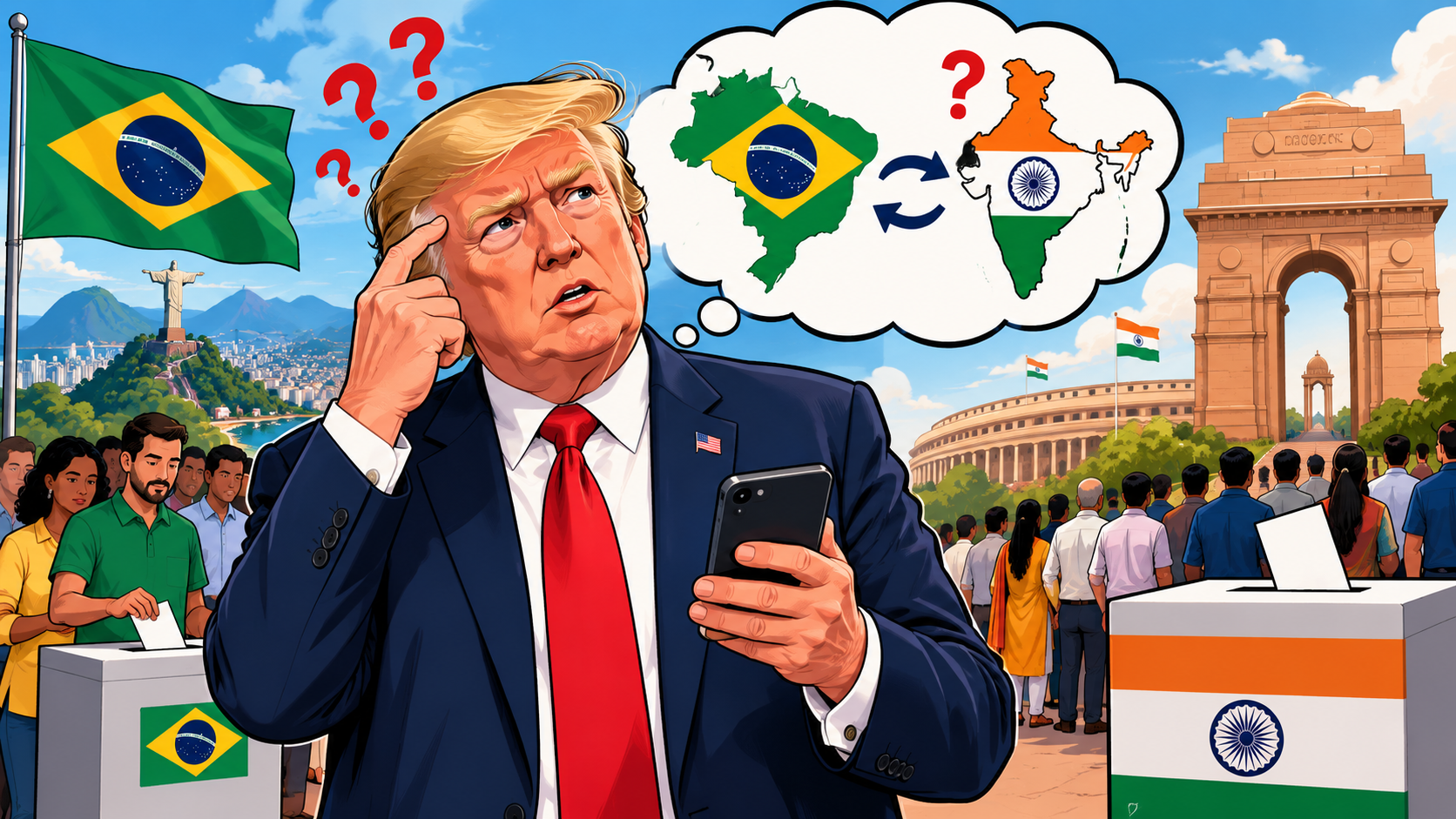
US President Donald Trump incorrectly refers to Brazil’s presidential vote as an Indian election while praising rapid vote counting and criticising the US electoral system
US President Donald Trump triggered confusion on social media after apparently mixing up Brazil and India while commenting on Brazil’s presidential election.
In a post on Truth Social, Trump said that around 125 million people had voted in what he described as the “first round of India’s Presidential Election”. His comments, however, appeared to refer to Brazil, which held the first round of its presidential election on Sunday.
The error quickly attracted attention because India does not conduct a nationwide direct election for its president, while the voter numbers and timing referenced by Trump closely aligned with the Brazilian election.
Trump Praises Speed of Vote Counting
Trump’s broader argument focused on the speed with which election results were produced.
He highlighted the large number of votes counted within a relatively short period and contrasted that with the time sometimes required to finalise results in parts of the United States.
The US president used the comparison to renew his criticism of the American electoral system, referring specifically to vote counting in places including Detroit, Philadelphia and California.
His remarks formed part of his longstanding criticism of election administration in the United States. However, the incorrect identification of the country became the most widely discussed element of the post.
Trump Appears to Have Been Referring to Brazil
Although Trump did not mention Brazil in the post, the timing and numbers strongly indicated that he was discussing the Brazilian presidential election.
Brazil held the first round of its presidential election on October 4, with more than 159 million people eligible to participate.
Incumbent President Luiz Inácio Lula da Silva and Senator Flávio Bolsonaro emerged as the two leading candidates. Neither secured the support required to win outright in the first round, sending the contest to a runoff scheduled for October 25.
The election has attracted international attention because of Brazil's economic and geopolitical importance as Latin America's largest economy.
Brazil’s Electronic Voting System Delivers Results Quickly
Brazil has operated an electronic voting system for decades, allowing election authorities to process results relatively quickly after polling closes.
The speed of Brazil’s election results appeared to be the central point Trump intended to highlight.
Electronic voting machines are used across the country, with votes transmitted and consolidated electronically. This allows authorities to report a substantial portion of the results within hours.
The system has frequently drawn international attention because Brazil combines a large electorate spread across a vast geographic area with relatively rapid vote tabulation.
India Does Not Directly Elect Its President
Trump’s reference to an Indian presidential election was factually incorrect because India does not choose its president through a nationwide popular vote.
The President of India is elected indirectly by an electoral college.
The electoral college consists of elected members of both Houses of Parliament and elected members of the legislative assemblies of states and eligible Union Territories.
Ordinary voters therefore do not cast ballots directly for presidential candidates.
India's presidential election process is fundamentally different from Brazil's system, where citizens directly vote for presidential candidates.
India's next presidential election is also not scheduled for 2026.
Social Media Users React to the Mix-Up
The geographical error quickly generated reactions across social media.
Users questioned why Trump had referred to an Indian presidential election when the voting taking place was in Brazil. Others pointed out the fundamental differences between the political systems of the two countries.
Some responses were humorous, while others questioned how such a mistake appeared in a public statement from the US president.
The incident became particularly noticeable because India and Brazil are both major emerging economies but have very different presidential election systems.
Trump Uses Brazil Vote to Renew US Election Criticism
Beyond the country mix-up, Trump's post was intended to make a broader political argument about election administration in the United States.
He contrasted Brazil's rapid vote tabulation with delays that can occur in some American jurisdictions.
The United States has a decentralised election system in which individual states establish many of their own voting, counting and certification procedures. Differences in mail voting rules, ballot-processing regulations and reporting procedures mean that final results can take varying amounts of time.
A slower count, however, does not by itself demonstrate fraud or corruption.
Trump nevertheless used the comparison to repeat his criticism of the US electoral system.
Brazil Heads Toward October 25 Runoff
Attention in Brazil is now shifting toward the second round of voting.
With neither leading candidate securing an outright first-round victory, Lula da Silva and Flávio Bolsonaro are set to compete in the runoff on October 25.
The contest could have implications beyond domestic Brazilian politics.
Brazil is a major exporter of commodities including iron ore, crude oil, soybeans, coffee and sugar. It is also an influential member of BRICS and an increasingly important participant in discussions around global trade, climate policy and emerging-market cooperation.
The direction of economic policy following the election will therefore be closely watched by international investors.
Why Brazil’s Election Matters for Global Markets
Brazil is one of the world's largest emerging economies and an important player across commodities, agriculture, energy and mining.
Political developments can influence expectations around fiscal policy, government spending, privatisation, infrastructure investment, environmental regulation and management of state-linked companies.
Investors will consequently monitor signals from both presidential candidates ahead of the runoff.
Currency markets will also watch the Brazilian real, while international investors could reassess exposure to Brazilian equities depending on expectations around economic and fiscal policy.
India-Brazil Relations Remain Strategically Important
Despite Trump's apparent mix-up, India and Brazil have increasingly important economic and diplomatic ties.
Both countries are members of BRICS and the G20 and cooperate across areas including trade, energy, agriculture, pharmaceuticals and multilateral diplomacy.
Brazil is an important supplier of commodities, while India represents one of the world's largest and fastest-growing consumer markets.
The two countries also share interests in reforming global institutions and increasing the representation of emerging economies in international decision-making.
Global Attention Now Turns to Brazil’s Runoff
The social-media controversy surrounding Trump's post is likely to fade, but Brazil's presidential contest will remain important for international markets.
The October 25 runoff will determine the country's political leadership and could shape economic policy in Latin America's largest economy.
Investors will watch fiscal commitments, commodity policy, infrastructure plans and the direction of Brazil's relationships with major partners including the United States, China and India.
For now, Trump's post has attracted attention for an entirely different reason: an attempted comparison of election systems became a viral political moment after the US president apparently mistook Brazil's presidential election for India's.