Teacher Shortages, Overcrowded Classrooms and Poor School Conditions Fuel Nationwide Student Protests as Demonstrations Spread From Paris to Other French Cities
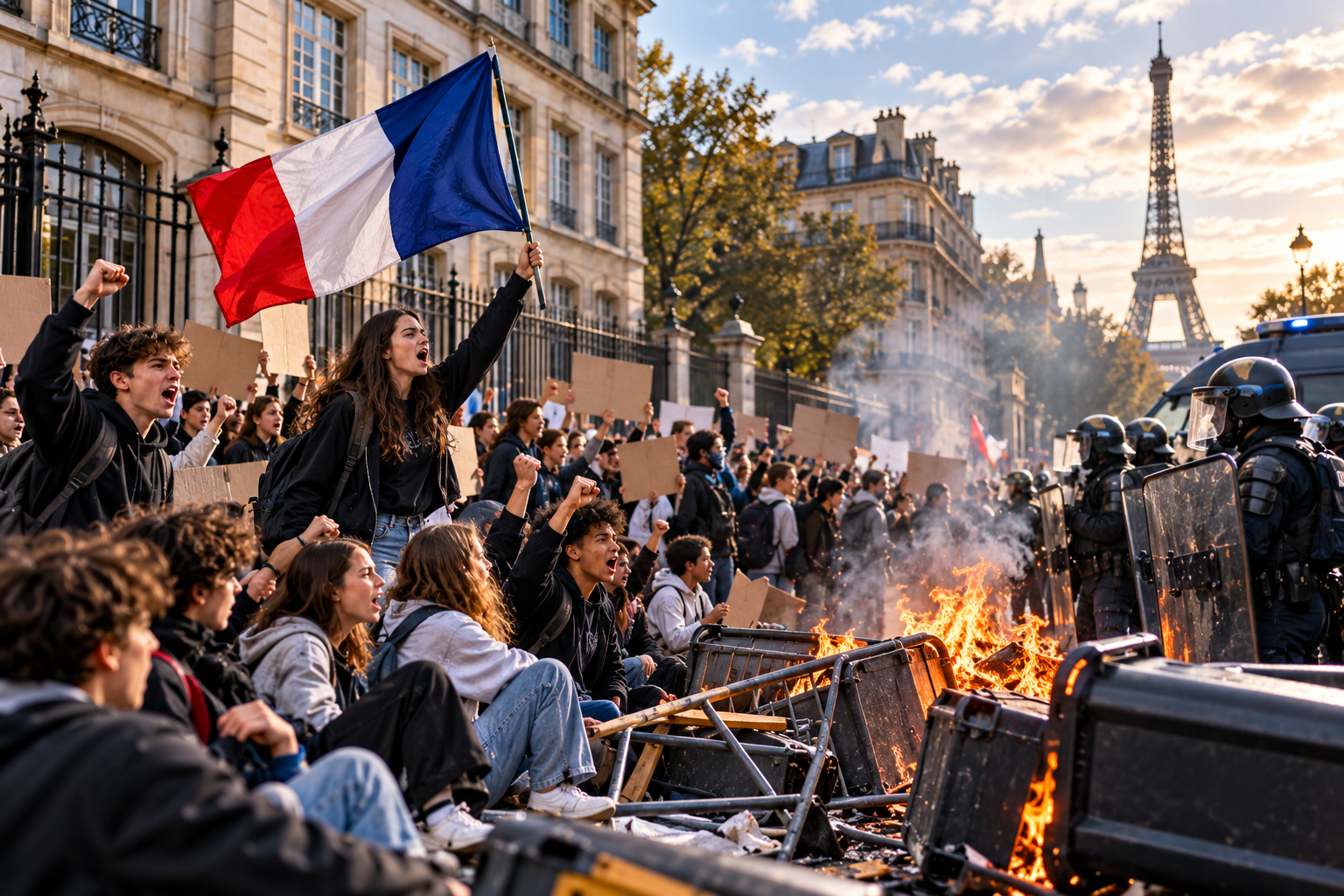
Thousands of students have taken to the streets and blocked high schools across France, protesting what they describe as worsening conditions in the country's education system.
The demonstrations, which began in September, have expanded from the Paris region to cities including Montpellier, Nantes and Marseille. What initially centred on concerns raised by teachers has developed into a wider student movement involving school closures, blockades and clashes with police.
The unrest has created significant disruption to education, with authorities reporting that hundreds of educational establishments have been affected.
Education System at the Centre of the Protests
The protests are primarily taking place at lycées, France's public upper-secondary schools attended generally by students between the ages of 15 and 18.
Students have raised several concerns about the day-to-day functioning of schools.
Among their main complaints are shortages of teachers, frequent teacher absences, overcrowded classrooms, inadequate facilities and demanding school schedules.
Some students have also criticised timetables that can extend from around 8 am until 6 pm, arguing that such long school days contribute to fatigue and make learning more difficult.
The demonstrations therefore reflect concerns not only about staffing levels but also about the broader quality and organisation of education.
Protests Began With Support for Teachers
The movement can be traced back to September 17, when students at Saint-Exupéry High School in the Paris suburb of Créteil began demonstrating in support of teachers.
Teachers had been protesting over shortages of staff and resources.
The initial action subsequently spread as students at other schools joined the movement, turning concerns about staffing and resources into a nationwide campaign.
Authorities later agreed to provide additional staff at Saint-Exupéry High School, including a deputy principal and a nurse, after the situation there escalated.
However, the broader movement continued to grow.
Hundreds of Schools Affected
The scale of the disruption has increased significantly.
According to figures cited by Agence France-Presse, more than 5,000 people have been arrested since the protests began, while approximately 735 educational establishments have been affected.
The French government has also warned that hundreds of schools could face partial or complete closures as security concerns persist.
Education Minister Edouard Geffray said lessons at roughly 400 to 500 high schools could be partially or totally suspended where security conditions were considered inadequate.
The closures have added another layer of disruption for students and families already affected by the demonstrations.
Blockades Spread Across France
Students have erected blockades outside schools in several cities.
In some locations, bins and barriers were set on fire, while access to school buildings was prevented. There have also been reports of barriers being burned on tram tracks.
The demonstrations have extended beyond high schools as university students joined the movement.
A student union said access to around 30 university campuses, including campuses in Paris and Marseille, had been blocked.
The expansion to universities indicates that dissatisfaction is no longer confined to one level of the French education system.
Protests Turn Violent in Some Areas
Although the movement centres on education-related grievances, some demonstrations have developed into violent confrontations.
Several school principals have reportedly faced harassment, assaults or injuries during blockades.
Authorities have also reported dozens of injuries, including injuries linked to objects thrown during clashes and police riot-control measures.
Students have accused police of using excessive force, particularly through the use of tear gas and other crowd-control equipment.
The French government, meanwhile, has condemned incidents involving vandalism and violence while acknowledging that many of the underlying student concerns are legitimate.
Social Media Amplifies the Movement
Online platforms have played an important role in spreading the protests.
Dramatic videos and images from demonstrations have circulated widely, particularly on TikTok and other social-media platforms.
The rapid sharing of footage has helped students in different cities see events taking place elsewhere and has contributed to the movement's nationwide visibility.
However, the circulation of short and often highly emotional videos has also intensified tensions and made it more difficult to separate peaceful demonstrations from incidents involving violence or property damage.
Government Announces Measures
French Prime Minister Sebastien Lecornu said on Sunday that the government was taking additional steps to address concerns raised by students and education staff.
The measures include efforts to ensure that classes continue, improve school facilities and reorganise school schedules.
The government has also promised greater transparency around the French university admissions platform.
The response reflects an attempt to address both immediate disruptions and longer-term concerns surrounding the education system.
Government Condemns Vandalism
While acknowledging the legitimacy of student grievances, the government has drawn a clear distinction between peaceful protest and violence.
Lecornu said the government was accelerating consideration of a so-called “vandal-pays” bill, under which those responsible for property damage would be required to bear the cost of repairing it.
Authorities argue that students have a right to protest but that vandalism, attacks and disruption to public infrastructure cannot be accepted.
The approach has nevertheless failed to satisfy protest organisers.
Students Demand Concrete Action
Protest organisers have called for demonstrations to continue, arguing that the government's response has not yet produced sufficient concrete measures.
The central demand is for improvements that students can see directly in schools, including more teachers, better facilities and more manageable schedules.
The gap between government announcements and protesters' expectations has therefore become an important factor determining whether the demonstrations continue to escalate or gradually lose momentum.
Political Dimension Emerges
The protests have also acquired a political dimension.
France is entering a period of heightened political activity ahead of the next presidential contest, and the education protests have become part of wider political debate.
The government has accused the far-left France Unbowed party of encouraging the demonstrations.
Presidential candidate Jean-Luc Mélenchon has rejected the characterisation, saying his party has called for nonviolent methods of protest while criticising what it describes as a repressive government response.
The political debate could make it more difficult for authorities to separate the education issue from broader ideological divisions in French society.
Why Teacher Shortages Matter
At the heart of the protests is a problem affecting the functioning of schools: insufficient staffing.
Teacher shortages can result in cancelled classes, larger class sizes and greater pressure on existing staff.
For students, repeated teacher absences can disrupt academic continuity, particularly for those preparing for examinations or university admissions.
The issue also affects teachers, who may face heavier workloads and increased administrative pressure when schools operate below required staffing levels.
Addressing staffing shortages could therefore become one of the most important tests of the government's education response.
School Conditions Add to Student Frustration
Infrastructure and classroom conditions have emerged as another major grievance.
Students are demanding improvements to facilities and a learning environment that can accommodate growing educational needs.
For young people spending long hours at school, inadequate facilities can have a direct impact on comfort, concentration and overall learning outcomes.
The protests therefore reflect a broader demand for investment in public education rather than a dispute limited to teacher numbers.
What Happens Next?
The immediate challenge for the French government is to restore normal school operations while addressing the concerns that triggered the protests.
Authorities must also prevent further violence and protect students, teachers, school administrators and public infrastructure.
For protesters, the next phase will depend on whether government announcements translate into visible changes in schools.
If students believe that staffing, facilities and schedules are not improving, demonstrations could continue and potentially expand.
If authorities deliver measurable improvements and establish a credible dialogue with students and teachers, tensions could begin to ease.
Market and Economic Outlook
Although the protests are centred on education rather than financial markets, prolonged nationwide disruption could have broader economic implications if it affects transportation, public services or consumer activity.
The immediate impact is likely to remain limited because the demonstrations are concentrated around educational institutions. However, sustained unrest could increase political uncertainty and put additional pressure on the French government's ability to implement public-sector reforms.
For policymakers, the episode highlights the growing importance of investment in public education, staffing and infrastructure.
For France, the larger question extends beyond the current protests: whether the government can expand and modernise the education system while maintaining fiscal discipline and public confidence.
The coming weeks will determine whether the movement remains primarily an education protest or develops into a broader political and social challenge.