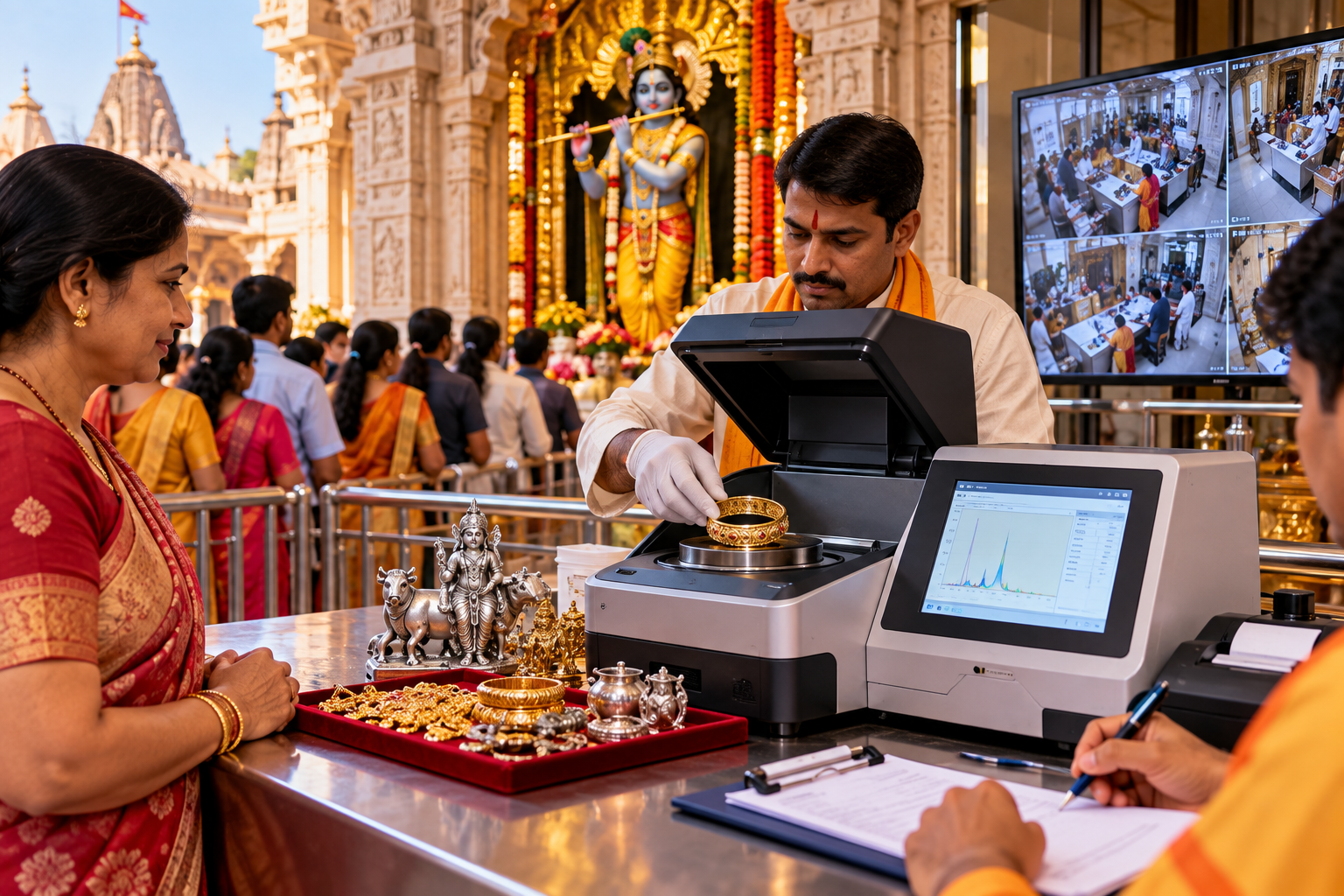
Sri Krishna Janmasthan Sewa Sansthan plans to begin non-destructive metal purity testing from October 11, with devotees receiving individual test reports as part of a broader effort to strengthen transparency in donation management.
The Sri Krishna Janmasthan Sewa Sansthan in Mathura, Uttar Pradesh, is set to introduce an advanced computerised testing machine to assess the purity of metal donations received at the temple. The initiative aims to make the handling and evaluation of donated metals more transparent by providing devotees with documented information about their contributions.
According to Sewa Sansthan Secretary Kapil Sharma, the machine is expected to become operational from October 11, coinciding with the beginning of Navratri. It will be capable of testing the presence of 20 different metals, allowing the temple trust to examine metal donations through a more systematic process.
Devotees to Receive Individual Purity Reports
Under the proposed procedure, metal purity testing will take place in the presence of the devotee making the donation. The donor will receive a copy of the test report along with the donation receipt, creating a documented record of the transaction.
Sharma said the report will also carry the devotee’s mobile phone number and require the donor’s signature. The Sewa Sansthan will retain another copy in its archives for record-keeping and future reference.
This process is intended to establish a clearer documentation trail for metal donations, allowing both the temple administration and donors to maintain records of the material submitted and the results of its purity assessment.
Non-Destructive Testing to Preserve Donated Items
A key feature of the new machine is that it can test metal purity without requiring the donated item to be broken or damaged. According to Sharma, the assessment can be conducted while the metal remains in its original form.
This could be particularly relevant for donations made in the form of jewellery or other metal objects whose physical condition donors may wish to preserve. The trust has not disclosed further technical specifications of the machine in the information provided.
The ability to conduct testing without damaging an item is expected to make the process more convenient while allowing the temple to assess the metal content of donations during the counting procedure.
Metal Donations to Be Tested Under CCTV Surveillance
The temple trust plans to test all metal donations received through hundis, or donation boxes, during the counting process. The procedure will take place under CCTV surveillance and according to the trust’s prescribed donation-counting system.
The administration has already introduced multiple monitoring measures to oversee the handling of donations. Sharma said advanced CCTV cameras record activities inside the counting room, while workers, security guards and independent observers remain present during the counting process.
The trust also preserves CCTV recordings for six months. These recordings provide a reference for reviewing activities carried out inside the counting area, while the presence of multiple personnel and observers adds another layer of supervision.
Strengthening Accountability in Temple Donation Management
Religious institutions receive donations in different forms, including cash, jewellery and other valuable materials. Recording, assessing and safeguarding these contributions requires processes that maintain accurate documentation and support accountability.
The proposed metal-testing system combines on-site assessment with individual reports, donor signatures and archived records. Together, these measures are intended to make the treatment of metal donations more traceable from the point of testing to the trust’s record-keeping process.
However, the information available does not specify the machine’s testing methodology, its accuracy standards, the types of items it can accommodate or whether additional verification will be used for disputed results. These details may become clearer once the system begins operating.
Outlook: A Technology-Based Approach to Donation Transparency
The introduction of computerised metal purity testing marks a technology-based step in the Sri Krishna Janmasthan Sewa Sansthan’s efforts to strengthen transparency in donation management. The planned system is designed to give devotees documented test results while preserving the donated item in its original form.
Its effectiveness will depend on how consistently the testing procedure is implemented, how records are maintained and how the trust handles cases in which a donor questions a result. As the machine is scheduled to become operational during Navratri, its implementation will provide an opportunity to assess how technology can support more structured and accountable processes for managing temple donations.