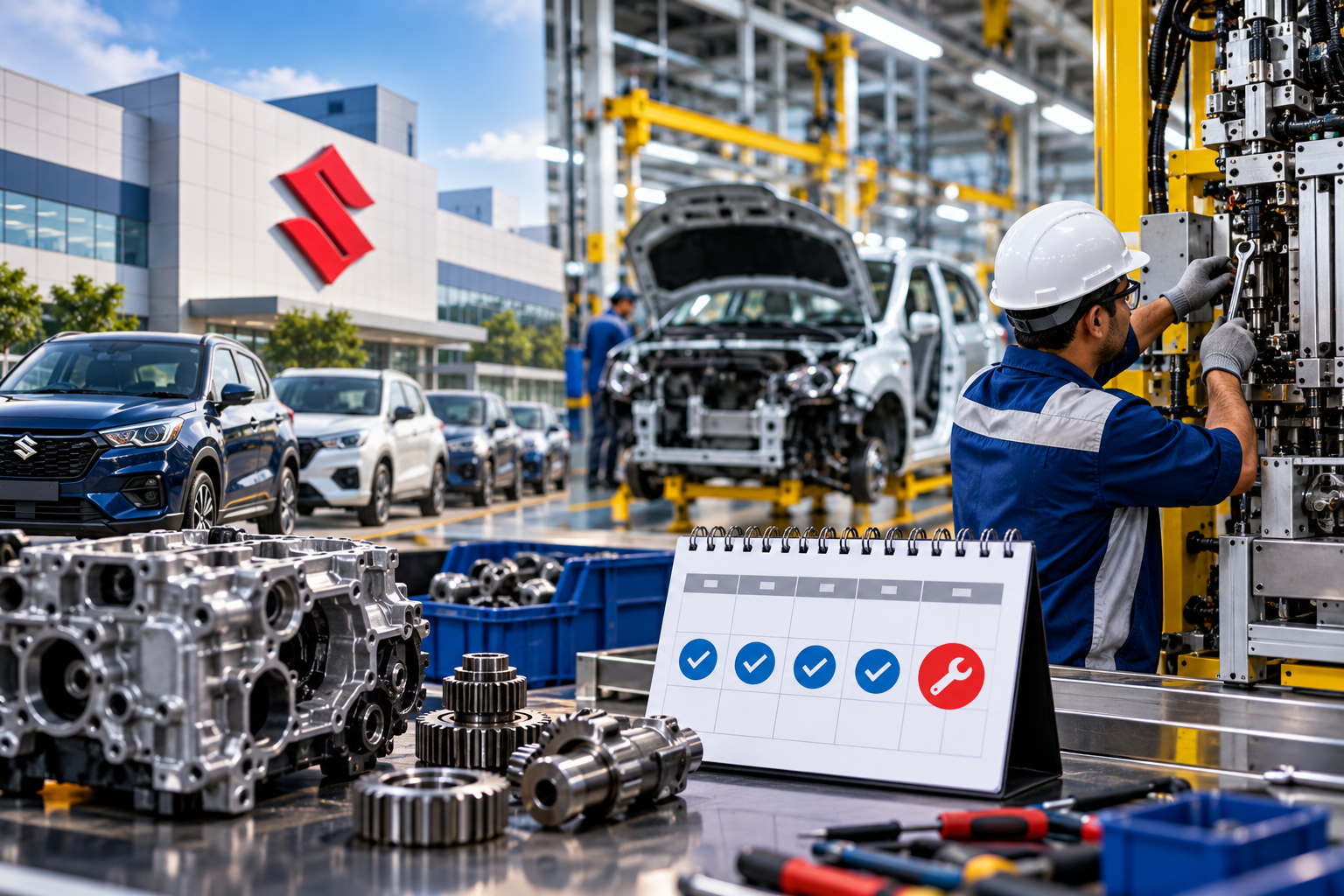
The Japanese automaker wants suppliers to provide daily machine downtime and a full weekly maintenance break to reduce production disruptions and improve quality, but the shift could increase costs and require fresh investments in manufacturing capacity.
Suzuki Introduces New Production Schedule for Indian Suppliers
Suzuki Motor Corporation has asked its Indian suppliers to stop production for one day each week to facilitate machinery maintenance, prevent unexpected breakdowns and maintain component quality as the company prepares to expand vehicle manufacturing in India.
According to a Reuters report, this is the first time Suzuki has issued such a directive to its Indian suppliers. The move comes as its Indian subsidiary, Maruti Suzuki India, targets annual production capacity of four million vehicles by 2030, compared with approximately 2.4 million currently.
The company is seeking a more disciplined manufacturing schedule across its supplier network, with an emphasis on equipment maintenance and operational reliability. As vehicle production increases, the availability and consistency of components will become increasingly important to keeping assembly lines running smoothly.
Maruti Suzuki did not provide a comment when contacted by Reuters for the report.
What Changes Under the New Production Model?
Suzuki wants suppliers to move towards an operating schedule of 20 hours a day, six days a week, by September 2027, according to people familiar with the matter cited by Reuters.
Under the proposed model, production machinery would receive approximately four hours of downtime each night, alongside one full day each week for maintenance.
The company’s president, Toshihiro Suzuki, reportedly discussed the six-day production schedule with suppliers during a meeting in India in August. Maruti Suzuki has since asked suppliers to sign declarations by the end of 2026 confirming that production lines supplying components to the automaker will not operate seven days a week.
The approach is intended to reduce the risks associated with continuous machine operation, including equipment failures, factory accidents, unexpected stoppages and quality problems.
For suppliers, however, the change will require a reassessment of production planning, maintenance schedules, workforce deployment and manufacturing capacity.
Why Suzuki Is Prioritising Quality and Reliability
Maruti Suzuki is preparing for a significant expansion in production as it seeks to strengthen its position in India's competitive passenger vehicle market. Higher output will place additional demands on suppliers producing components for engines, transmissions, safety systems and other vehicle assemblies.
When production equipment operates continuously without sufficient maintenance, the risk of wear-related failures and unplanned downtime can increase. A machine breakdown at a component supplier can disrupt deliveries and potentially interrupt vehicle assembly at the customer's factory.
Regular maintenance windows can help manufacturers inspect equipment, replace worn parts and identify problems before they lead to larger disruptions. More predictable maintenance schedules may also improve production planning and reduce the need for emergency repairs.
The proposed schedule reflects Suzuki's effort to strengthen manufacturing reliability ahead of its planned expansion. Its effectiveness, however, will depend on how suppliers implement the changes and whether the additional downtime is offset by improved productivity and fewer interruptions.
Maruti Suzuki Targets Four Million Vehicles by 2030
Maruti Suzuki's production ambition represents a substantial increase from its current annual output of approximately 2.4 million vehicles. Achieving the target will require coordination across vehicle assembly plants, component manufacturers, logistics providers and other parts of the supply chain.
The company is also preparing a series of vehicle launches ahead of 2030, while working to improve manufacturing efficiency and introduce new powertrain and safety technologies. Suzuki has separately outlined plans to halve vehicle development lead times by the end of the decade.
India has become Suzuki's largest market and an increasingly important manufacturing base for exports. The company is seeking to expand shipments to destinations including Japan and Europe, while Maruti Suzuki's exports to Japan, Europe and the Middle East were projected in the Reuters report to approach 500,000 units in 2026.
A reliable supplier network will be essential to supporting these ambitions. Component shortages, inconsistent quality or unplanned production stoppages could complicate efforts to raise output and meet delivery commitments.
Supplier Costs Could Rise as Production Hours Are Reduced
The new schedule could create financial and operational challenges for Indian component manufacturers.
Many suppliers traditionally operate machinery continuously throughout the week to maximise utilisation and spread fixed costs across a larger volume of production. Moving to a six-day schedule would reduce the time available for manufacturing unless companies increase capacity, improve productivity or reorganise their production processes.
Suppliers may therefore need additional machinery, expanded facilities or more efficient production lines to compensate for the reduced operating window. These changes could require capital expenditure at a time when commodity and raw material prices are already putting pressure on manufacturing costs, according to people cited by Reuters.
The financial impact will vary across suppliers. Companies with spare capacity, flexible production systems or opportunities to improve productivity may find it easier to adapt. Manufacturers already operating near their limits could face greater pressure to invest in additional equipment or reorganise operations.
The transition could also affect labour planning, shift arrangements, inventory management and delivery schedules. Suppliers will need to determine how to maintain the required component volumes without compromising the maintenance time sought by Suzuki.
Indian Auto Component Industry Faces a Capacity Challenge
India's passenger vehicle market has expanded considerably in recent years. The Reuters report cited domestic car sales reaching approximately five million vehicles in 2026, compared with around three million in 2019.
Growing demand creates opportunities for component manufacturers, but it also raises expectations around delivery reliability, production flexibility and quality standards.
Automakers increasingly depend on coordinated supply chains in which components arrive according to tightly scheduled production requirements. A disruption at one supplier can affect multiple stages of vehicle assembly, particularly when manufacturers maintain limited inventories.
Suzuki's directive could encourage suppliers to invest in preventive maintenance and manufacturing resilience. At the same time, the industry will need to balance equipment availability with the cost of maintaining additional production capacity.
For component makers, the challenge will be to preserve production volumes while ensuring that machinery receives sufficient maintenance. The changes could also prompt suppliers to examine automation, process efficiency and alternative ways of organising production.
Competition Adds Pressure to Maruti Suzuki's Expansion Plans
Maruti Suzuki remains a major participant in India's passenger vehicle market, but competition has intensified as domestic rivals Tata Motors and Mahindra & Mahindra have introduced vehicles with additional features and technology.
The competitive environment increases the importance of launching new products on schedule and maintaining consistent manufacturing quality. Production disruptions or component defects can affect delivery timelines, warranty costs and customer confidence.
Suzuki's proposed supplier schedule forms part of a broader manufacturing strategy focused on efficiency, quality and faster vehicle development. However, the impact on Maruti Suzuki's competitive position will depend on several factors, including product launches, consumer demand, pricing, technology and the ability of suppliers to meet the new requirements economically.
Outlook: Balancing Higher Production With Manufacturing Discipline
Suzuki's proposed six-day production week marks a significant change in how its Indian supplier network is expected to schedule manufacturing operations. The plan seeks to create regular maintenance windows and reduce the risk of breakdowns as Maruti Suzuki works towards its four-million-vehicle annual production target by 2030.
The transition will require suppliers to balance lower machine operating time with the need to maintain component volumes. Some manufacturers may need to invest in additional capacity, while others could focus on improving productivity and maintenance practices.
Key factors to watch include supplier compliance with the proposed schedule, capital expenditure requirements, production efficiency and any resulting changes in component costs or delivery reliability.
The central challenge will be whether the supply chain can accommodate the maintenance requirement without creating new capacity constraints. The outcome will help determine how effectively Maruti Suzuki's supplier network supports its planned manufacturing and export expansion.