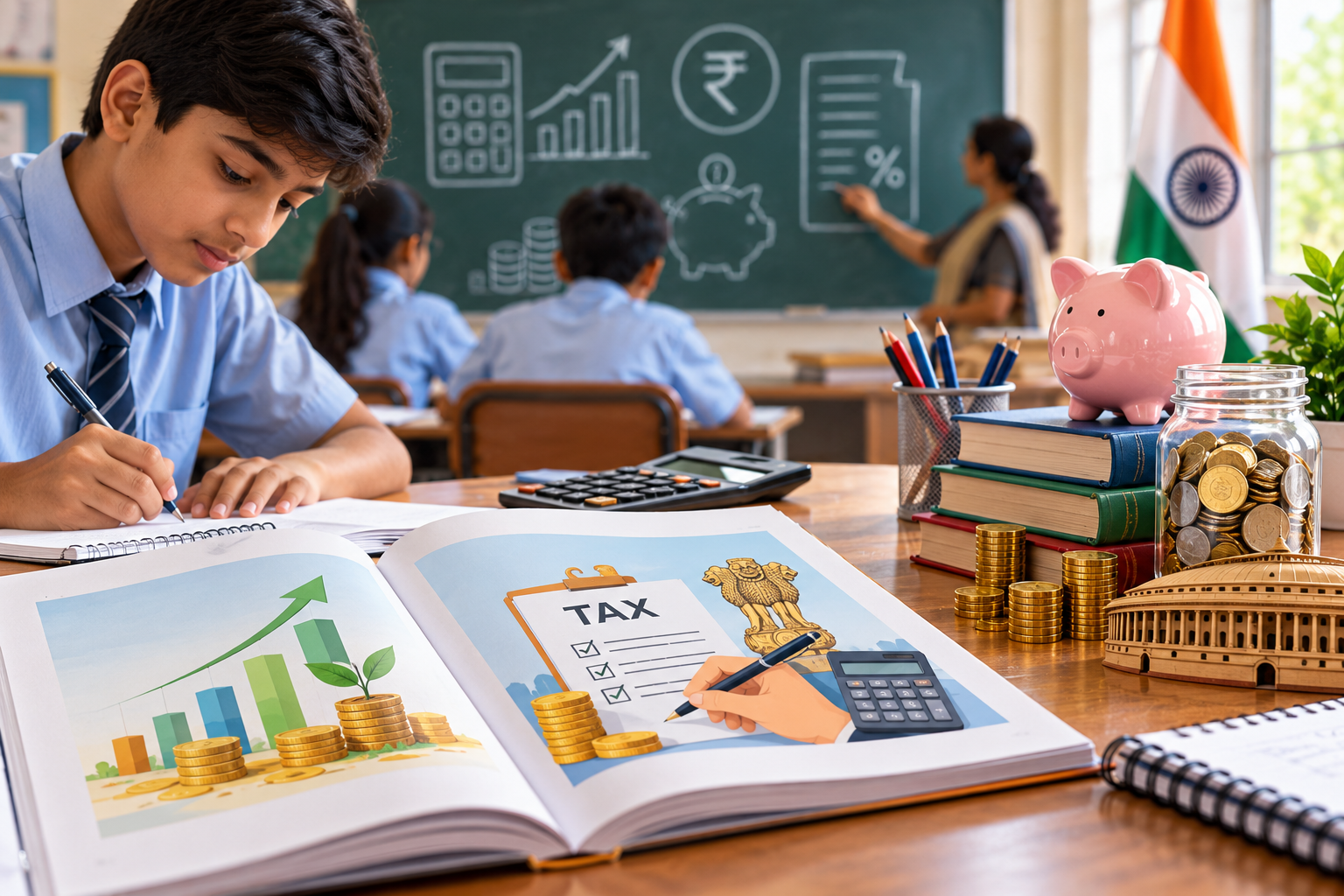
The new social science textbook explains income tax slabs under India’s new tax regime and introduces students to budgeting, saving, investing and risk management, connecting financial literacy with responsible citizenship.
Income Tax Becomes Part of Class 9 Curriculum
The National Council of Educational Research and Training (NCERT) has introduced a detailed section on personal income tax in its new Class 9 social science textbook, Understanding Society India and Beyond – Part 2. The chapter teaches students how to calculate income tax using the slab structure under India’s new tax regime and explains why paying taxes is an important civic responsibility.
According to the report by news agency PTI, NCERT chief Dinesh Prasad Saklani said the textbook includes an actual slab-wise tax calculation exercise for students. The move brings a practical financial concept into classroom learning at an early stage, helping students understand how taxation works before they enter the workforce.
The development also broadens the role of school-level financial education. Instead of limiting lessons to basic economic concepts, the curriculum introduces students to everyday decisions involving money, financial planning and public responsibilities.
How Students Will Learn to Calculate Income Tax
The chapter, titled “Managing Your Personal Finances”, explains that India follows a slab-based system for calculating personal income tax. Under this structure, different portions of taxable income may be taxed at different rates according to the applicable slabs.
Students are introduced to the tax slabs under the new income tax regime and are asked to work out tax liability using the prescribed rates. The exercise provides a practical example of how tax calculations operate rather than treating taxation solely as a theoretical concept.
According to PTI, the section focuses on the new regime and does not discuss the old tax regime. This gives students a defined framework for understanding the calculation process without immediately introducing the full range of exemptions, deductions and other provisions that can make individual tax planning more complex.
The textbook’s example is an educational exercise. Actual tax liability depends on the applicable financial year’s rules, the taxpayer’s income and other relevant provisions.
Why the Textbook Focuses on the New Tax Regime
India introduced the new income tax regime in the Union Budget of February 2020, with the system applying from financial year 2020–21. It generally offers a different structure of tax rates and fewer exemptions and deductions than the old regime.
From April 1, 2023, the new regime became the default option for individual taxpayers, subject to the applicable rules. Eligible taxpayers may still opt for the old regime under the prevailing provisions.
For students, focusing on the new regime provides a relatively structured introduction to income tax calculations. It allows them to understand how income slabs and tax rates work before studying more advanced questions involving deductions, exemptions and tax-saving choices.
However, the textbook’s emphasis should not be interpreted as the abolition of the old tax regime. Taxpayers’ choices and obligations continue to depend on the rules applicable to their circumstances.
Five Building Blocks of Personal Finance
Income tax is only one component of the chapter. NCERT also introduces students to the broader principles of managing money, explaining that financial management involves decisions about earning, spending, saving, investing and protecting against risks.
The chapter identifies five broad areas of personal finance:
Income: Understanding where money comes from and how people earn it.
Budgeting: Planning expenditure and allocating available money according to needs and priorities.
Saving: Setting aside money for future expenses, emergencies and longer-term goals.
Investing: Using money in financial instruments that may generate returns or help build wealth over time.
Protection and risk management: Recognising financial uncertainties and preparing for unexpected expenses or losses.
Together, these concepts introduce students to the relationship between present financial decisions and future financial stability.
Students Get an Introduction to Investment Options
The textbook also introduces investment avenues such as fixed deposits, bonds, stocks or equity shares, and mutual funds.
These instruments differ in their risk characteristics, liquidity, potential returns and investment horizons. Introducing them at school level can help students understand that saving and investing are related but distinct activities.
Saving generally involves setting aside money for future use, while investing involves committing money to an asset or financial instrument with the objective of earning a return or meeting a financial goal. Investments can fluctuate in value, and returns are not guaranteed in every case.
For students, the purpose of learning about these instruments is to build familiarity with financial choices rather than encourage immediate participation in financial markets. A foundational understanding can help them ask more informed questions as they grow older and begin managing their own money.
Taxation as a Civic Responsibility
The chapter also connects personal finance with citizenship. According to PTI, the textbook describes paying taxes honestly and on time as an important responsibility because tax revenue helps fund the country’s development.
This approach introduces students to the link between individual financial obligations and public services. Tax revenue supports government expenditure across areas such as infrastructure, education, healthcare and public administration, subject to government budgets and spending decisions.
By explaining taxation alongside budgeting and saving, the curriculum places personal financial management within a broader economic context. Students can begin to understand that financial decisions have both individual consequences and wider implications for society.
Why Financial Literacy Matters Before Students Start Earning
Financial decisions often begin well before a person receives a salary. Children may manage pocket money, plan purchases, save for personal goals or make choices about spending. These experiences provide an early opportunity to understand budgeting and financial priorities.
Learning about taxation, meanwhile, can help students prepare for responsibilities they may encounter when they enter employment or begin earning taxable income. Familiarity with income tax slabs may make future salary discussions, tax calculations and financial planning less unfamiliar.
An early introduction to investing and risk management can also establish an important distinction: building financial security requires more than earning money. It involves controlling expenditure, maintaining savings, evaluating financial choices and understanding the risks associated with different products.
The chapter therefore approaches financial literacy as a life skill rather than a subject that becomes relevant only after adulthood.
A Wider Role for Financial Education in Schools
The inclusion of personal income tax in Class 9 reflects an effort to connect classroom learning with practical financial decisions. Students are introduced to tax calculations, investment options and financial planning within a single chapter, allowing them to see how these concepts relate to one another.
The textbook was released on Tuesday, according to the report, while its first part had been released in June.
The effectiveness of this approach will depend partly on how teachers explain the concepts and how students apply them through classroom exercises. Clear examples, practical budgeting activities and age-appropriate discussions of saving and investment could help translate the material into useful everyday knowledge.
Outlook: Financial Literacy Could Shape Future Money Decisions
The introduction of income tax calculations in Class 9 brings taxation into formal school education alongside budgeting, saving, investing and risk management. It gives students an early opportunity to understand how tax slabs work and why tax compliance is connected to civic responsibility.
The wider significance lies in the curriculum’s focus on practical money management. Students who become familiar with financial concepts at school may be better prepared to evaluate financial choices when they begin earning, saving, borrowing or investing.
The textbook is an educational starting point, not a substitute for detailed tax guidance or professional financial advice. Nevertheless, placing personal finance in the school curriculum creates an opportunity to build foundational knowledge before students face more complex financial decisions as adults.