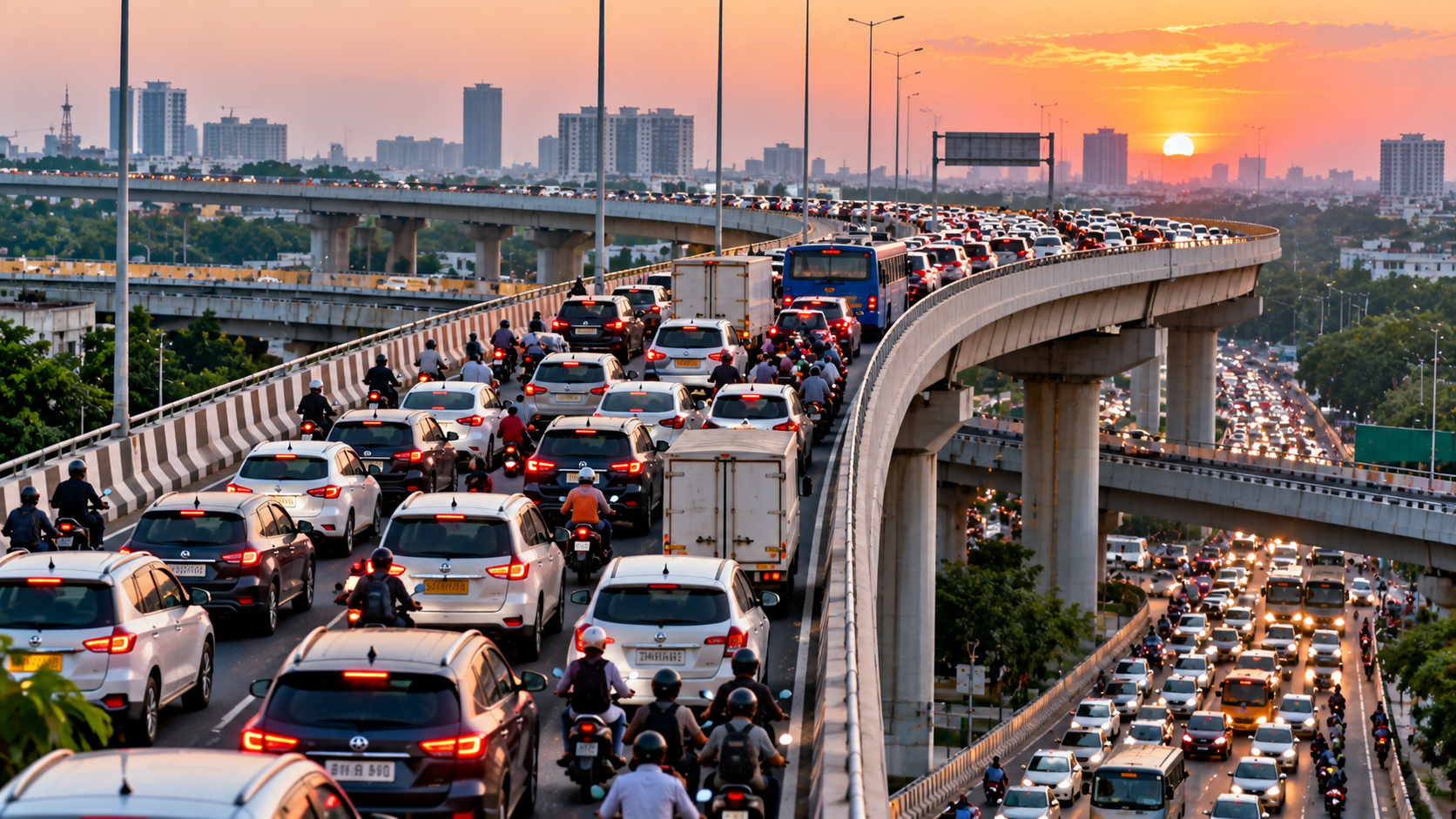
Delhi’s newly opened elevated corridor, built at a cost of ₹1,635 crore after years of delays, has encountered traffic snarls at key merging points near Sarai Kale Khan, prompting authorities to consider changes to the road layout and traffic management.
Delhi’s Barapullah Phase-III elevated corridor witnessed significant traffic congestion just a day after opening to commuters, raising questions about whether the new infrastructure can deliver the intended reduction in travel time. The corridor, designed to improve connectivity between East and South Delhi, experienced long queues during Thursday’s morning and evening peak hours, with traffic movement affected for much of the day.
The project was approved in 2014 and originally scheduled for completion in 2017. After repeated delays, the ₹1,635-crore corridor was inaugurated by Union Home Minister Amit Shah earlier this week and opened to traffic on Wednesday.
Commuters travelling from Mayur Vihar Phase-I towards Sarai Kale Khan reported substantial delays, with some saying they spent around 40 minutes in traffic while another commuter reported taking 55 minutes to reach the flyover’s first intersection.
Following the congestion, Delhi Traffic Police and the Public Works Department (PWD) conducted a joint aerial survey to identify bottlenecks and assess whether changes to the road layout could improve traffic flow.
Heavy Traffic Reported During Peak Hours
The newly opened corridor faced congestion during both morning and evening rush hours on Thursday. Traffic queues extended for several kilometres on affected stretches, particularly around the approach from Mayur Vihar Phase-I towards Sarai Kale Khan.
Delhi Traffic Police acknowledged the congestion and said the issue had been taken up on priority. Officers were directed to strengthen traffic regulation and deployment at critical merging and exit points.
Barricades were also placed near the entrance to manage vehicle movement. Authorities subsequently reported that traffic conditions had improved later in the evening after the barricades were removed and traffic was regulated.
A senior traffic police officer said commuters had been advised to use alternative routes, including the DND Flyway and Akshardham route, during the disruption.
Meanwhile, PWD officials said the carriageway connecting AIIMS towards Mayur Vihar was opened on Thursday afternoon, facilitating movement along the newly commissioned corridor.
Six Lanes Converging Into Three Create a Bottleneck
The joint survey by Delhi Traffic Police and PWD identified a major traffic bottleneck near the Sundial junction at Sarai Kale Khan.
According to the inspection findings reported by Hindustan Times, traffic from multiple directions converges into the existing Barapullah corridor at a point where the available road width is insufficient to accommodate the combined flow smoothly.
Additional Commissioner of Police (Zone-II Traffic) Dinesh Kumar Gupta explained that three lanes of traffic arrive from Mayur Vihar while another three lanes merge from the Sundial loop. However, the receiving corridor has only three lanes.
This creates a situation in which six lanes of approaching traffic must merge into three lanes, increasing the likelihood of queues and delays.
The survey also identified a sharp turn on the loop near Sundial Park. A lane ends at an angle close to 90 degrees, creating another conflict point as vehicles attempt to merge into the main traffic stream.
These findings suggest that the congestion is not simply a consequence of high vehicle volumes. The design and geometry of the merging points are also contributing to the disruption.
New Corridor Attracts Traffic From Existing Routes
The opening of the flyover has also changed traffic patterns in the surrounding road network.
According to the inspection findings, the new route has attracted vehicles that might otherwise have travelled along National Highway 24 or the DND Flyway. This additional traffic has increased pressure on the existing Barapullah corridor, particularly where several approaches converge.
Infrastructure projects intended to ease congestion can sometimes shift traffic towards new bottlenecks if connecting roads, intersections and exit points are unable to accommodate the additional demand.
In the case of Barapullah Phase III, the effectiveness of the corridor will depend not only on the elevated road itself but also on how smoothly it connects with the surrounding network.
Authorities Consider Changes to Road Layout
Delhi Traffic Police has taken up the merging-point problems with the agencies concerned and proposed modifications to the road geometry near Sundial.
One proposal involves introducing a smoother curve so vehicles can merge gradually rather than negotiating an abrupt turn. Police have also asked PWD to install barricades at the problematic junction to help reorganise vehicle movement.
Traffic signals at selected merging points are among the other measures reportedly under consideration. Authorities are also looking at updating traffic and navigation information for the new corridor on Google Maps so commuters receive more accurate route guidance.
The impact of these measures will depend on their implementation and whether they reduce conflicts between vehicles approaching from different directions.
A coordinated approach involving traffic police, road engineers and infrastructure agencies will be necessary to address the identified bottlenecks.
A ₹1,635-Crore Project Delayed for Nearly a Decade
The Barapullah Phase-III project was approved in 2014 to improve connectivity between Mayur Vihar Phase-I and Sarai Kale Khan, linking the route with the existing Barapullah network towards AIIMS.
Construction began in 2015, with completion originally expected in 2017. However, the project encountered repeated delays, extending the timeline by several years before its eventual inauguration.
The corridor was intended to provide a signal-free connection between East and South Delhi and reduce pressure on alternative routes, including the DND Flyway and Akshardham corridor.
Its delayed delivery and the congestion witnessed immediately after opening have renewed attention to the importance of coordinating road design, traffic forecasts and junction planning before commissioning major infrastructure projects.
The early traffic problems do not, by themselves, establish whether the corridor will achieve its longer-term objectives. Traffic patterns may change as commuters adjust to the new route and authorities implement corrective measures.
Commuters Question Whether Travel Time Will Improve
The initial congestion prompted criticism on social media, with users questioning whether the new infrastructure would meaningfully reduce journey times.
Some commuters highlighted the contrast between the project's stated objective of saving time and the delays experienced at the merging points. Others raised broader concerns about traffic demand growing during the years required to complete large infrastructure projects.
Such reactions reflect commuter frustration, although a comprehensive assessment of the corridor's performance would require traffic-flow and travel-time data collected over a longer period.
The key measure of success will be whether the flyover reduces total journey times across the surrounding network, rather than merely shifting congestion from one road to another.
Outlook: Traffic Management Will Determine the Corridor’s Effectiveness
The immediate priority for Delhi authorities is to address the merging bottlenecks near Sundial and Sarai Kale Khan. Changes to road geometry, controlled merging, barricades and improved traffic guidance could help reduce congestion if they are implemented effectively.
Authorities will also need to assess whether traffic volumes remain elevated as more commuters begin using the new corridor and whether congestion spreads to adjoining roads.
For commuters, the experience over the coming days will depend on the speed of corrective action and the availability of clear route advisories. For the project itself, the longer-term test will be whether the ₹1,635-crore investment delivers smoother connectivity between East and South Delhi and reduces pressure on existing routes.
The flyover has opened after years of delays, but its intended benefits will depend on how effectively the surrounding road network handles the traffic it brings.