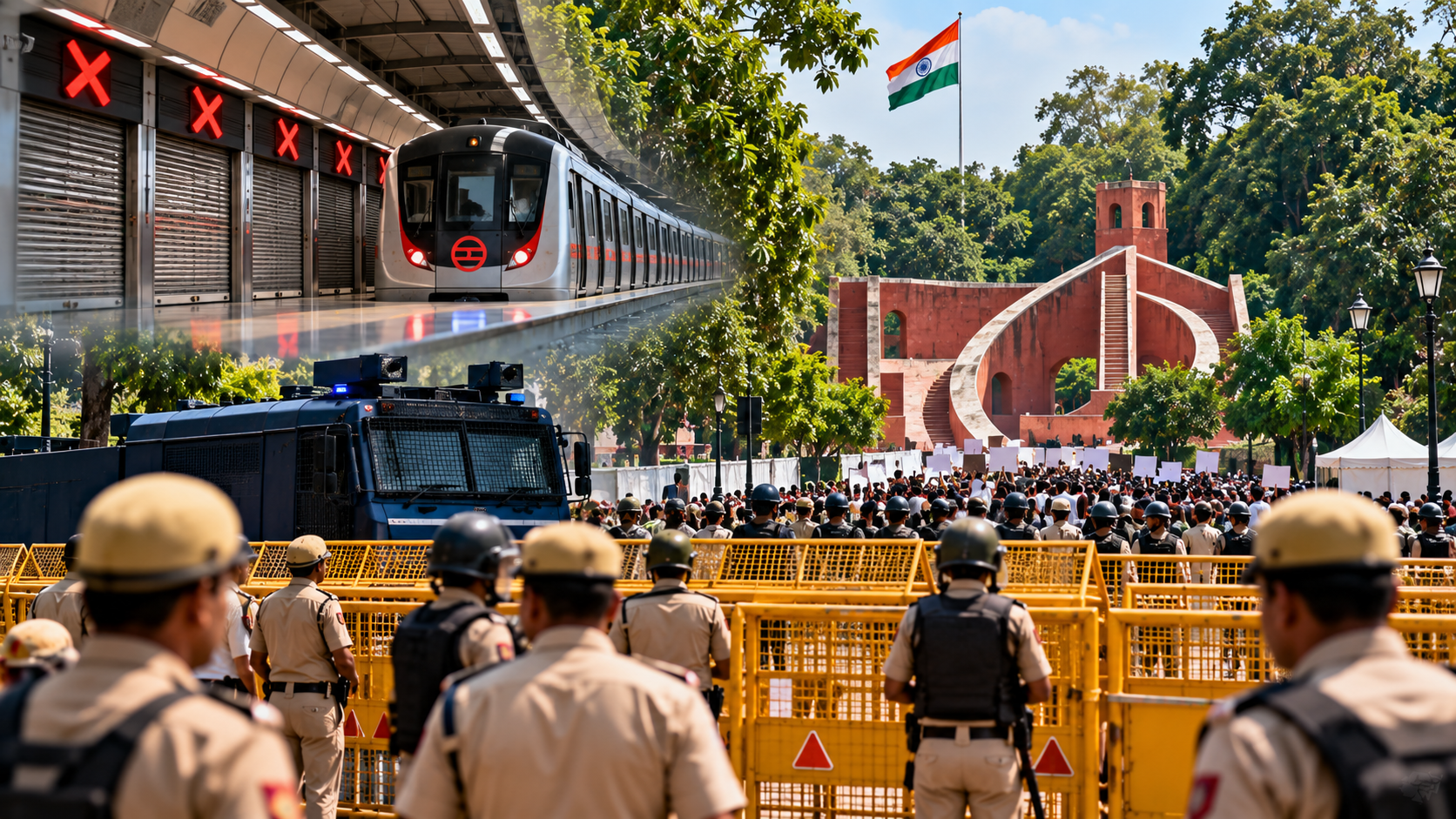
Delhi Police denies permission for a proposed demonstration over alleged irregularities in electoral roll revision, deploying additional forces and restricting access to several Metro stations across the national capital.
Security arrangements were intensified across central Delhi on Friday, October 2, ahead of a proposed protest at Jantar Mantar against Chief Election Commissioner Gyanesh Kumar over alleged irregularities in the Special Intensive Revision (SIR) of electoral rolls. Delhi Police denied permission for the demonstration, citing the expected turnout and restrictions on public gatherings.
Authorities deployed police personnel, Rapid Action Force (RAF) teams and a riot-control vehicle near Jantar Mantar. The security measures were accompanied by the closure of 11 Delhi Metro stations, affecting passenger movement across several important parts of the city.
The proposed demonstration has brought renewed attention to the ongoing debate surrounding electoral roll revisions, voter inclusion and the functioning of the Election Commission of India (ECI).
Delhi Metro Closes 11 Stations Amid Security Restrictions
Delhi Metro Rail Corporation (DMRC) announced the closure of 11 stations until further notice as part of the security arrangements. The affected stations are:
-
Janpath
-
Patel Chowk
-
Central Secretariat
-
Rajiv Chowk
-
Seva Teerth
-
Mandi House
-
Lok Kalyan Marg
-
INA
-
Chawri Bazar
-
Ramakrishna Ashram Marg
-
New Delhi
According to the information provided by authorities, interchange facilities remained available at Rajiv Chowk, Mandi House, INA, New Delhi and Central Secretariat. However, the closure of station entry and exit gates was expected to disrupt normal passenger movement, particularly for commuters travelling through central Delhi.
The restrictions were introduced as a preventive measure amid expectations of a sizeable gathering near the protest venue. Commuters were advised to follow official Metro and traffic advisories before travelling through the affected areas.
Heavy Security Deployment Around Jantar Mantar
Police and Rapid Action Force personnel were positioned at Jantar Mantar, with additional arrangements made to manage crowds and regulate movement around the demonstration site.
Police sources said additional security personnel had been sought from the Union Ministry of Home Affairs in view of the anticipated turnout. Authorities also indicated that further measures could be introduced depending on the situation and the movement of people in the area.
DCP New Delhi Sachin Sharma said Section 163 of the Bharatiya Nagarik Suraksha Sanhita (BNSS) was in force in New Delhi, restricting protests, demonstrations, marches and similar activities in the area. He urged people not to gather for demonstrations and asked the public to comply with the law and cooperate with the police.
The police also said notifications and public-awareness messages concerning road movement and Metro services were being issued.
Who Organised the Proposed Protest?
The proposed demonstration was called by the All India Students' Association (AISA), Rajya Sabha MP Manoj Jha and Supreme Court lawyer Prashant Bhushan. The Students' Federation of India (SFI) and the Democratic Youth Federation of India (DYFI) were also mentioned in connection with the planned agitation.
The organisers are seeking the removal of Chief Election Commissioner Gyanesh Kumar, alleging irregularities in electoral rolls and the conduct of elections.
The protest comes amid continuing public and political debate over the SIR process, which involves reviewing electoral rolls and checking voter eligibility. Questions surrounding deletions from electoral lists and procedures followed during the revision have become central to the controversy.
The police decision to deny permission and impose security restrictions has added another dimension to the dispute, bringing public order and the proposed demonstration into focus.
Electoral Roll Revision at the Centre of the Controversy
The agitation was reportedly triggered in part by a report published by The Indian Express, which said Election Commissioners Sukhbir Singh Sandhu and Vivek Joshi had raised objections at least 14 times over 10 months concerning decisions and procedures related to the SIR exercise and other electoral matters.
The reported objections have intensified scrutiny of how electoral roll revisions are conducted and how disagreements within the Election Commission are handled.
The broader debate involves the accuracy of voter lists, the treatment of potentially omitted voters and the procedures used to verify eligibility. Election authorities have faced calls to ensure that legitimate voters are not excluded while maintaining the integrity of electoral records.
The allegations remain contested issues, and the reported objections do not by themselves establish that electoral irregularities occurred. The underlying procedures and individual cases require examination on the basis of the relevant records and official findings.
What the Restrictions Mean for Delhi Residents
The closure of 11 Metro stations and heightened security around central Delhi could affect office commuters, visitors and people travelling through major interchange points. The impact will depend on how long the restrictions remain in force and whether additional road or transport measures are introduced.
Passengers travelling through the affected area should check official DMRC updates before starting their journeys and consider alternative routes where necessary. Residents and visitors should also follow police advisories concerning restricted zones and road movement.
The situation may change as authorities assess crowd movement and security requirements. The reported station closures were stated to remain in place until further notice.
Outlook: Public Order and Electoral Accountability in Focus
The developments in central Delhi highlight the intersection of public order, demonstrations and concerns over electoral administration. Police authorities have prioritised preventive security measures in response to the expected gathering, while protest organisers are seeking action over alleged irregularities in the SIR process.
The wider issue is likely to remain under public scrutiny as questions about voter-list revision, institutional procedures and accountability continue to be discussed. Further developments will depend on official decisions, the status of security restrictions and any subsequent clarification regarding the allegations surrounding the electoral revision exercise.