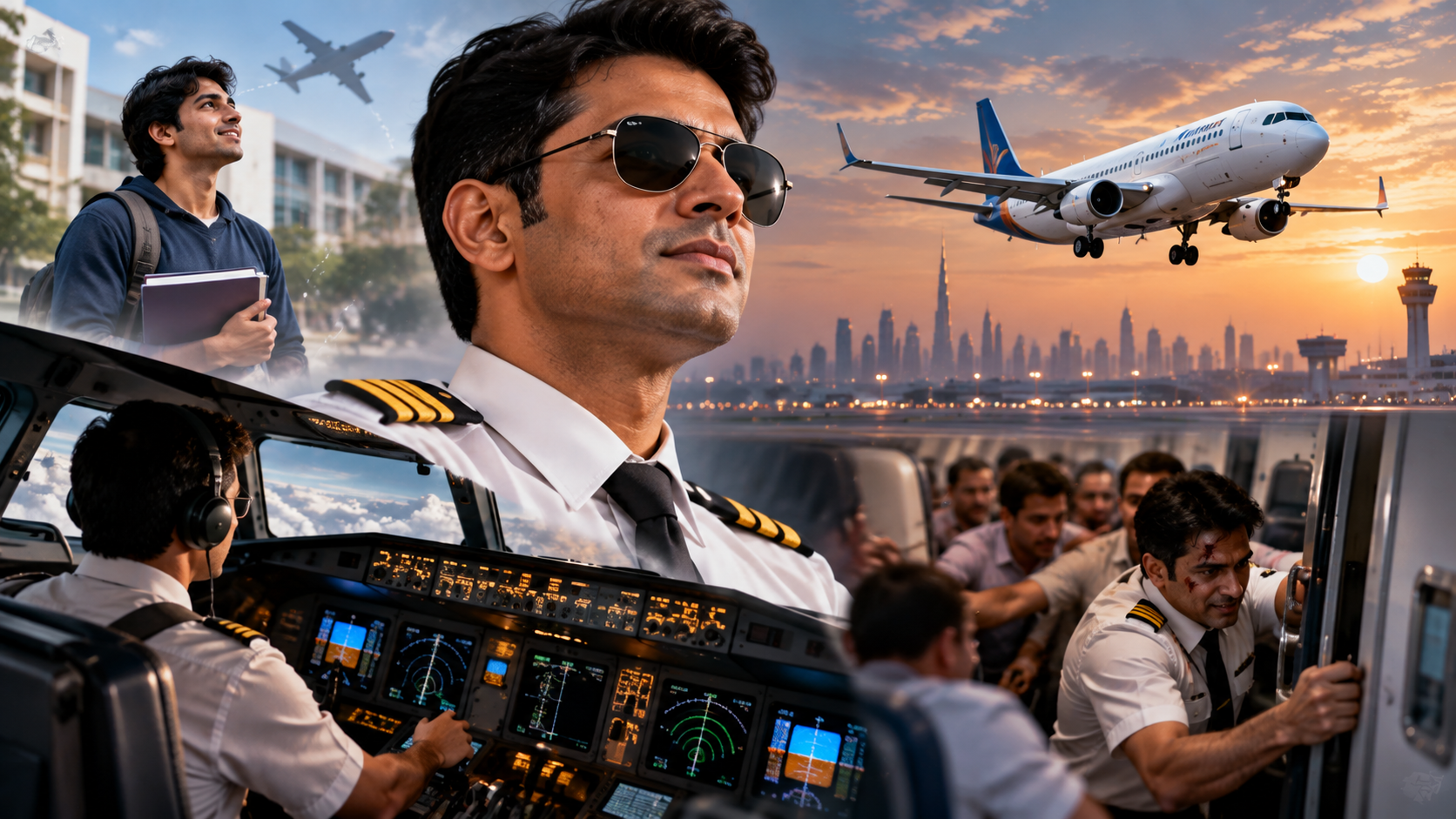
The Indian commander, who sustained serious injuries during an alleged cockpit attack aboard a Dubai-to-Tel Aviv flight, has received international recognition for his actions. His journey from textile engineering to commercial aviation reflects nearly 16 years of experience flying Boeing aircraft.
Smit Machchhar, the Indian captain of a FlyDubai flight who was seriously injured during an alleged attack by his copilot, is being praised for his actions during an onboard emergency that threatened the safety of 174 people. According to reports, Machchhar fought back despite his injuries and managed to open the cockpit door, allowing passengers to intervene and subdue the alleged attacker.
The incident occurred aboard FlyDubai flight FZ1073, travelling from Dubai to Tel Aviv. The Boeing 737 Max reportedly entered a steep dive during the struggle, losing more than 14,000 feet in approximately 30 seconds. The aircraft subsequently made an emergency landing in Tabuk, Saudi Arabia.
The incident has drawn international attention to the captain's response under extreme pressure, while authorities and the airline continue to address questions surrounding the cockpit altercation.
From Textile Engineering to the Cockpit
Machchhar's career in aviation began with a change of direction. He initially studied textile engineering, intending to join his family's business, and was pursuing a management course when an aviation seminar sparked his interest in flying.
In an October 2025 appearance on the YouTube podcast Bona-Fide Banter, Machchhar explained that becoming a pilot had not been his first career choice. His mother was apprehensive about the decision, partly because information about pilot training and career pathways was less accessible to families in India at the time. His father, meanwhile, encouraged him to explore the available training options.
Machchhar eventually pursued commercial pilot training in New Zealand. Before beginning his training, he had flown only a handful of times as a passenger, reflecting how the cost of air travel had made flying relatively uncommon in his early life.
His transition from engineering studies to aviation ultimately led to a career spanning commercial operations, aircraft training and mentoring aspiring pilots.
Nearly 16 Years of Experience Flying Boeing Aircraft
Machchhar began his airline career with SpiceJet before joining FlyDubai in 2022. According to the LinkedIn profile cited in the report, he had accumulated approximately 9,750 hours flying Boeing single-aisle aircraft over around 16 years.
At SpiceJet, he was among the early groups of pilots trained on the Boeing 737 Max after the airline introduced the aircraft in India. Following the two fatal 737 Max crashes in 2018 and 2019, the aircraft type was grounded, and Machchhar was assigned to fly an idle aircraft from Mumbai to Ahmedabad without passengers.
He later recalled that he had not told his father that he would be flying the Max on that occasion, instead saying he would be operating an older version of the Boeing 737. The episode illustrated the concerns surrounding the aircraft at the time, even among people familiar with aviation.
Machchhar continued flying the 737 Max after the aircraft returned to service. His experience included routine commercial operations as well as challenging situations requiring pilots to rely on their training and established emergency procedures.
Emergency Response During the FlyDubai Flight
The reported cockpit altercation unfolded during the Dubai-to-Tel Aviv journey. According to the account cited by Business Standard, Machchhar was stabbed by his copilot during the incident.
Despite sustaining serious injuries, the captain reportedly managed to unlock the cockpit door. Passengers then entered the flight deck and helped restrain the alleged attacker as the aircraft recovered from its steep descent.
The plane's reported loss of more than 14,000 feet in about 30 seconds underscored the severity of the emergency. It subsequently landed at Tabuk, Saudi Arabia, rather than continuing to its intended destination.
US President Donald Trump, Israeli Prime Minister Benjamin Netanyahu and Indian Prime Minister Narendra Modi publicly praised Machchhar's actions. Netanyahu said the captain had managed to unlock the cockpit door despite being badly wounded.
FlyDubai confirmed that an altercation had occurred between the pilots but did not comment on its cause. The airline urged people not to speculate while the investigation continued.
Captain's Medical Condition and Recovery
Following the emergency landing, Machchhar was admitted to a hospital in Tabuk. The Indian Embassy in Saudi Arabia said he was receiving medical attention and was reported to be in stable condition, although a fuller update was awaited at the time of its statement.
India's Ministry of External Affairs subsequently said on October 1 that he had been moved to Abu Dhabi for continued treatment and recovery. India's ambassador to the UAE visited him in hospital, while the ministry said Indian diplomatic missions were providing assistance to him and his family.
Prime Minister Modi also spoke with Machchhar's parents and wife, assuring them of the government's support through Indian missions abroad.
The captain's recovery remains a central concern following the incident, while the circumstances surrounding the attack continue to require investigation.
A Career Shaped by High-Pressure Decisions
Machchhar's professional experiences extend beyond the latest emergency. In his podcast interview, he described a challenging approach to Mykonos in Greece, where wind shear required him to execute an escape manoeuvre of the kind pilots practise in flight simulators.
He later identified Mykonos as his favourite airport, despite the difficult experience. The anecdote highlighted the demanding conditions commercial pilots can encounter and the importance of training for situations that cannot always be anticipated during routine operations.
He also recalled a flight during which cabin crew informed him that a pregnant passenger was experiencing labour pains much earlier than expected. The cockpit crew assessed diversion options and checked weather conditions at nearby airports. A short time later, the cabin crew reported that the woman had delivered her baby. Paramedics met the aircraft after landing, and both mother and child were reported to be fine.
Such incidents form part of the operational responsibilities of airline captains, who must assess changing circumstances, coordinate with cabin crew and make decisions that prioritise passenger safety.
Mentoring the Next Generation of Pilots
Alongside his flying career, Machchhar has been involved in mentoring students at FlyBy Aviation, a pilot-training academy he joined with three friends he had known since around 2007.
His interest in helping aspiring pilots reflects another aspect of his professional life: sharing practical experience with those preparing to enter the aviation industry.
Machchhar has also spoken about maintaining a separation between work and family life. In his podcast interview, he said that when he leaves the cockpit, his children want him to spend time playing with them rather than continuing to focus on aviation.
Asked to describe being a pilot in a single word, he chose “Blessed.”
Aviation Safety and the Investigation Ahead
The FlyDubai incident has placed cockpit security, crew interactions and emergency response under renewed scrutiny. However, the airline has not publicly established the reason for the altercation, and the reported allegations should not be treated as a final determination of responsibility.
Investigators will need to establish the sequence of events, examine the aircraft's flight data and assess the circumstances that led to the emergency descent and landing. Any conclusions about the cause of the incident or the actions of those involved will depend on the findings of the investigation.
The episode also demonstrates the importance of coordination between flight crews, passengers, airline operations and emergency services when an aircraft encounters a serious onboard threat.
For Machchhar, the incident has brought international attention to a career that began with an unexpected change of direction. His reported actions during the emergency have been widely praised, while his medical recovery and the investigation into the cockpit altercation remain important developments.