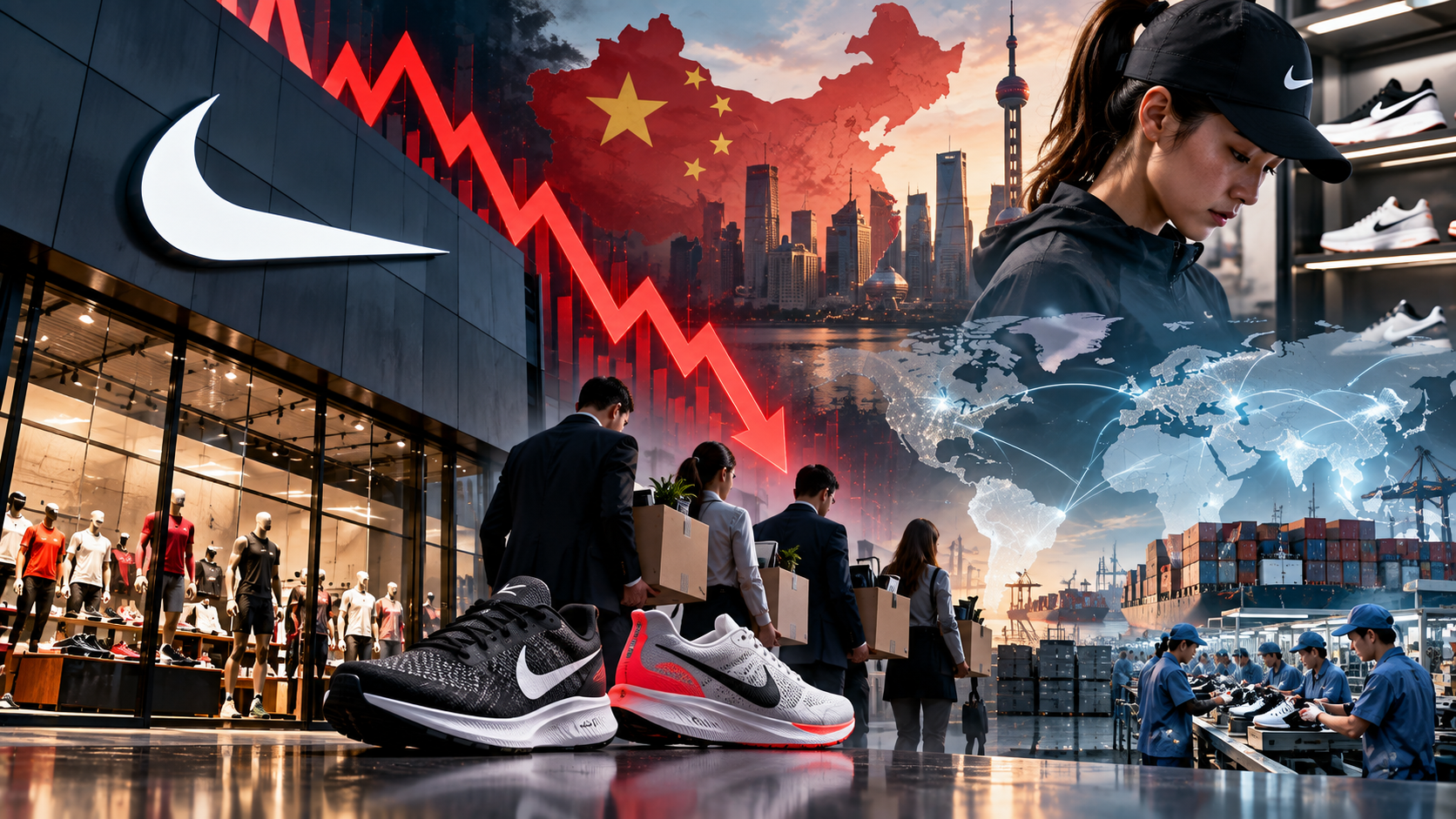
The sportswear giant expects revenue to decline by a high single-digit percentage in fiscal 2027 as its recovery faces continued pressure, particularly in China. CEO Elliott Hill is reshaping the company’s global operations, product strategy and retail relationships in an effort to restore growth.
Nike Deepens Restructuring Amid Weak Business Performance
Nike is preparing another round of job cuts and a restructuring of its global business as efforts to revive growth continue to face challenges. The announcement came alongside a weaker-than-expected revenue outlook, signalling that the company’s turnaround could take several more quarters.
The company has been working under CEO Elliott Hill to strengthen its core sports categories, rebuild relationships with wholesale retailers and improve the appeal of its product range. However, weak demand in important markets and difficulties in its sportswear and Jordan Brand businesses continue to weigh on performance.
Nike’s shares fell 8.5% in extended trading following the latest announcement, reflecting investor concerns about the pace of the recovery and the scale of the challenges ahead.
The restructuring will build on earlier cost-cutting measures and changes to the company’s operating model. Nike has not yet disclosed how many positions will be eliminated, but said employees would begin receiving notifications in 2027.
Fiscal 2027 Revenue Outlook Disappoints
Nike expects revenue to decline by a high single-digit percentage in fiscal 2027. The forecast is considerably weaker than the approximately 2% annual revenue decline expected by analysts surveyed by LSEG, according to the report.
The outlook indicates that management expects current business pressures to persist while changes to products, distribution and operations take effect.
In the first quarter, Nike’s revenue declined approximately 4% to $11.21 billion, below analysts’ average estimate of $11.32 billion. The results highlight the difficulty of restoring sales growth even as the company works to reduce costs and improve its product mix.
Nike has also said it will update its targets during the fiscal year beginning in November as it progresses with its restructuring. The company withdrew its annual forecasts in October 2024 to give Hill time to assess the business and develop a recovery strategy.
China Remains Nike’s Biggest Growth Challenge
China has emerged as one of the most significant obstacles to Nike’s turnaround. Sales in the country fell 26% on a constant-currency basis in the first quarter, with the weakness extending a declining trend that has lasted nine consecutive quarters.
China represents approximately 15% of Nike’s annual revenue and is one of its major markets. The company is facing competition from both international rivals and domestic sportswear brands, increasing the pressure to deliver products that appeal to local consumers.
The prolonged decline suggests that the challenges extend beyond short-term economic conditions. Product relevance, consumer preferences, pricing and competition are all important factors in the company’s performance in the region.
Nike has been reducing the volume of Jordan retro releases while attempting to strengthen other product categories. Management has acknowledged that improving the performance of sportswear, the Jordan Brand and Greater China will take time.
Changes to China’s Online Distribution Strategy
Nike is also changing how its products are distributed in China. Starting in January, the company plans to withdraw online sales rights from some of its largest retail partners in the country.
The move is intended to give Nike tighter control over pricing and distribution while addressing extensive discounting. However, the company expects the transition to take multiple seasons and has warned that it will weigh on near-term revenue and profitability.
The strategy carries risks. Greater control over distribution may help reduce excessive promotions, but its effectiveness will depend on whether consumers respond positively to Nike’s products and pricing.
Analysts cited in the report have questioned whether the main issue in China is distribution or the appeal of the products themselves. The distinction is important because changes to sales channels alone may not restore demand if consumers increasingly prefer competing brands.
Global Business Structure to Be Simplified
As part of the restructuring, Nike plans to reorganise its global operations into three geographic regions instead of four:
-
Americas
-
Asia Pacific and Greater China
-
Europe, Middle East and Africa (EMEA)
The revised structure is intended to simplify operations and support the company’s broader recovery efforts.
Nike expects the restructuring programme, including previous initiatives, to deliver approximately $2.5 billion in savings through fiscal 2031. Most of the savings are expected to be realised in fiscal 2029 and fiscal 2030, indicating that the full financial benefits will take time to emerge.
The company also plans to establish a new campus in India, citing access to talent and the development of strong capabilities. The initiative adds an India-focused element to its global operating plans, although the report does not specify the campus’s investment size or expected workforce.
North America Provides Some Support
While China remains under pressure, Nike recorded a more positive performance in North America, its largest regional market. Sales in the region increased 2% on a constant-currency basis in the first quarter.
The company’s performance business, particularly running-related products, contributed to the improvement. Hill has made a strategic push towards core sports categories as Nike seeks to reconnect with consumers and strengthen demand for performance-oriented products.
Nevertheless, the growth in North America has not been sufficient to offset weakness in other parts of the business. Nike’s management has acknowledged that its performance division is not yet large enough to counter pressure across sportswear, Jordan Brand and Greater China.
The challenge will be to expand demand in stronger categories while improving product relevance in markets where sales have weakened.
Competition and Brand Partnerships Add to the Pressure
Nike’s difficulties are unfolding amid intensifying competition in the global sportswear industry. Domestic brands in China and international competitors are competing for consumer spending, while changes in athlete endorsements and brand partnerships add another layer of pressure.
French football star Kylian Mbappé ended his two-decade association with Nike in September and joined Swiss sportswear company On, according to the report. The development comes as Nike works to reinforce its position in performance sports and maintain the appeal of its athlete partnerships.
Nike’s gross margin, however, improved by 60 basis points to 42.8% in the quarter ended August 31, helped by lower warehousing and logistics costs. This suggests that some cost efficiencies are supporting profitability even as revenue remains under pressure.
The company’s removal from the S&P 100 in September, following a quarterly index rebalancing, also marked a change in its standing among large US blue-chip companies. The index change does not itself determine Nike’s future performance, but it comes amid a period of weaker sales and investor scrutiny.
What Investors Will Monitor Next
Nike’s recovery will depend on whether its product strategy can generate renewed demand, particularly in China, and whether its cost-saving measures can improve operating performance without undermining the business’s longer-term capabilities.
Investors are likely to focus on comparable sales across regions, progress in running and other performance categories, inventory and promotional activity, gross margins, and the pace at which restructuring savings are realised.
The China distribution changes will also be closely watched. While tighter control may reduce discounting, the company must demonstrate that it can win back consumers through products that meet changing preferences.
The gap between Nike’s latest revenue outlook and analyst expectations highlights the uncertainty surrounding the timing of a sustained recovery.
Market Outlook
Nike’s latest forecast points to continued near-term pressure on revenue, with China remaining a major risk to its recovery. The planned job cuts and operating changes could reduce costs over time, but their success will depend on whether they are accompanied by stronger demand and more compelling product launches.
For investors, the key distinction is between cost reduction and a durable return to growth. Lower operating expenses can support margins, but sustained improvement will require Nike to stabilise sales, strengthen its competitive position and improve performance in its largest markets.
The coming quarters will provide important evidence on whether Hill’s strategy is translating into better results. Until sales trends improve, Nike’s recovery timeline and the financial benefits of its restructuring are likely to remain central considerations for the market.