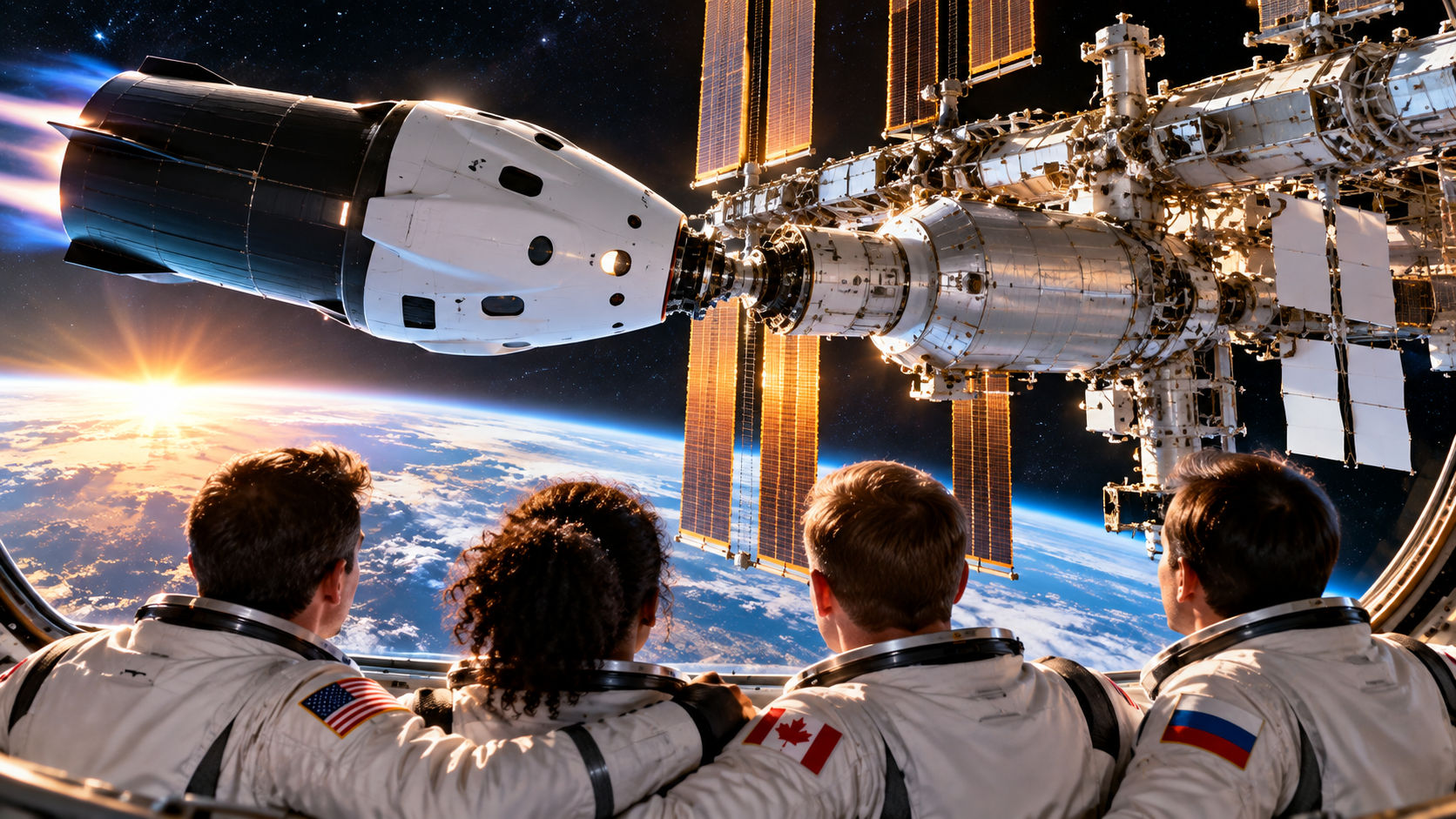
NASA’s four-member Crew-13 mission reached the International Space Station after an approximately eight-hour journey, marking the fastest US crewed flight to the orbiting laboratory, according to the report. The launch followed a three-week delay to address a fuel-system leak in the Dragon spacecraft.
Crew-13 Completes Rapid Journey to the Space Station
Four astronauts arrived at the International Space Station (ISS) on Thursday after SpaceX completed a crewed launch and an approximately eight-hour transit from Florida. The journey set a new speed record for a US crewed flight to the station, surpassing previous missions operated by NASA and commercial partners.
The mission was launched by SpaceX for NASA from Cape Canaveral Space Force Station. Although thick clouds threatened to delay the countdown, weather conditions improved sufficiently for the rocket to lift off safely.
The relatively short journey was made possible in part by the space station’s orbital position at the time of launch, which allowed the spacecraft to reach its destination faster than on many earlier missions.
The four astronauts are expected to spend approximately six months aboard the orbiting laboratory, conducting research, maintaining station systems and supporting ongoing scientific operations.
Jessica Watkins Makes History as Mission Commander
NASA astronaut Jessica Watkins commanded the mission, becoming the first Black woman to lead a crew on an orbital mission, according to the report.
A geologist by training, Watkins previously worked with NASA’s Curiosity Mars rover programme before travelling to the International Space Station in 2022. Her experience in planetary science and space operations forms part of the expertise she brings to the six-month mission.
The other members of the crew are NASA astronaut Luke Delaney, a retired Marine; Canadian astronaut Joshua Kutryk, a colonel in the Royal Canadian Air Force; and Russian astronaut Sergey Teteryatnikov, a former submariner.
The mission brings together astronauts from the United States, Canada and Russia, reflecting the multinational character of the International Space Station programme.
Three-Week Delay Before Successful Launch
The launch had been postponed for three weeks while engineers addressed a leaking fuel system in the Dragon capsule. The delay highlights the importance of resolving technical issues before carrying astronauts into orbit.
Weather conditions also posed a potential challenge on launch day, with thick clouds threatening to interrupt the countdown. Conditions eventually cleared, allowing the mission to proceed.
Spacecraft reliability remains a central concern for human spaceflight because launch vehicles and crew capsules must operate within strict safety requirements. Detailed technical checks, repairs and launch-readiness reviews are essential before astronauts can begin their journey.
The successful arrival of Crew-13 marked the completion of this mission’s launch and transit phase, although the crew’s work aboard the station will continue for several months.
Six Months of Research and International Cooperation
During their stay, the astronauts will join the existing ISS crew and take over from four astronauts who have been living aboard the station since February.
The station serves as a research platform for experiments in microgravity, human physiology, materials science and other fields. Its continued operation also supports the development of technologies and procedures that could be useful for longer missions beyond low Earth orbit.
The presence of astronauts from different countries demonstrates the continuing role of international cooperation in space research. Despite geopolitical tensions on Earth, the ISS has remained a shared platform for scientific work involving multiple space agencies.
Personal Milestone for Canadian Astronaut Joshua Kutryk
The mission also carries a significant family milestone for Canadian astronaut Joshua Kutryk. His wife, Heather, is expected to give birth to their third child in late November, while he remains aboard the space station.
The Canadian Space Agency has said it will provide support to the family during this period. NASA has previously arranged communication links that allowed astronauts to connect with family members during childbirth while in orbit.
The situation illustrates one of the personal challenges of long-duration spaceflight: astronauts must balance professional responsibilities in orbit with important events taking place at home.
Crew members and mission managers must plan communications and family support carefully because returning to Earth early is not always practical.
SpaceX Maintains a Busy Launch Schedule
The Crew-13 arrival came during a particularly active period for SpaceX. According to the report, the company launched a Falcon rocket from California carrying more than 100 small satellites only a few hours after the crewed mission lifted off.
Another Falcon launch from Florida, carrying a classified satellite for the US National Reconnaissance Office, was also scheduled for later that night.
These activities reflect SpaceX’s role across several areas of the space industry, including crew transportation, satellite deployment and government missions. The company’s reusable launch systems and high launch cadence have made it a central provider of commercial and government spaceflight services.
The report also noted that SpaceX’s Starship had reached orbit for the first time that same week, adding to a period of significant activity across its launch programmes.
What the Mission Means for the Space Industry
The successful Crew-13 flight highlights the operational importance of reliable crew transportation and the ability to maintain regular access to the International Space Station. Faster transit times can reduce the duration astronauts spend travelling, although the overall mission still requires extensive preparation, training and safety checks.
For the wider space economy, activity across crewed missions, satellite launches and next-generation launch systems demonstrates the range of services now being developed by commercial providers alongside government agencies.
The industry’s progress will continue to depend on spacecraft reliability, launch costs, customer demand, regulatory requirements and the ability to sustain safe operations over repeated missions.
Space Industry Outlook
SpaceX’s latest crewed mission reinforces the growing role of commercial companies in human spaceflight and orbital infrastructure. Continued launches for NASA, satellite operators and government customers could support further activity across launch services, spacecraft manufacturing, communications and space-based research.
However, the pace of expansion will depend on successful missions, technical performance, contract execution and the economics of launch operations. Delays caused by technical issues remain an important reminder that reliability and safety take priority over launch frequency.
For the broader space sector, the key developments to monitor include future crew rotations to the ISS, progress in reusable launch technology, commercial satellite deployments and the development of systems intended for missions beyond low Earth orbit. Crew-13’s arrival represents another milestone in maintaining the operational continuity of the space station while commercial spaceflight continues to evolve.