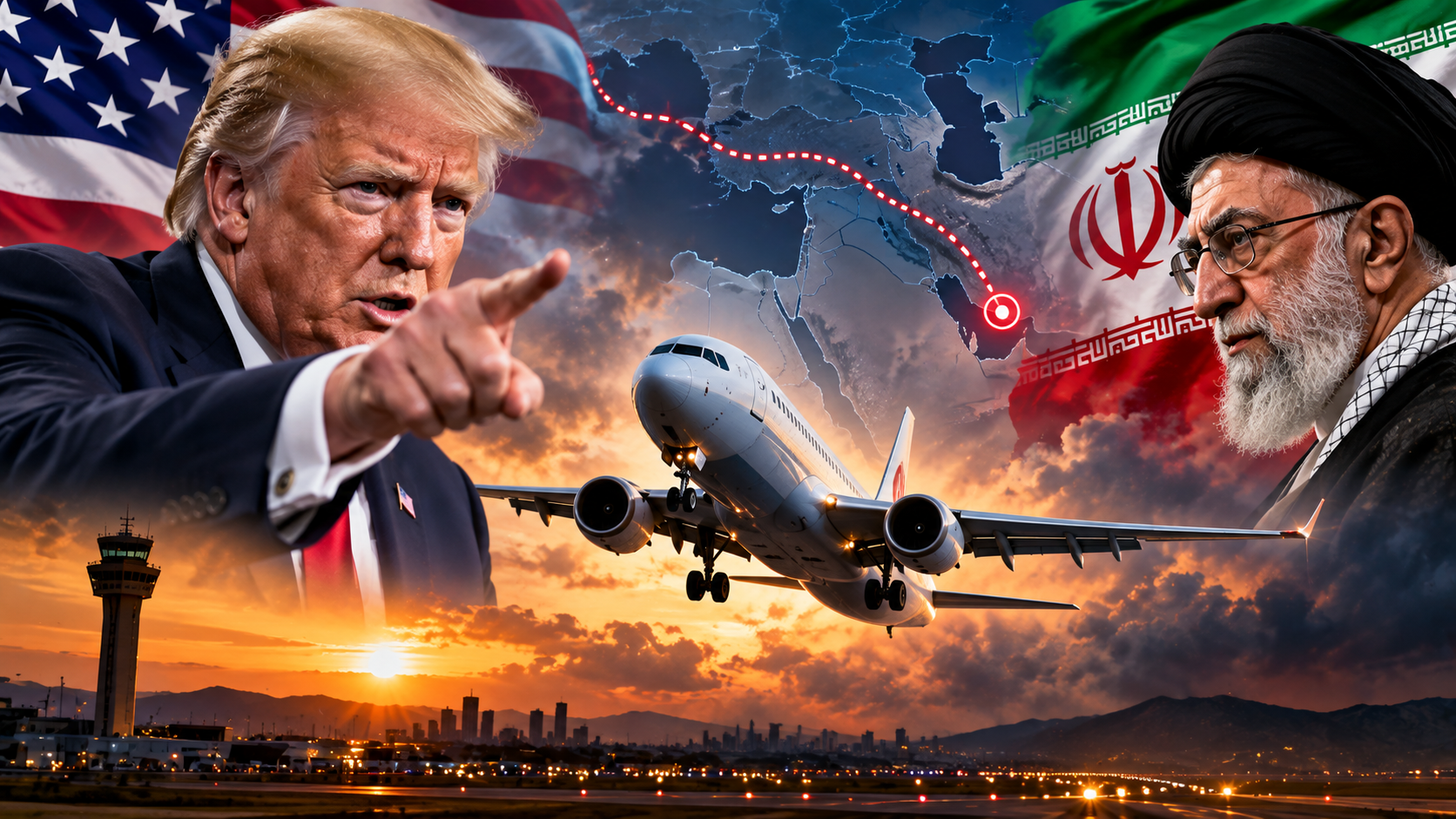
US President Donald Trump has threatened a forceful response against Iran if investigators establish its involvement in an alleged attempt to bring down an Israel-bound aircraft. Authorities are examining the motive behind the incident, which left the captain injured and prompted passengers to intervene.
Trump Issues Warning as Investigation Continues
US President Donald Trump has warned that Iran would be hit “very hard” if evidence establishes that Tehran was connected to an alleged cockpit attack aboard a FlyDubai flight travelling from the United Arab Emirates to Tel Aviv. His remarks came as investigators continued to examine the incident involving a co-pilot accused of attacking the aircraft’s captain during the flight.
Speaking to reporters at the White House on Thursday, Trump said officials were working to establish whether Iran had any links to the suspect. Although he indicated that the information he was hearing pointed towards possible Iranian involvement, he did not provide supporting evidence or explain the basis for his suspicion.
The US president also said Washington would retaliate forcefully if Iran were found responsible. However, Iran’s alleged involvement has not been established, and investigators have not publicly confirmed a motive for the attack.
What Happened Aboard the FlyDubai Aircraft?
The aircraft, a Boeing 737 MAX 8, was carrying 182 people, most of them Israeli passengers, on a journey from the UAE to Tel Aviv. According to the account provided in the source report, the co-pilot allegedly attacked the captain, causing the aircraft to descend sharply and fly erratically.
Passengers reportedly entered the cockpit after the injured captain opened the door, helping restrain the co-pilot and assist the crew in regaining control. The aircraft eventually landed safely in Tabuk, Saudi Arabia.
Captain Smit Machchhar, an Indian national, was reported to be recovering in Abu Dhabi. His actions and those of the passengers who intervened have drawn attention to the efforts made to prevent the situation from escalating into a catastrophic aviation incident.
FlyDubai said the aircraft was secured by on-duty crew members, who diverted and landed it safely. The precise sequence of events and the circumstances that led to the alleged assault remain subjects of investigation.
Emergency Signals Raised Concerns About Possible Unlawful Interference
Flight-tracking information cited in the report indicated that two emergency transponder codes were transmitted during the incident. The first, 7700, is the general aviation emergency code. The second, 7500, signals unlawful interference, which can include a hijacking or similar security incident.
The aircraft reportedly descended from approximately 33,000 feet to 17,000 feet in around a minute before making an erratic turn near the Jordanian-Saudi border. It subsequently landed in Tabuk.
These flight movements and emergency signals are important elements for investigators reconstructing what happened. However, the signals alone do not establish who was responsible for the incident or whether it was part of a wider plot.
Authorities Examine Multiple Possible Motives
A regional official briefed on the investigation said the suspect, reportedly an Omani citizen, was in custody. Saudi authorities were working with officials from several countries, including the UAE, Israel, Oman and the United States, to establish the motive.
The official said investigators were considering several possibilities, including terrorism and other explanations, without ruling out any scenario at that stage. The suspect had not been publicly identified in the report.
Israeli Prime Minister Benjamin Netanyahu alleged that the co-pilot had undergone Islamist indoctrination, but did not publicly provide details supporting the claim. When asked how he knew this, his office declined to comment, according to the report. Netanyahu also acknowledged that it was too early to determine whether Iran was involved.
The UAE has launched its own investigation, including examining whether the incident was connected to a terrorist purpose. The aircraft’s registration and the application of UAE law to offences committed aboard the plane are among the jurisdictional considerations described in the report.
Israeli security officials were also reported to be assisting the investigation in Saudi Arabia. Israel requested that the suspect be transferred to Israel for questioning, although the status of that request was unclear.
US-Iran Tensions Complicate the Diplomatic Picture
Trump’s warning comes amid a prolonged conflict involving the United States and Iran, with diplomatic efforts to end the fighting reportedly facing difficulties. Iranian officials said they had received a US response to Tehran’s latest proposal, although they did not disclose its contents.
The US president has publicly rejected aspects of Iran’s proposals and left open the possibility of renewed military action. The report also said the US military had dispatched roughly 9,000 troops aboard a group of ships to the Middle East, potentially bringing three aircraft carriers into the region by late October.
Mediators have continued efforts to secure an agreement and address issues including the Strait of Hormuz, a strategically important route for international energy shipments. Any confirmed connection between Iran and the aviation incident could add another complication to already strained diplomatic relations.
For now, the distinction between an allegation and an established finding remains critical. Trump’s statements signal the possibility of a stronger US response, but the investigation has yet to publicly establish Iranian responsibility.
Aviation Security and Regional Cooperation Under Scrutiny
The incident has also raised questions about cockpit security, crew procedures and the screening of personnel on international routes. Netanyahu suggested that the suspect may have passed through a loophole in Israeli aviation rules concerning pilots from countries without diplomatic relations with Israel. That assertion has not, in the supplied report, been independently substantiated.
The investigation will need to establish how the alleged attack unfolded, what security procedures were followed, and whether any individual or organisation helped plan or facilitate it. Investigators may also examine cockpit access, emergency communications, the suspect’s background and coordination between aviation and security agencies.
The safe landing of the aircraft prevented a potentially disastrous outcome, but the final findings will be necessary to determine whether the incident was an isolated act or involved a broader security threat.
Global Market Outlook
The immediate market implications will depend on whether the incident leads to confirmed evidence of state involvement, further military action or a breakdown in diplomatic efforts. A significant escalation between the United States and Iran could increase volatility across global financial markets.
Crude oil is a key variable to monitor. Any threat to energy infrastructure or shipping through the Strait of Hormuz could affect oil prices and inflation expectations. For India, which relies heavily on imported crude oil, a sustained increase in energy costs could put pressure on the import bill, the rupee, corporate margins and inflation.
Investors may also monitor safe-haven demand, global bond yields, currency movements and changes in risk appetite if geopolitical tensions intensify. These are potential transmission channels rather than evidence that markets have already reacted to this specific incident.
The central issue remains the investigation’s outcome. Until authorities establish the facts, Iran’s alleged connection should be treated as unconfirmed, and any assessment of the wider geopolitical or market consequences remains conditional.