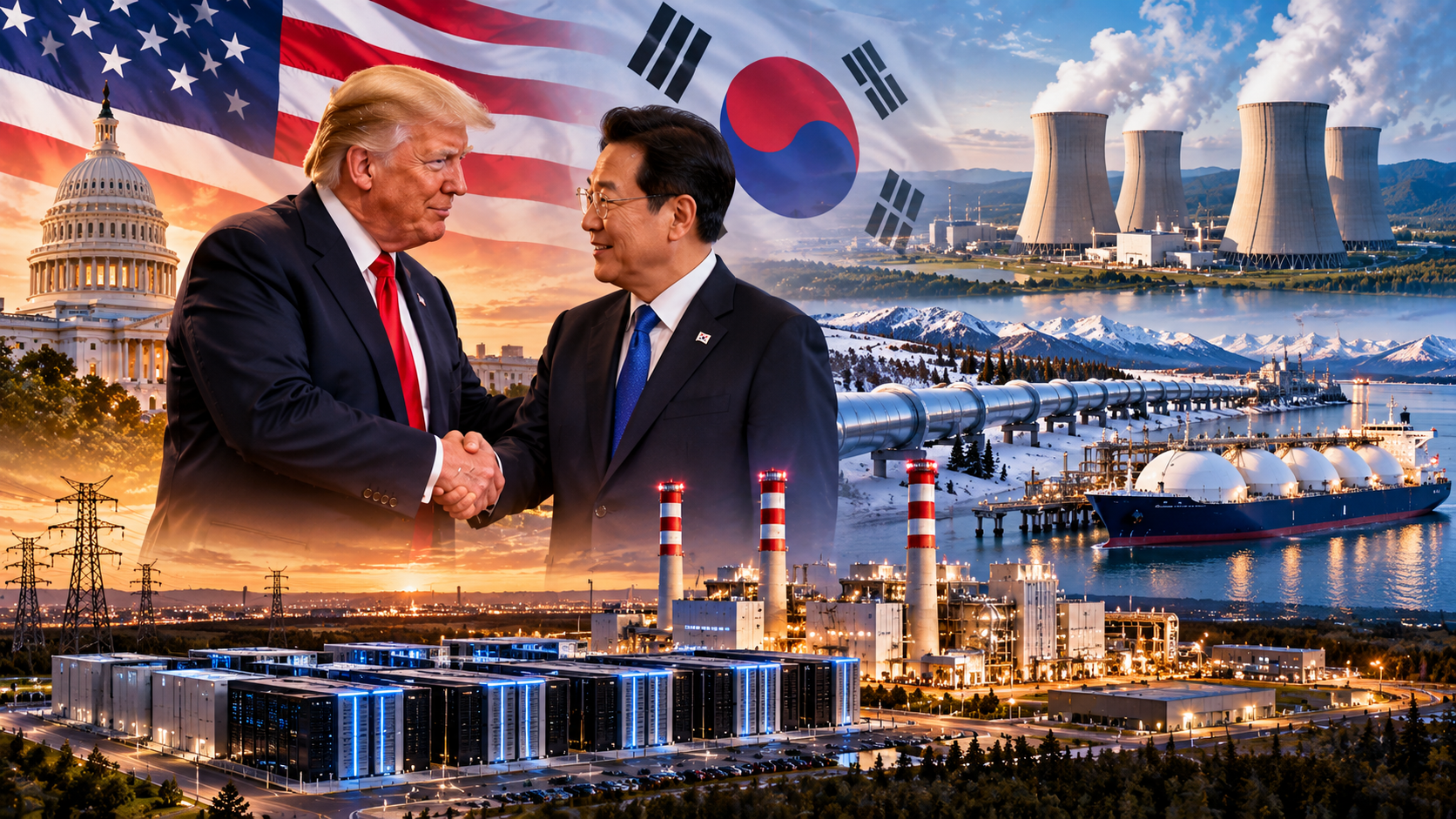
Package includes eight nuclear reactors, a Texas gas-fired power project and a proposed Alaska LNG development, but Seoul says the Alaska investment is not yet final
US President Donald Trump has announced plans for up to $200 billion of South Korean investment in major US infrastructure and energy projects, marking the first major implementation step under a broader $350 billion strategic investment package agreed between Washington and Seoul.
The projects unveiled by the US administration include eight large-scale nuclear reactors, a gas-fired power facility in Texas and the long-delayed Alaska LNG project. However, South Korea has drawn a distinction between projects it has selected and those that remain subject to commercial and legal review.
The most significant uncertainty surrounds the proposed Alaska LNG investment, which Trump has put at roughly $54 billion. Seoul's government said no final decision has been made on whether to invest in the project or on the eventual size of any investment.
$350 Billion Strategic Investment Framework
The newly announced projects form part of a wider $350 billion strategic investment package associated with a US-South Korea trade agreement.
Under the framework, $150 billion was earmarked for shipbuilding-related investment, while another $200 billion was designated for strategic investments in the United States.
The latest announcement therefore represents the beginning of the project-level implementation of the strategic investment component rather than the completion of the entire $350 billion programme.
The scale of the proposed investments places energy infrastructure at the centre of the economic relationship between the two countries.
Eight Nuclear Reactors in the US
One of the largest confirmed components involves South Korean investment of about $120 billion in eight nuclear reactors.
The planned nuclear investment comes at a time when US electricity demand is increasing, particularly because of data centres, artificial intelligence infrastructure and new manufacturing facilities.
South Korea has significant expertise across nuclear engineering, equipment and project development, making its companies potential participants in the expansion of US nuclear-generation capacity.
The projects could also create opportunities for South Korean engineering and equipment suppliers while supporting additional US electricity-generation capacity.
However, the eventual project pipeline, construction schedules, financing arrangements and individual reactor locations will determine the economic impact of the investment.
$22.3 Billion Texas Power Project
South Korea has separately confirmed a $22.3 billion investment in a gas-fired power project in Encinal, Texas.
The facility is expected to have more than 6 gigawatts of generation capacity and is being developed to supply electricity to energy-intensive operations, including artificial intelligence data centres.
South Korean officials said the project was selected after an assessment of its commercial viability.
The project highlights the growing connection between the AI infrastructure boom and demand for new electricity-generation capacity in the US. Reuters reported that initial commercial operations are targeted for 2029.
For South Korean investors and companies, the project could provide exposure to the rapidly expanding US data-centre electricity market while supporting the country's broader strategic investment commitments.
Alaska LNG Investment Remains Uncertain
The most politically prominent component of the announcement is the proposed Alaska LNG project.
Trump has placed the South Korean investment in the project at around $54 billion. Seoul, however, said the investment is not yet final.
South Korea's industry ministry said it would review the Alaska LNG project for commercial viability and compliance with legal procedures. President Lee Jae Myung also said the commercial viability of the LNG project and nuclear investments would need to be confirmed before they proceed.
That distinction is important because the Alaska project has been under discussion for years but has repeatedly faced questions over cost, financing, customer commitments and commercial returns.
What Is the Alaska LNG Project?
The proposed Alaska LNG development is designed to transport natural gas from Alaska's North Slope through an approximately 800-mile pipeline to a liquefaction facility on the state's southern coast.
The project is designed to transport around 3.9 billion cubic feet of natural gas per day and produce up to 20 million tonnes of LNG annually, according to the White House figures cited by Reuters.
Its geographic location could give it a shorter shipping route to major Asian LNG markets compared with US Gulf Coast export terminals.
Reuters reported that the project is estimated to cost between roughly $44.5 billion and $54.5 billion, depending on the scope and estimates, and is being developed by Glenfarne Group with the state of Alaska also holding an ownership interest.
Commercial Viability Is the Key Test
The biggest challenge for Alaska LNG is not simply securing political backing but establishing a commercially viable financing and offtake structure.
The project has lined up preliminary commitments covering around 13 million tonnes of annual LNG supply, but additional commitments are required and existing arrangements need to become sufficiently binding to support a final investment decision.
Japan's JERA and Tokyo Gas have also signed preliminary agreements to purchase a combined 2 million tonnes a year if the project is developed.
Reuters has reported that the project still faces competition from lower-cost LNG supplies from the US Gulf Coast and Canadian developments. High construction costs and the risk of cost overruns remain additional considerations.
Energy Security and Asian LNG Supply
If developed, Alaska LNG could give Asian buyers another source of natural gas and provide the US with a major new LNG export route to the Pacific.
For South Korea, the project could potentially strengthen long-term energy supply diversification. South Korea is one of the world's major LNG-importing economies and relies heavily on imported energy.
For Washington, an Alaska LNG development would support the administration's objective of expanding US energy exports and strengthening energy relationships with Asian allies.
However, those strategic considerations do not remove the need for commercially viable pricing and long-term purchase agreements.
Investment Could Strengthen US-Korea Economic Ties
The announcement also demonstrates how trade policy, industrial investment and energy security are increasingly interconnected in the US-South Korea relationship.
The investment programme could generate business for American construction companies, engineering firms, equipment manufacturers, utilities and energy developers. South Korean companies could gain greater access to US infrastructure projects and long-term energy markets.
The nuclear, gas and LNG projects could also create opportunities across the supply chain, including engineering, construction equipment, power equipment, steel, specialised components and services.
Political and Implementation Considerations
The investment announcement comes ahead of the US midterm elections, and Trump has highlighted the package as part of his administration's economic agenda. Reuters reported that the White House announcement is among a series of investment and economic initiatives being promoted by the administration.
For the projects themselves, however, implementation will depend on factors beyond political announcements.
Financing arrangements, regulatory approvals, construction costs, customer commitments, project economics and contractual terms will determine how much of the proposed investment ultimately translates into actual construction and capital deployment.
The distinction is particularly important for Alaska LNG, where Seoul has explicitly said that its investment decision remains subject to further review.
Implications for Energy and Infrastructure Markets
The proposed package could have wider implications for US energy and infrastructure markets if the projects move ahead.
The nuclear component would add potential long-term demand for reactor equipment, engineering and construction services. The Texas gas-fired facility would support electricity supply for energy-intensive industries and data centres, while Alaska LNG could generate demand across pipeline construction, liquefaction infrastructure, shipping and gas production.
The projects also reflect a broader shift in infrastructure investment towards sectors supporting AI, manufacturing, energy security and strategic supply chains.
What Happens Next?
The next stage will be project-level due diligence and implementation.
South Korea will continue evaluating the commercial and legal framework of Alaska LNG, while the Texas power project and nuclear investments move through their respective development processes.
For Alaska LNG, the key milestones will include additional LNG offtake commitments, financing arrangements and a final investment decision.
The nuclear projects will require project selection, regulatory approvals and detailed financing structures before construction can begin.
US-South Korea Economic Outlook
The proposed $200 billion investment programme represents a significant expansion of South Korean capital commitments to the US, but the headline figure should not be interpreted as an immediate cash deployment across all projects.
The Texas power project and nuclear investments have received clearer confirmation, while the Alaska LNG component remains conditional on further commercial and legal evaluation.
The broader significance of the announcement will therefore depend on execution. If the projects secure financing and move into construction, they could deepen US-South Korean industrial ties while supporting US electricity generation, energy exports and infrastructure development.
For markets, the key indicators to watch will be actual capital commitments, project approvals, LNG offtake agreements, construction timelines and the final investment decision on Alaska LNG.
::