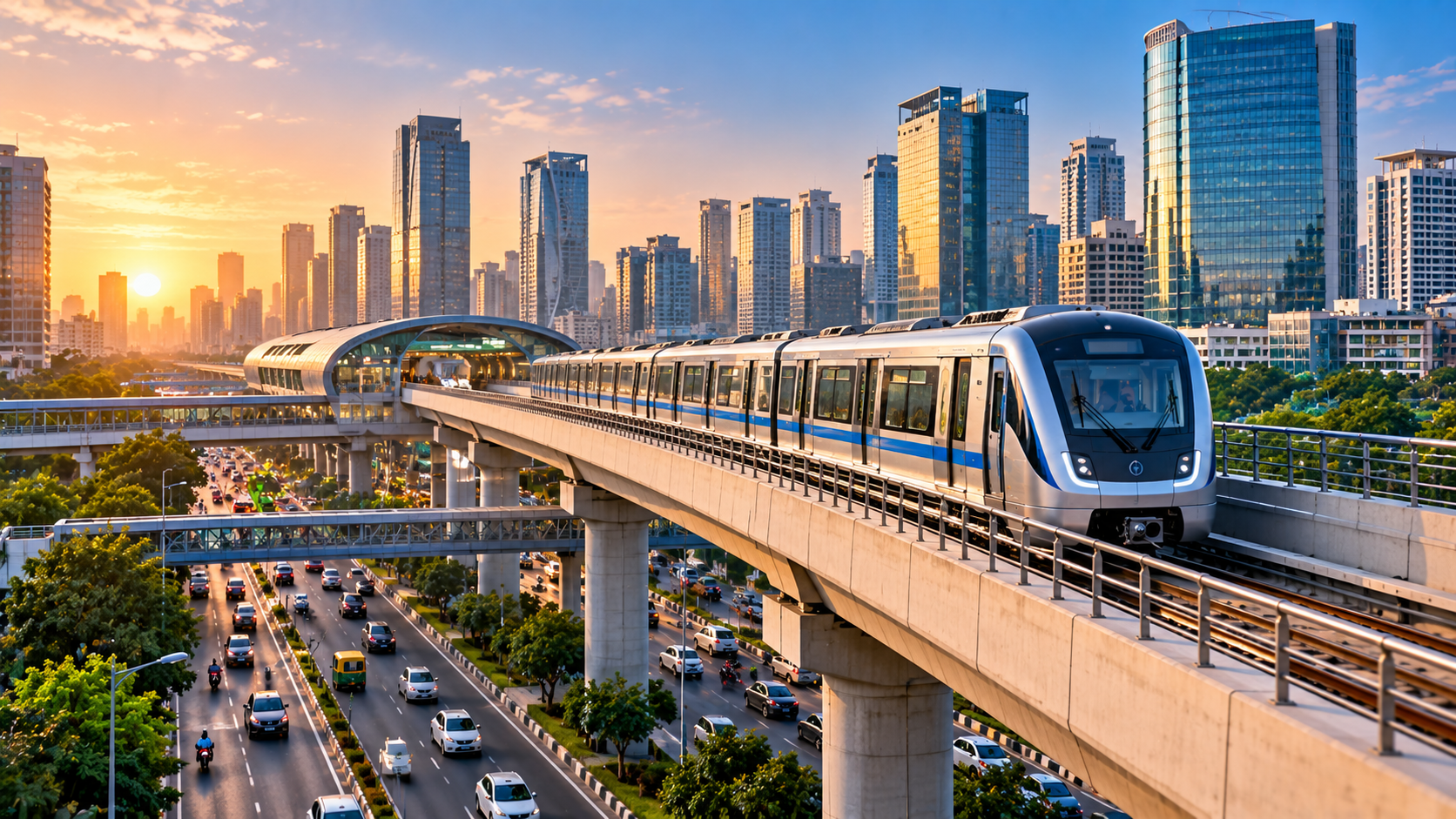
15.3-km elevated corridor from Sector 9 to Cyber City to get 14 stations, interchanges with Rapid Metro and Namo Bharat, and double-decker stretches at key traffic corridors
The Haryana government has approved a ₹1,662-crore civil construction package for Phase 2 of the Gurugram Metro, clearing an important hurdle for the next stage of the city's ambitious mass-transit project.
According to officials, Gurugram Metro Rail Limited (GMRL) is expected to float the tender within the first week of October. The package will cover the elevated corridor from Sector 9 to DLF Cyber City through several established residential and commercial areas of Old Gurugram.
The approval is significant because Phase 2 will complete the northern portion of the larger Millennium City Centre-Cyber City metro corridor and connect residential neighbourhoods with major employment centres such as Udyog Vihar and Cyber City.
15.3-Km Corridor With 14 Stations
The Phase 2 stretch will cover around 15.3 km and comprise 14 stations. The alignment will pass through important areas including Sector 7, Sector 4, Sector 5, Ashok Vihar, Sector 3, Bajghera Road, Palam Vihar Extension, Palam Vihar, Sector 23A, Sector 22, Udyog Vihar Phase 4, Udyog Vihar Phase 5 and Cyber City.
The route is designed to improve connectivity between Old Gurugram and the city's major commercial and employment districts.
Cyber City, in particular, is one of Gurugram's largest corporate hubs, while Udyog Vihar hosts a large concentration of offices and industrial and commercial establishments. The metro is therefore expected to serve a substantial daily commuter base once the corridor becomes operational.
Double-Decker Metro Sections to Ease Road Congestion
One of the notable engineering features of Phase 2 will be double-decker sections along Bajghera and Old Delhi Road.
In these stretches, the metro infrastructure will be elevated above existing road traffic, allowing the road network to continue functioning underneath. Around 2 km of the alignment is expected to use such flyover-cum-metro structures.
The design is particularly relevant for Gurugram, where several arterial roads experience heavy congestion during peak office hours. By combining road and metro infrastructure within the same corridor, the project aims to use limited urban space more efficiently.
Interchange With Rapid Metro and Namo Bharat
Another important feature of the Phase 2 alignment will be multimodal connectivity.
The corridor is planned to provide interchange facilities with the existing Rapid Metro network as well as the Namo Bharat Rail corridor. This could allow commuters to shift between different rail systems instead of relying on road transport for the entire journey.
The planned integration is part of a wider effort to create a more connected public transport network across Gurugram and its surrounding areas.
Phase 1 Already Under Construction
The larger Gurugram Metro project covers approximately 28.5 km and has been sanctioned with 27 stations and a depot. GMRL describes the corridor as a link between Old and New Gurugram, with connectivity to residential, institutional, commercial and industrial areas.
The first phase runs from Millennium City Centre to Sector 9. Construction is already underway on this section.
Phase 1 includes stations serving locations such as Sector 45, Cyber Park, Sector 47, Subhash Chowk, Sector 48, Sector 72A, Hero Honda Chowk, Udyog Vihar Phase 6, Sector 10, Sector 37 and Basai Village, before reaching Sector 9. The broader project also includes a spur towards the Dwarka Expressway.
GMRL's official tender information shows that construction packages for the Millennium City Centre-Sector 9 portion have already progressed through the contracting process.
Full Corridor Targeted to Transform Gurugram Connectivity
The Union Cabinet originally approved the Gurugram metro connectivity project in 2023 at a completion cost of ₹5,452 crore. The sanctioned project comprised a 26.65-km main elevated corridor and a 1.85-km spur towards the Dwarka Expressway.
The project is intended to create a continuous public transport link between Millennium City Centre and Cyber City while improving connectivity across areas that have historically depended heavily on road-based transportation.
The line also has the potential to strengthen connectivity between established commercial centres and developing residential zones, particularly along the Old Gurugram corridor.
World Bank Funding and Tender Process
The Phase 2 tender process has been closely linked to financing arrangements involving the World Bank.
Earlier in 2026, GMRL submitted a revised proposal for the civil works package after changes were made to the scope of work. The revised proposal covered components such as track laying, station construction and selected double-decker structures, while traction and certain design components were excluded from the World Bank-funded package.
The latest Haryana approval for the ₹1,662-crore civil package now clears the way for the tender to move forward.
The increase from earlier estimates reflects changes in the scope and structure of the civil works package and should be viewed separately from the overall cost of the complete metro project.
Why Phase 2 Matters for Gurugram
Gurugram's rapid expansion has produced a geographical mismatch between residential neighbourhoods and employment centres. Large office districts such as Cyber City and Udyog Vihar attract commuters from across the National Capital Region, while several established residential areas of Old Gurugram remain heavily dependent on roads.
The new metro corridor is intended to address this gap by providing an elevated public transport option through densely populated areas.
Better rail connectivity could also support transit-oriented development around stations, although the actual impact will depend on station accessibility, last-mile connectivity, feeder services and integration with existing transport systems.
Potential Impact on Real Estate and Commercial Activity
Metro infrastructure can influence real estate demand by improving accessibility to employment centres and reducing dependence on private vehicles.
For Gurugram, the Phase 2 alignment passes through areas that already contain a mix of residential colonies, commercial establishments and business districts. Improved connectivity could increase the attractiveness of properties located close to stations, while encouraging greater commercial activity along the corridor.
However, the extent of any property-market impact will depend on the final construction schedule, station access, last-mile connectivity and the quality of interchange facilities.
Execution Timeline Remains Important
The approval comes after delays in moving the Phase 2 tender forward. With the larger corridor targeted for completion around 2029, timely tendering and construction will be important to maintaining the project's overall schedule.
Metro projects of this scale also involve multiple stages beyond civil construction, including track installation, signalling, electrical and traction systems, testing, safety certification and commissioning.
Any delays in one component can affect the opening timeline of the entire corridor.
What Comes Next
With the ₹1,662-crore civil package cleared, the immediate milestone is the floating of the Phase 2 tender and subsequent selection of the construction contractor.
The project will then move through bidding, award, mobilisation and construction. Coordination with road agencies, landowners and other transport systems will also be important, particularly around the double-decker sections and planned interchange points.
Meanwhile, work on Phase 1 from Millennium City Centre to Sector 9 will continue in parallel.
Infrastructure Outlook
The approval of the Phase 2 civil works package marks another major step in the development of Gurugram's planned 28.5-km metro network. The Sector 9-Cyber City section is particularly important because it connects Old Gurugram with some of the city's largest employment and commercial centres.
If tendering and subsequent construction progress according to schedule, the project could gradually reduce dependence on road-based commuting and create stronger links between Gurugram's residential, commercial and employment districts.
For the city's infrastructure and real-estate ecosystem, the key factors to monitor will now be the tender award, construction progress, station-level execution, interchange development and adherence to the targeted completion timeline.