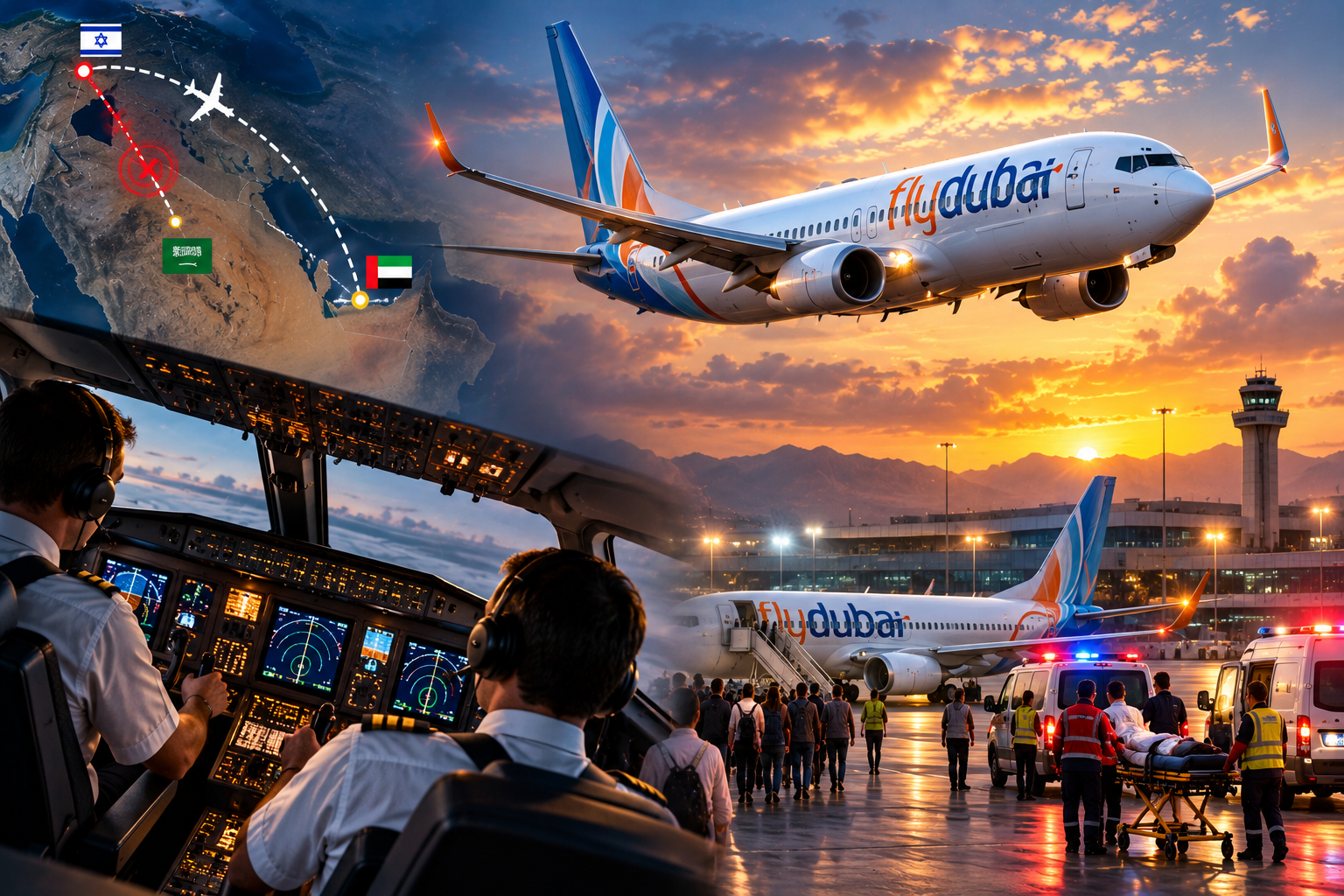
Flydubai flight FZ1073 was diverted to Saudi Arabia after a violent cockpit incident; Indian captain Smit Machchhar was injured and passengers and crew helped bring the situation under control
A Flydubai flight travelling from Dubai to Tel Aviv was diverted to Saudi Arabia on Wednesday after a violent incident inside the cockpit left the captain injured and triggered an emergency response.
Flight FZ1073, operating a Boeing 737-8 MAX from Dubai International Airport to Ben Gurion Airport, landed safely at Tabuk in northwestern Saudi Arabia after the aircraft transmitted emergency signals and experienced a rapid descent.
The flight was carrying 174 people, including 27 children. All passengers were subsequently reported safe.
According to Israeli officials and Reuters reporting, the co-pilot allegedly stabbed Indian Captain Smit Machchhar and attempted to take control of the aircraft. The precise motive and complete sequence of events remain under investigation. Flydubai has confirmed that an incident occurred on board but has cautioned against speculation before authorities complete their investigation.
How the Incident Began
The aircraft was cruising at around 33,000-34,000 feet when an altercation reportedly broke out between the two pilots.
According to reports cited by Israeli officials, the co-pilot attacked Captain Machchhar inside the cockpit. The aircraft subsequently entered a rapid descent.
Flight-tracking information showed the aircraft losing nearly 14,000 feet in less than 30 seconds at one point during the emergency. The aircraft later stabilised at a lower altitude and diverted towards Tabuk, Saudi Arabia.
The aircraft also transmitted emergency signals during the incident. Flight-tracking data indicated that an initial general emergency code was followed by a code associated with unlawful interference before the aircraft later returned to a general emergency signal.
The unusual emergency initially raised concerns about a possible hijacking.
Israeli officials subsequently said the episode was not believed to be a conventional hijacking, although later accounts described the incident as an alleged attempt by the co-pilot to take control of the aircraft.
Captain Smit Machchhar Injured in the Cockpit
Captain Smit Machchhar, an Indian national and experienced commercial pilot, was seriously injured during the confrontation.
Despite his injuries, reports say Machchhar managed to resist the attacker and open the cockpit door. This allowed passengers and other crew members to enter the flight deck and intervene.
Reuters reported that two additional Flydubai pilots were travelling on the aircraft and later helped take control of the aircraft and land it safely at Tabuk.
Both pilots were taken to hospital after the aircraft landed.
Machchhar subsequently underwent medical treatment and was reported to be in stable condition. Indian officials have remained in contact with his family and Saudi authorities.
Passengers and Crew Enter Cockpit
The situation changed after the cockpit door was opened.
Passengers and crew members reportedly entered the cockpit and helped restrain the co-pilot.
Reuters reported that passengers described a chaotic sequence of sudden altitude drops followed by periods in which the aircraft stabilised. Some passengers then realised that a struggle was taking place near the front of the aircraft.
Israeli passenger Almog Italie told reporters that the aircraft appeared to drop sharply several times, creating significant turbulence and confusion among passengers.
Another passenger, Yaniv Hayoun, was among those who entered the cockpit. He later described seeing the attacker interfering with the aircraft's controls.
The intervention of passengers, cabin crew and additional pilots became a crucial part of the response that ultimately allowed the aircraft to reach the airport safely.
Backup Pilots Help Land the Aircraft
Once the immediate threat inside the cockpit was brought under control, the aircraft was diverted to Prince Sultan bin Abdulaziz International Airport in Tabuk.
The presence of additional qualified pilots on board was significant during the emergency. According to Reuters, two off-duty Flydubai pilots helped take control of the aircraft and land it safely.
The aircraft reached Tabuk without further reported incident.
Saudi authorities subsequently provided medical assistance to the injured pilots.
The passengers were later transported from Saudi Arabia back to Israel on another Flydubai aircraft. Reuters reported that all 174 passengers were ultimately accounted for and returned safely.
Why the Aircraft Was Diverted to Saudi Arabia
The aircraft was travelling west towards Israel when the emergency occurred.
Given the rapid descent, emergency communications and the situation inside the cockpit, the crew diverted to Tabuk, which provided a suitable airport for an emergency landing.
The diversion also took place against the backdrop of heightened security concerns in the wider West Asian region.
Israeli authorities initially considered the possibility of a hijacking and responded accordingly. However, officials later indicated that the incident appeared to have originated from an altercation between the pilots rather than a conventional external hijacking.
The precise classification of the incident remains subject to investigation.
What Flydubai Has Said
Flydubai confirmed that flight FZ1073 experienced an incident while travelling from Dubai to Tel Aviv.
The airline said the aircraft landed safely in Tabuk and that all passengers were safe and accounted for.
The airline has also said that its teams were working with the relevant authorities and that further information would be provided as confirmed details became available.
Flydubai has temporarily suspended flights to and from Israel while the investigation continues.
The airline's limited public comments have also highlighted the importance of waiting for official findings before drawing conclusions about the motive behind the incident.
Investigation Into the Cockpit Attack
Authorities in Saudi Arabia and Israel are investigating what happened inside the aircraft.
One of the key questions is why the co-pilot allegedly attacked the captain and attempted to interfere with the aircraft's controls.
The motive has not been established publicly.
Reuters reported that Saudi authorities were expected to question the co-pilot, while Israeli authorities were examining the circumstances surrounding the incident.
Several early reports contained differing descriptions of the incident, including whether it should be considered an attempted hijacking or another form of unlawful interference.
Investigators will need to establish the sequence of events using cockpit data, flight-recorder information, communications, witness accounts and other evidence.
Incident Renews Focus on Cockpit Security
The episode has also renewed attention on security measures designed to protect aircraft cockpits.
Commercial aircraft have reinforced cockpit doors and strict access procedures intended to prevent unauthorised entry. However, an incident involving members of the flight crew presents a different security challenge from an external intrusion.
The incident has already prompted discussion about whether additional cockpit recording or monitoring measures could help investigators understand such events.
A Bloomberg report published by Business Standard noted that cockpit video recording could potentially provide investigators with a visual record during an incident, although privacy concerns and opposition from pilot groups have historically complicated proposals for mandatory cockpit cameras.
Any changes to aviation-security rules would ultimately depend on findings from the investigation and decisions by aviation regulators.
Captain Machchhar's Aviation Career
Captain Smit Machchhar is an experienced commercial pilot who previously worked with Indian airline SpiceJet before joining Flydubai.
Reuters reported that Machchhar spent around 11 years with SpiceJet and joined Flydubai in 2022. He has approximately 9,750 hours of flying experience, primarily on Boeing 737 aircraft.
Reports said he had initially considered joining his family's textile business before developing an interest in aviation. He subsequently trained in New Zealand and built a career in commercial aviation.
His experience has been highlighted in reporting following the incident as authorities and aviation professionals assess how the emergency was managed.
PM Modi Praises Captain Machchhar
Prime Minister Narendra Modi on Thursday praised Captain Machchhar and described him as a hero.
Modi said the pilot had demonstrated courage despite being seriously injured and credited his actions with helping prevent a major tragedy.
The Prime Minister also wished Machchhar a speedy recovery.
Israeli Prime Minister Benjamin Netanyahu also praised the Indian captain and the passengers and crew who intervened during the incident.
Netanyahu said Machchhar's actions, including opening the cockpit door, enabled passengers and crew members to overpower the attacker.
The international recognition came as the pilot continued receiving medical treatment in Saudi Arabia.
Passengers Return Safely to Israel
Following the emergency landing, passengers remained in Saudi Arabia while arrangements were made for their onward journey.
A replacement Flydubai aircraft was subsequently used to transport the passengers to Israel.
Reuters reported that the passengers arrived safely in Tel Aviv after the emergency landing in Tabuk.
The safe return of all passengers brought the immediate operational emergency to an end, although the investigation into what happened inside the cockpit remains ongoing.
What Happens Next?
The investigation is expected to focus on several areas, including the actions of the two pilots, cockpit access, emergency communications, flight-data records and the circumstances that led to the rapid descent.
Authorities are also likely to examine whether existing crew-screening and cockpit-security procedures were followed and whether additional safeguards are required.
For Flydubai, the immediate priority remains cooperation with authorities and the safe resumption of operations on affected routes once regulators and the airline determine that appropriate measures are in place.
Market Outlook
The Flydubai incident is primarily an aviation-safety and security event rather than a conventional market-moving corporate development. However, its potential implications extend to airline operations, route availability, aviation security procedures and insurance costs.
The temporary suspension of Flydubai flights to and from Israel could affect the airline's near-term operations on those routes. The longer-term impact will depend on the investigation, the duration of the suspension and whether regulators introduce additional security requirements.
For the broader aviation industry, the key issue will be whether authorities introduce changes to cockpit-security, crew-screening or recording procedures following the investigation.
For now, the most significant development is that all 174 passengers reached safety, while Captain Smit Machchhar continues to recover from injuries sustained during the cockpit confrontation. The investigation will determine the precise sequence of events and the motive behind the alleged attack.