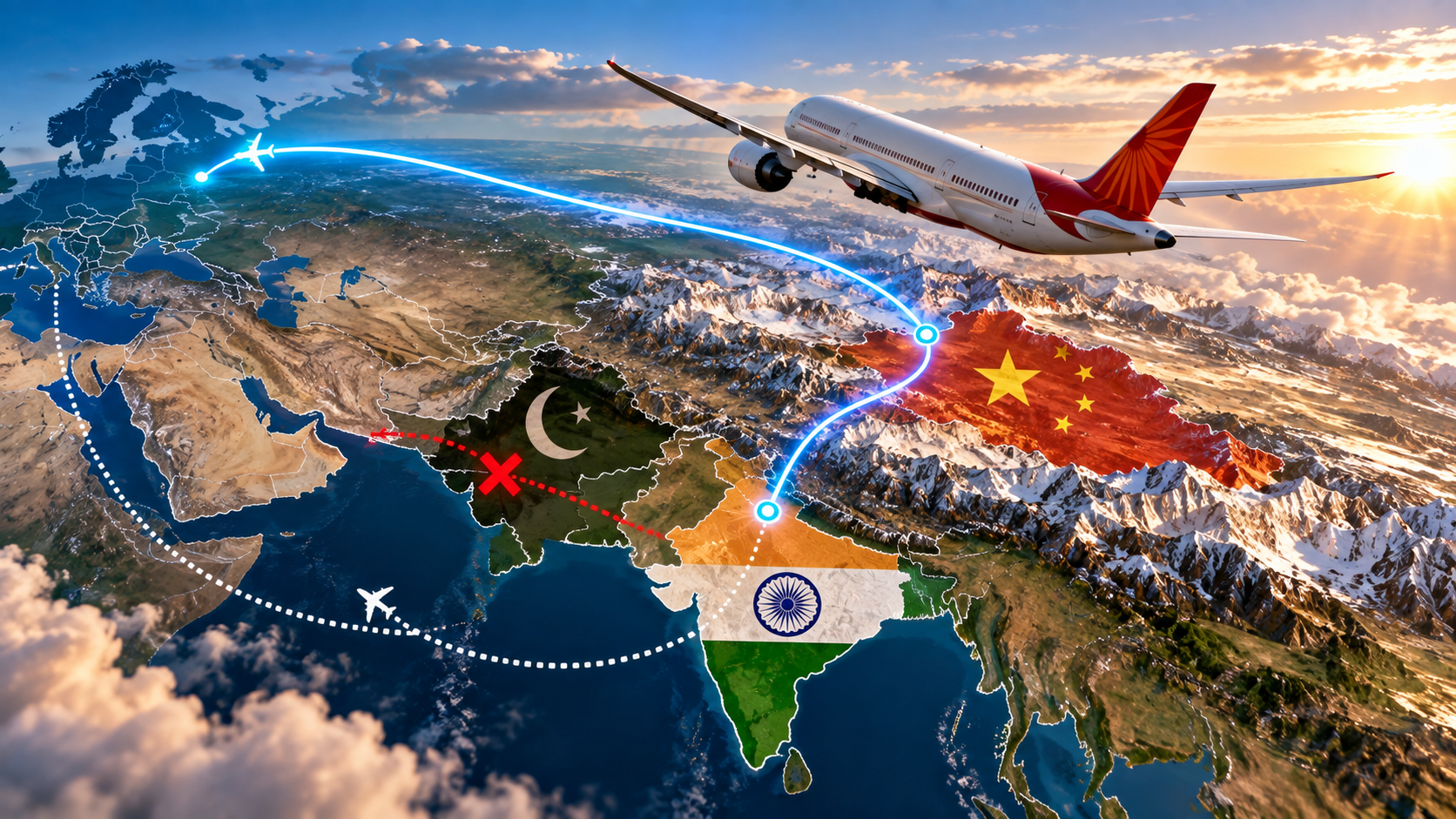
India is exploring a Hotan route through China to reduce the time and cost burden created by the prolonged Pakistan airspace closure, but diplomatic approvals, high-altitude terrain and emergency-diversion constraints remain major challenges
India is exploring an alternative international air corridor through China's Xinjiang region as airlines continue to face longer routes because of the prolonged closure of Pakistani airspace.
Civil Aviation Minister Ram Mohan Naidu said discussions on a possible route through Hotan in southwestern Xinjiang are underway between India and China, with the Ministry of External Affairs also engaging with Beijing. No agreement or operational timeline has been announced so far.
The proposal is significant for Indian airlines because a viable northern corridor could shorten flights from India towards Europe and North America, potentially reducing fuel consumption, crew costs and aircraft utilisation pressures.
However, the route would require arrangements with China and would have to meet stringent aviation-safety requirements because parts of the proposed corridor pass through some of the world's most challenging mountainous terrain.
Pakistan Airspace Closure Has Reshaped Westbound Flights
Pakistan's airspace restrictions on Indian aircraft have remained in place since April 2025 and were most recently extended until October 24, 2026. The latest Pakistani NOTAM applies to Indian-registered aircraft as well as aircraft owned, operated or leased by Indian airlines and operators, including military flights.
The restriction has forced Indian carriers operating western long-haul services to use alternative routes. Depending on the destination and routing, aircraft can be required to fly substantially farther around Pakistan, adding both time and fuel expenditure.
Air India has been particularly exposed because Delhi and Mumbai are important hubs for its long-haul network to Europe and North America. Air India's former CEO Campbell Wilson had previously estimated the financial impact of the Pakistan airspace closure at around ₹4,000 crore. The Airports Authority of India also recorded his comments on the additional financial burden created by the restrictions.
The longer routings become even more significant when jet-fuel prices are elevated because every additional hour in the air increases fuel burn as well as crew and aircraft-utilisation costs.
Why Hotan Is Being Considered
The proposed alternative centres on Hotan, a city in southwestern Xinjiang, close to the northern side of the Himalayas and the Karakoram.
A possible route from northern India could head north towards the Himalayan region, enter Chinese airspace around Xinjiang and then connect with established routes towards Central Asia and Europe.
The precise routing would depend on the airspace permissions and route structure eventually agreed between the two countries. Indian authorities have not publicly announced a final flight path.
The attraction is straightforward: if Indian airlines can obtain a commercially and operationally viable corridor through Xinjiang, some flights could avoid the lengthy detour over the Arabian Sea and onward through the Middle East.
Indian authorities have reportedly been discussing alternative routes with China for around a year, although no agreement has yet been reached.
Potential Savings for Airlines
The most immediate benefit would be a reduction in flying distance on selected western routes.
Shorter routes can potentially deliver savings through lower fuel consumption, fewer crew hours and better utilisation of aircraft. For long-haul carriers operating wide-body aircraft, even relatively small reductions in flight time can become financially meaningful when multiplied across a large number of services.
A shorter route could also reduce the need for technical refuelling stops on some flights, depending on the aircraft type, payload, weather conditions and final route design.
The benefit would not necessarily be identical for every destination. European cities located farther north could see different savings from destinations in West Asia or southern Europe.
For airlines, therefore, the key question is not simply whether China permits an overflight but whether the approved route is sufficiently direct and operationally practical to deliver meaningful savings.
China Would Need to Approve the Airspace Access
One of the biggest hurdles is diplomatic.
Civil aviation overflight rights are governed through international aviation frameworks and bilateral arrangements, but an airline cannot simply select a foreign airspace corridor because it is geographically shorter.
India and China already have an air-services agreement listed by India's Ministry of Civil Aviation, dating from December 1988. However, the proposed use of Chinese airspace by Indian airlines would still require the relevant operational and diplomatic arrangements for the specific routing and services involved.
Chinese authorities would need to approve the route, applicable flight procedures and other operational conditions.
That makes the proposal partly an aviation issue and partly a diplomatic one.
India-China Relations Add Another Layer
The proposed air corridor comes against the backdrop of India's broader engagement with China, including ongoing discussions over their disputed boundary.
In August 2026, China said the 25th round of India-China Special Representatives' talks on the boundary question produced an eight-point set of outcomes and consensus, including commitments to maintain peace and tranquillity in border areas and continue negotiations.
The air corridor is a commercial aviation proposal rather than a border arrangement, but its implementation would still require sustained official engagement between the two governments.
For India, the objective is primarily operational: reduce the economic burden created by the Pakistan airspace restrictions. For China, any approval would involve consideration of its own airspace management, aviation security and bilateral relations.
The Himalayas Create a Major Safety Challenge
Even if diplomatic approval is obtained, geography presents another significant obstacle.
Parts of the proposed route are close to the Himalayas, Karakoram and other very high mountain ranges. That creates particular challenges for aircraft in emergency situations.
Commercial aircraft are designed to descend rapidly to lower altitudes following a depressurisation event because passengers and crew have limited supplemental oxygen. Over extremely high terrain, however, the normal emergency-descent profile may not be possible without carefully planned escape routes.
Engine failures create a related challenge. A twin-engine aircraft operating at high altitude may need to descend significantly after losing an engine, and the available flight path must maintain adequate terrain clearance.
Consequently, a route through mountainous terrain requires detailed assessments of minimum safe altitudes, navigation, weather, emergency procedures and suitable diversion airports.
Limited Diversion Airports Could Restrict the Route
Another major consideration is the availability of suitable airports for emergency diversions.
International carriers generally prefer routes with multiple suitable diversion airports distributed along the flight path. This gives pilots more options in cases involving medical emergencies, mechanical problems, severe weather or other operational disruptions.
The Xinjiang corridor has comparatively fewer airports that may be suitable for international wide-body aircraft diversions, especially when terrain and weather are considered.
Reuters-based reporting cited in the original report also noted that international airline activity at Hotan has been extremely limited. That means regulators and airlines would need to conduct detailed operational assessments before treating the corridor as a routine international route.
Weather Could Be Another Variable
The region's geography can also produce complex weather conditions.
High-altitude terrain can create rapidly changing winds, turbulence and visibility conditions. Winter operations could present additional challenges because of snow and icing at high-altitude airports and mountain passes.
Airlines would therefore need route-specific weather data, navigation infrastructure, communications coverage and contingency procedures before deploying regular services through the corridor.
The final route would need to satisfy both regulatory requirements and individual airlines' operational safety standards.
Air India Could Be a Major Beneficiary
Air India has a particularly strong interest in shorter western routes because of its long-haul network from Delhi and Mumbai.
The airline operates a fleet of Boeing 777s, Boeing 787s and Airbus A350s, aircraft types capable of operating long international sectors. A route that reduces flight time could improve aircraft utilisation and potentially allow more efficient scheduling.
The impact could also extend to passenger experience. Shorter flying times can make nonstop services more attractive compared with longer routings or journeys involving technical stops.
However, the actual benefit would depend on the route eventually approved, the destinations covered and whether the corridor is available on a sufficiently consistent basis.
IndiGo Could Also Gain From a New Northern Corridor
IndiGo's international expansion makes access to alternative airspace increasingly relevant.
The airline is building a larger long-haul network and has announced plans involving wide-body Airbus A350 aircraft. A reliable northern corridor could potentially become useful as its long-haul operations expand.
However, any benefit would depend on aircraft capability, route permissions and the final operating framework established by Indian and Chinese authorities.
The Iran and Middle East Factor
The need for alternative routes has become more important because Indian airlines cannot rely on a single alternative to Pakistan.
Geopolitical developments in West Asia have periodically affected airspace availability and forced airlines to adjust routes. Industry monitoring groups have reported that many carriers have continued to avoid certain parts of Iranian airspace, pushing Asia-Europe traffic towards alternative northern or southern corridors.
This makes route diversification strategically important for airlines operating long-haul services between India and the West.
A China-Xinjiang option would therefore give Indian carriers another potential pathway rather than simply replacing one route with another.
What Could Stop the Hotan Corridor?
Several conditions would need to be satisfied before the proposed route could become operational.
First is diplomatic approval. India and China would need to agree on the necessary airspace and operational arrangements.
Second is aviation safety. Regulators and airlines would need to establish safe minimum altitudes, emergency procedures and acceptable escape routes through mountainous terrain.
Third is diversion infrastructure. The availability, capability and operational readiness of suitable airports would have to be assessed.
Fourth is commercial viability. The route must deliver enough savings to justify the additional complexity of operating through a new corridor.
Fifth is consistency. Airlines need predictable access. A corridor that can be used only intermittently would be less useful for scheduling and network planning.
A Strategic Alternative, Not Yet a Final Route
India's interest in the Hotan corridor reflects the growing economic importance of airspace access for airlines.
The prolonged Pakistan restriction has demonstrated how geopolitical decisions can directly affect fuel consumption, flight times, aircraft utilisation and airline profitability. For carriers operating long international routes, airspace is effectively part of their operating infrastructure.
The proposed Xinjiang corridor could provide India with another option, but it remains at the discussion stage. The Ministry of Civil Aviation has confirmed that Hotan is under consideration and that discussions with China are taking place; it has not announced a final agreement or launch date.
Aviation Outlook
The Hotan proposal is likely to remain closely watched by India's international airlines because a shorter northern route could potentially reduce the cost and time burden created by the Pakistan airspace closure.
For passengers, the most visible benefit would be shorter journey times on eligible routes. For airlines, the larger opportunity lies in lower fuel consumption, better aircraft utilisation and improved economics on long-haul operations.
But geography and diplomacy make the proposal considerably more complex than simply drawing a shorter line on a flight map. The final outcome will depend on India-China negotiations, airspace permissions, safety assessments, diversion planning and the commercial calculations of individual carriers.
Until those conditions are resolved, the Hotan corridor remains a proposal under discussion rather than an approved alternative route.
::