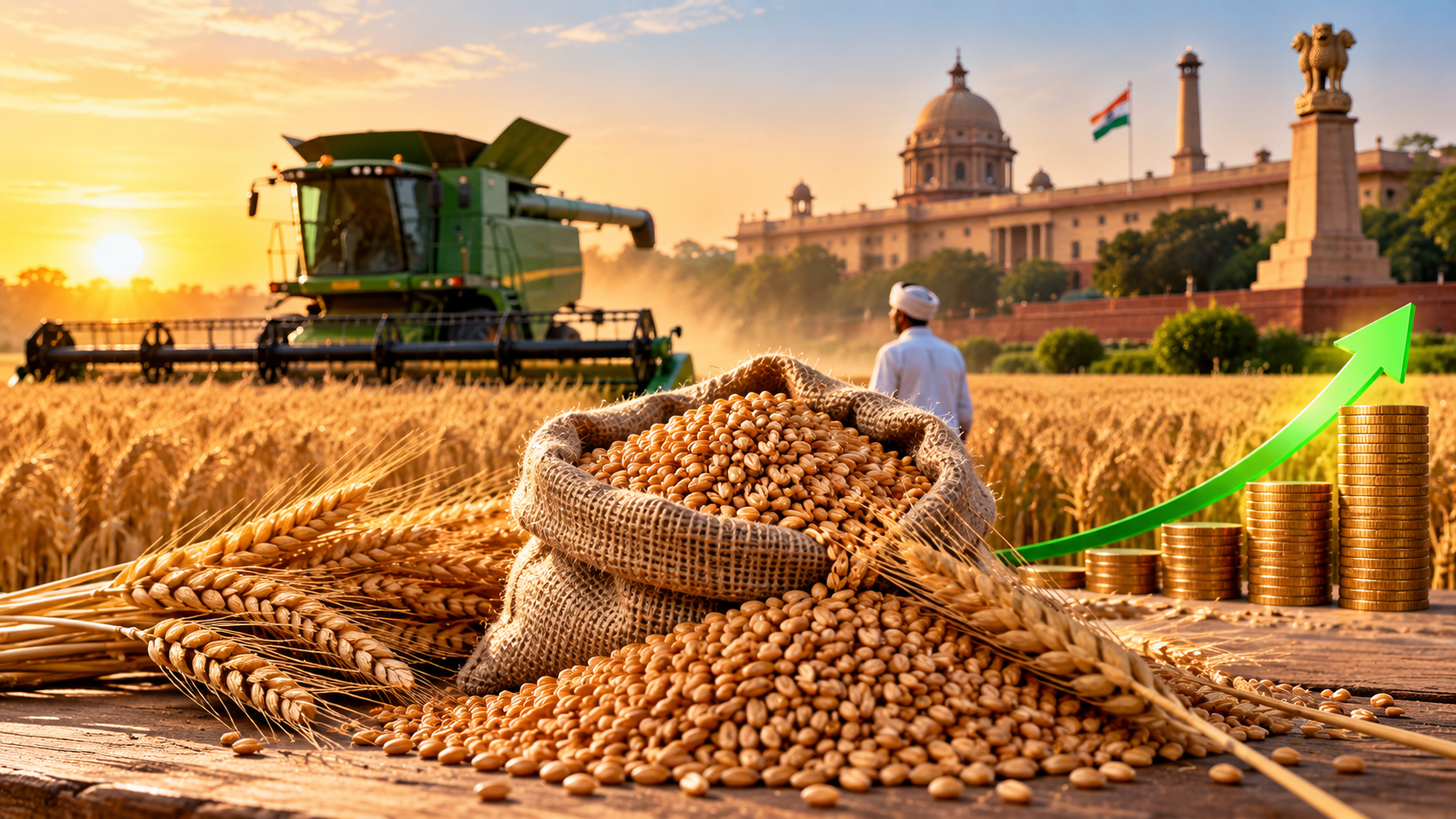
Proposed increase would take the minimum support price above ₹2,600 per quintal as the government weighs farm input costs, weather risks and domestic and global grain prices
The Union Cabinet is likely to approve a ₹25 per quintal increase in the minimum support price (MSP) of wheat for the 2027-28 rabi marketing season, taking the benchmark procurement price to ₹2,610 per quintal, according to sources cited in a report on Wednesday.
The proposed increase comes ahead of the upcoming wheat sowing season and would mark another rise in the government-set support price for India's most important rabi cereal crop. The MSP for wheat for the current 2026-27 marketing season was fixed at ₹2,585 per quintal.
The reported proposal is based on recommendations of the Commission for Agricultural Costs and Prices (CACP), with factors including cultivation costs, weather-related risks, and prevailing domestic and international prices taken into consideration.
Wheat MSP Has Been Rising Steadily
The proposed ₹25 increase would be considerably smaller than the ₹160 per quintal increase announced for the 2026-27 marketing season.
According to government data, wheat MSP rose from ₹2,425 per quintal for the 2025-26 marketing season to ₹2,585 for 2026-27. The government had estimated the all-India weighted average cost of production for wheat at ₹1,239 per quintal for the 2026-27 season, resulting in an MSP representing a 109% margin over that cost.
The proposed ₹2,610 MSP for 2027-28 would therefore represent an increase of around 1% over the current benchmark.
The longer-term increase is also significant. Wheat MSP stood at ₹1,400 per quintal in 2014-15, compared with ₹2,585 for 2026-27, representing an increase of about 84% over that period, according to government figures.
Why Wheat MSP Matters
Wheat is India's principal rabi crop, with sowing generally beginning in October and harvesting starting from April. The crop is particularly important for food security because it forms a major part of India's cereal consumption and government foodgrain procurement system.
The MSP provides a benchmark price at which government agencies can procure eligible agricultural produce. However, MSP is not an automatic purchase guarantee for every farmer or every quantity produced. The government has stated that only the marketable surplus is available for procurement, particularly when market prices fall below MSP.
For farmers, the announced MSP can influence sowing decisions, crop economics and expectations regarding post-harvest prices. For the broader economy, wheat procurement and stocks also have implications for food distribution and cereal price management.
CACP Recommendations and Cost Considerations
The CACP recommends MSPs after considering several factors, including production costs, demand and supply conditions, domestic and international prices, inter-crop price parity and the implications for consumers and the broader economy.
The government has maintained a policy of fixing MSPs at a minimum of 1.5 times the all-India weighted average cost of production for mandated crops. This approach has been followed since 2018-19.
For wheat, the government had estimated the production cost at ₹1,239 per quintal for the 2026-27 marketing season. The corresponding MSP was ₹2,585 per quintal.
The latest reported recommendation comes against a backdrop of uncertainty around weather conditions and global agricultural markets. Wheat production can be affected by temperature patterns during the crop's growth cycle, while international grain prices and trade conditions can influence domestic market prices.
Production Target Set at 121 Million Tonnes
The Agriculture Ministry has set a wheat production target of 121 million tonnes for the 2026-27 crop year, which runs from July 2026 to June 2027.
Achieving higher production remains important for maintaining domestic availability and supporting food-security requirements. Wheat output is influenced by acreage, irrigation availability, fertiliser use, weather conditions and yields.
A higher MSP can provide farmers with a stronger price reference while they make decisions about acreage and crop allocation. At the same time, actual farm-gate realisations depend on procurement availability, local mandi prices, quality, transportation costs and market conditions.
Implications for Food Prices and Government Procurement
The wheat MSP also has implications beyond farm incomes because government procurement is closely linked to the country's foodgrain management system.
A higher procurement benchmark can increase the cost of wheat acquired by government agencies if procurement takes place at or around the revised MSP. The eventual impact on consumer prices, however, would depend on several factors, including procurement volumes, government stock levels, open-market prices, foodgrain releases and broader food inflation.
The government reported that 310 lakh tonnes of the six major rabi crops were procured during RMS 2025-26, with the total MSP value of procurement at ₹79,267 crore.
What the ₹25 Increase Means for the Wheat Market
If the reported proposal is formally approved and notified, the wheat MSP would rise to ₹2,610 per quintal for the 2027-28 marketing season.
The increase itself is modest compared with the previous year's ₹160 hike, suggesting that the latest adjustment would primarily update the support price rather than represent a major change in the government's wheat pricing framework.
For farmers, the key issue will remain the relationship between MSP and actual market realisations. For consumers and food companies, wheat availability, procurement and wholesale prices will remain important variables.
For the government, the balance between supporting farm returns, maintaining adequate foodgrain stocks and managing food inflation will continue to be central to wheat policy.
Agricultural Market Outlook
The reported ₹25 increase would keep wheat MSP on its upward trajectory while providing farmers with a higher official price benchmark for the 2027-28 marketing season. The next important developments will be the formal Cabinet notification, the final MSP structure for all rabi crops and the government's procurement strategy.
Market participants will also track wheat sowing acreage, winter weather conditions, production estimates, domestic mandi prices and global grain-market trends. Any significant deviation in production or market prices could influence procurement requirements and the broader food-inflation outlook.