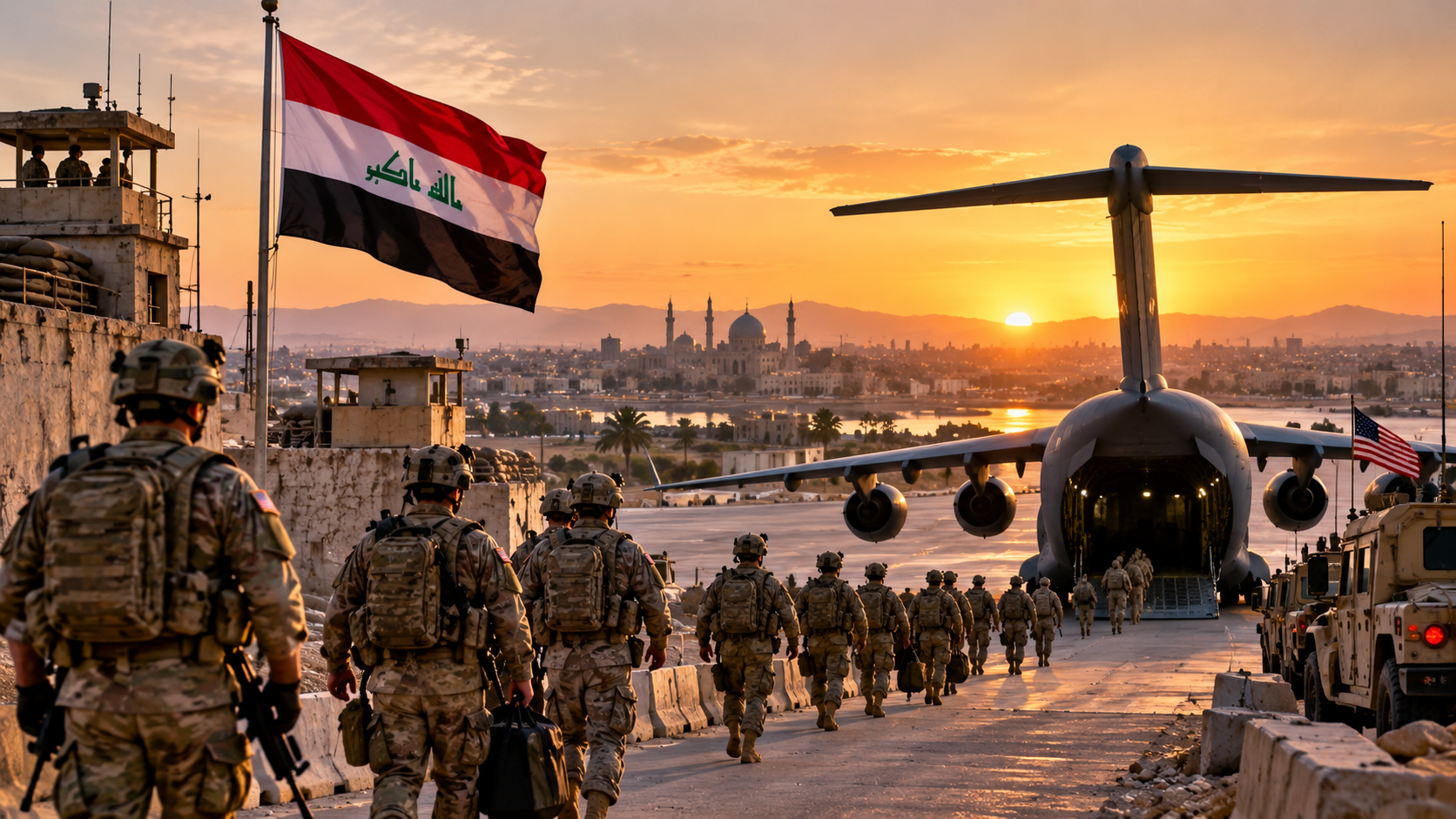
Final US troops leave northern Iraq as Operation Inherent Resolve ends; Baghdad takes primary responsibility for security while Washington retains a limited training and intelligence role
The United States has completed the withdrawal of its remaining troops from Iraq, formally ending a 12-year military mission focused on defeating the Islamic State (ISIS) as an organised territorial force.
The final US troops and equipment departed from an air base in Erbil, in Iraq's semi-autonomous Kurdistan region, on September 30 under an agreement reached between Washington and Baghdad. The Pentagon described the departure as an “orderly” withdrawal and said the conclusion of the mission marked a transition from a wartime coalition operation to an Iraqi-led security effort.
The development closes a major chapter in the US military presence in Iraq, which began with the 2003 invasion, although the current anti-ISIS mission itself began in 2014.
Operation Inherent Resolve Comes to an End
The US-led Operation Inherent Resolve was launched in 2014 after ISIS seized large areas of Iraq and Syria and established control over significant territory.
The campaign supported Iraqi security forces in retaking territory from the militant organisation. Over subsequent years, ISIS lost its territorial strongholds, and the group was reduced largely to dispersed cells and clandestine networks.
Washington and Baghdad agreed in 2024 to wind down the multinational coalition mission and transition towards a bilateral security relationship. Most US forces had already left bases in other parts of Iraq, leaving a smaller contingent in the Kurdish region before the final withdrawal.
The Pentagon said the 12-year campaign had defeated ISIS as an organised military threat in Iraq, while stressing that Iraqi forces would now take the lead in preventing the group's remnants from rebuilding.
Last Troops Leave Erbil Air Base
The final withdrawal centred on the US presence at an air base in Erbil.
Pentagon spokesperson Sean Parnell said US troops and equipment had completed their departure from the facility. The move follows the previously agreed September 30 deadline for ending the US-led military mission in Iraq.
The departure is significant for Iraq's Kurdistan region, where US forces had maintained a presence after the broader American military footprint across Iraq was reduced.
Kurdish officials have expressed concerns about the security implications of losing US air-defence and intelligence capabilities, particularly amid heightened regional tensions.
Baghdad Calls Withdrawal a Sign of Sovereignty
Iraqi Prime Minister Ali al-Zaidi presided over a handover ceremony and described the withdrawal as the beginning of a new phase for the country.
The Iraqi government has presented the end of the US-led mission as evidence of the growing capability of Iraqi state institutions and security forces.
Under the new arrangement, Iraq's own security forces will take primary responsibility for combating ISIS remnants and maintaining internal security. The United States, however, has said it will continue providing targeted training and intelligence support to Iraqi partners.
This means the end of the military mission does not necessarily represent the end of US-Iraq security cooperation.
Why the Withdrawal Is Happening Now
The withdrawal was agreed before the current regional escalation involving the United States and Iran.
However, its completion comes at a particularly sensitive moment, with the broader US-Iran conflict having spilled into Iraq through attacks involving Iran-backed armed groups.
Reuters reported that US forces and facilities in Iraq had faced hundreds of attacks from Iran-aligned militias during the recent conflict. The presence of American troops had therefore become both a security asset in the fight against ISIS and a target for groups opposed to the US military presence.
The final departure therefore comes amid a significantly different regional security environment from the one that existed when the withdrawal agreement was reached.
What Happens to ISIS After the US Exit?
The end of the US military mission does not mean that ISIS has disappeared.
The group no longer controls the large areas of territory it once held, but security officials and analysts continue to track its sleeper-cell networks.
Reuters reported that Iraqi security officials remain concerned about the group's ability to exploit gaps in intelligence, surveillance and air capabilities. US forces had provided Iraqi partners with intelligence, aerial surveillance and reconnaissance capabilities during the anti-ISIS campaign.
The Iraqi security establishment will now have greater responsibility for maintaining pressure on ISIS remnants without the same level of direct US military presence.
Kurdish Region Raises Security Concerns
The Kurdish region has been among the areas expressing concern about the withdrawal.
According to AP, Kurdish officials have been particularly concerned about the removal of US air-defence systems amid the continuing regional conflict. The region has faced attacks involving drones and ballistic missiles, making air-defence capabilities a major security issue.
The concern is not limited to ISIS. The Kurdish region also sits within a wider security environment involving Iran-aligned groups, Turkish military operations and cross-border tensions.
For Kurdish authorities, the US withdrawal therefore represents both the conclusion of the anti-ISIS mission and a change in the region's wider security architecture.
Iran-Backed Groups Welcome the US Departure
Iran-aligned armed groups in Iraq have publicly welcomed the withdrawal, portraying it as the removal of a foreign military presence.
The departure removes a US military counterweight that has been present in Iraq for much of the period since ISIS emerged.
Reuters reported that analysts see the possibility of Iran-aligned groups seeking greater influence over security and political institutions following the US departure.
At the same time, the precise extent of any change in Iran's influence will depend on developments inside Iraq, including the government's relationship with armed groups and its ability to maintain control over security decision-making.
Militia Disarmament Remains Unresolved
The US withdrawal was initially linked by the Iraqi government to a broader effort to disarm non-state armed groups.
That effort has made limited progress. Some smaller groups have agreed to surrender weapons, but powerful Iran-aligned militias have resisted disarmament or attached conditions to any move.
Prime Minister al-Zaidi has subsequently pushed the militia-disarmament deadline to June 2027, according to AP and Reuters reporting.
The issue could become one of the most important domestic security challenges for Baghdad following the US withdrawal.
From 2003 Invasion to 2026 Withdrawal
The latest withdrawal is part of a much longer US military history in Iraq.
US forces invaded Iraq in 2003 to overthrow Saddam Hussein's government. American troops subsequently fought insurgent groups and became involved in a prolonged period of sectarian conflict.
The US formally withdrew most combat forces in 2011.
However, the rise of ISIS led the Iraqi government to request renewed international military assistance in 2014. The resulting US-led coalition campaign eventually helped Iraqi forces regain territory captured by ISIS.
The final withdrawal in 2026 therefore closes the latest phase of American military involvement, although it does not erase the broader security and political relationship between Washington and Baghdad.
US-Iraq Relationship Moves to a New Phase
The Pentagon has framed the withdrawal as a transition rather than a complete break in bilateral security ties.
Washington is expected to maintain cooperation with Iraqi institutions through training, intelligence sharing and other forms of security engagement.
That arrangement gives Iraq greater responsibility for its own military operations while allowing the US to maintain a security relationship without the same level of permanent troop deployment.
The effectiveness of that model will depend on the ability of Iraqi forces to independently gather intelligence, conduct counterterrorism operations and respond to emerging threats.
Regional Power Balance Could Shift
The US withdrawal also has implications beyond Iraq's borders.
Iraq maintains relationships with both Washington and Tehran, making its security policy particularly sensitive to the regional balance between the two powers.
Reuters has reported that Iran and its allied groups view the American departure as a strategic development, while some Iraqi officials and analysts worry that the absence of US forces could create greater room for Iran-aligned groups and potentially allow ISIS remnants to rebuild.
These are competing assessments rather than settled outcomes. Iraq's own institutions, political leadership and security forces will play a central role in determining how the country's post-withdrawal security environment develops.
Economic and Energy Implications
The withdrawal also matters from an economic perspective because Iraq remains one of the world's major oil-producing countries and depends heavily on petroleum revenues.
Reuters reported that Washington continues to have significant financial influence over Iraq's oil-revenue system through arrangements involving the Federal Reserve Bank of New York and Iraq's central bank.
Consequently, the end of the US military mission does not mean that the broader US-Iraq relationship has ended. Financial, energy, diplomatic and security links remain important components of the relationship.
What to Watch Next
Several developments will determine the consequences of the US withdrawal:
ISIS activity: Whether Iraqi forces can keep ISIS sleeper cells from rebuilding their operational capabilities.
Militia disarmament: Whether Baghdad can make progress towards its revised June 2027 objective.
Kurdistan security: How the Kurdish region responds to the removal of US air-defence and military capabilities.
Iran's influence: Whether Iran-aligned armed groups increase their role in Iraq's political and security institutions.
US-Iraq cooperation: How Washington's promised training and intelligence support operates without a permanent US military presence.
Regional tensions: Whether the broader US-Iran conflict continues to affect Iraqi territory and security.
Regional Outlook
The completion of the US troop withdrawal marks a major transition in Iraq's security landscape. The immediate military footprint has ended, but the wider US-Iraq relationship continues through bilateral security cooperation and targeted support.
For Baghdad, the next phase places greater responsibility on Iraqi institutions and security forces to prevent an ISIS resurgence, manage armed groups and maintain internal stability.
For the Kurdish region, the loss of direct US military protection and air-defence capabilities remains a significant concern amid continuing regional tensions. Meanwhile, Iran-aligned groups are likely to view the withdrawal as an important change in the regional balance.
The longer-term impact will therefore depend less on the physical departure of the final US troops and more on how Iraq manages the resulting security responsibilities, the future of militia disarmament and the continuing threat posed by ISIS remnants.