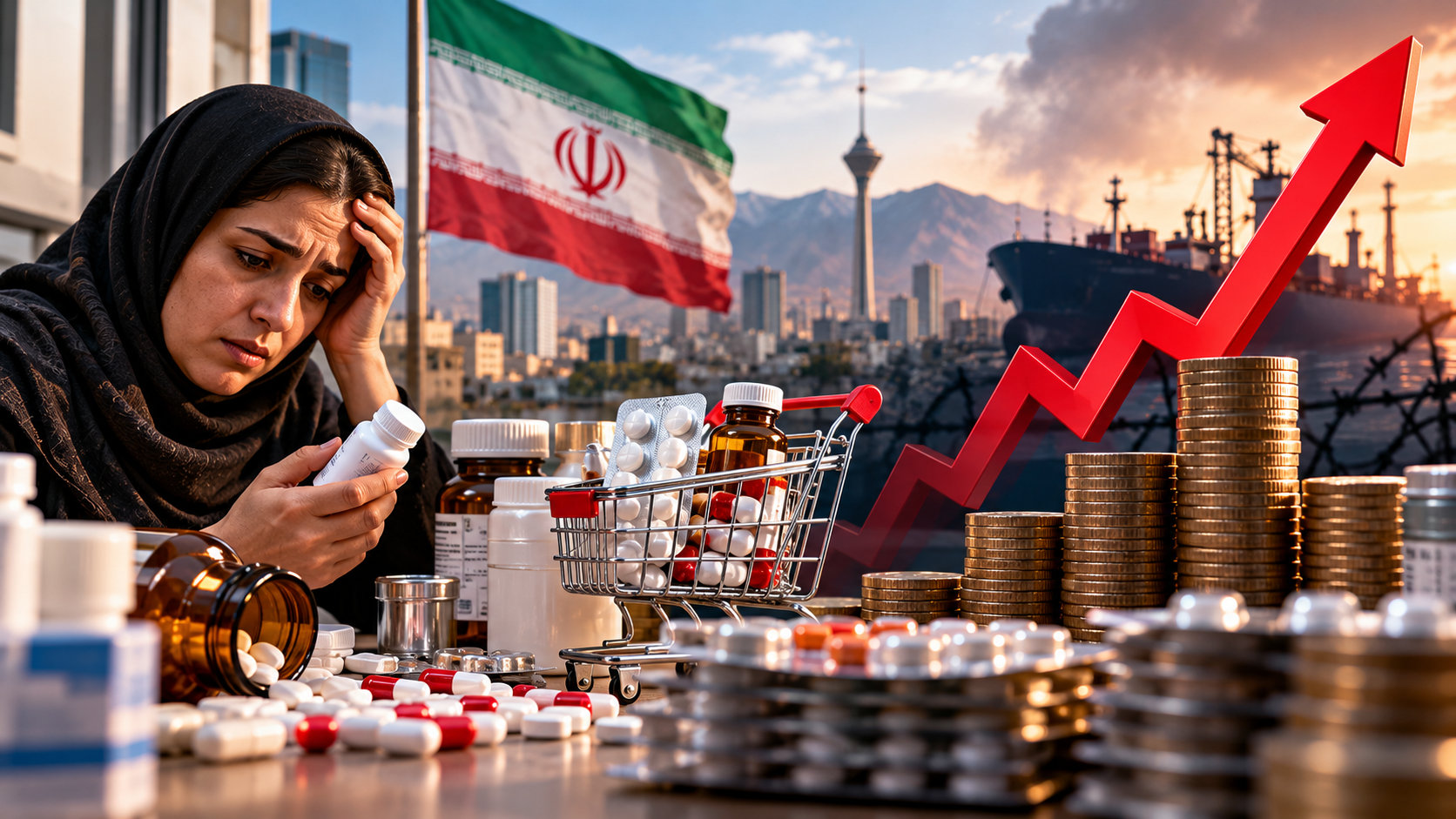
Medicine costs have risen sharply in Iran as the prolonged conflict, restrictions on shipping and financial sanctions disrupt access to imported pharmaceutical inputs, putting additional pressure on households and pharmacies
Pharmaceutical costs become another front in Iran’s economic crisis
Medicine prices in Iran have risen sharply as the country's prolonged war and worsening economic conditions disrupt pharmaceutical supply chains, leaving some patients struggling to find or afford essential treatments.
According to an Associated Press report published on September 30, some medicines have more than tripled in price, while certain treatments have become difficult to obtain at pharmacies. The pressure comes as Iran faces a combination of a US naval blockade, intensified sanctions, currency depreciation, inflation and disruption to international trade.
The pharmaceutical crisis is developing alongside broader economic stress. Iran's currency fell to a record low of more than 2.5 million rials per US dollar on September 29, according to AP, further increasing the cost of imported goods and foreign-currency-linked inputs.
Domestic production does not eliminate import dependence
Iran produces more than 80 per cent of its medicines domestically, according to figures cited by AP. However, domestic manufacturing remains dependent on imported active pharmaceutical ingredients, raw materials, specialised equipment and other components.
Before the war, pharmaceutical imports and components were transported largely through maritime routes. The reported US naval blockade has disrupted those shipments, forcing some importers to seek more expensive air-freight alternatives.
That alternative has also come under pressure after sanctions affecting Iranian airlines disrupted parts of the country's international aviation network. The result is a pharmaceutical supply chain facing higher transportation costs and greater uncertainty.
The distinction is important: producing medicines domestically does not necessarily mean a country can manufacture every ingredient or component domestically.
Financial sanctions create additional hurdles
The pharmaceutical supply problem is also linked to the financial infrastructure surrounding international trade.
US sanctions do not formally prohibit all humanitarian medicine transactions, but financial restrictions can make legitimate transactions difficult. Banks, pharmaceutical suppliers and shipping companies may avoid Iranian business because of compliance risks and the possibility of sanctions exposure.
This creates what health-policy experts describe as a practical barrier: a transaction may be legally permitted, but companies and financial institutions can still decide that processing it carries too much commercial or regulatory risk.
The effect can be particularly significant for medicines requiring specialised ingredients or suppliers outside Iran.
Pharmacies struggle with availability and delayed payments
The disruption is increasingly visible at retail pharmacies, even though hospitals have generally continued to receive many essential medicines.
The AP report cited cases in which families searched multiple pharmacies to complete prescriptions because individual outlets had only part of the required medicines in stock.
Pharmacies are also facing financial pressure because insurance companies have reportedly fallen significantly behind on reimbursements. Mohammad Jamalian, a member of Iran's parliamentary health committee, said insurers owed pharmacies around $270 million and that some payments were as much as nine months overdue, according to AP.
Delayed reimbursements can create a difficult cycle: pharmacies have less cash available to replenish inventory, suppliers face slower payments, and patients encounter greater difficulty obtaining medicines.
Medicine prices have increased dramatically
The scale of the price increases is becoming a major concern for households.
Iranian officials said around 2,000 types of medicines had undergone price adjustments over the previous six months because of inflation and currency pressures, according to the AP report.
Some individual medicines have recorded much larger increases. The report cited an ointment whose price rose more than fourfold within three months. Essential tablets used by kidney-dialysis patients were also reported to have risen by roughly 350 per cent.
Over-the-counter medicines have not been immune. Even common painkillers have reportedly become significantly more expensive and, in some cases, difficult to find.
For households whose incomes have not kept pace with inflation, the increase creates a direct affordability problem rather than simply a higher healthcare bill.
Damage to pharmaceutical facilities adds another layer of pressure
The pharmaceutical industry is also dealing with physical damage caused by the conflict.
Iranian officials have said that airstrikes damaged more than 40 pharmaceutical factories, including facilities involved in producing cancer treatments, according to AP.
Damage to manufacturing infrastructure can have consequences well beyond the affected facilities. Pharmaceutical production depends on a network of raw-material suppliers, packaging companies, warehouses, transport operators and distribution centres. Disruption at any stage can affect availability at pharmacies.
The extent of the production decline has not been publicly quantified by the Iranian government, according to the AP report.
Hospitals remain a priority, but specialised medicines are under pressure
The government appears to be prioritising hospital supplies, helping prevent a broader collapse in access to essential medicines.
However, shortages are reportedly more visible in some outpatient and specialised treatments. The AP reported difficulties obtaining certain psychiatric medicines used to treat bipolar disorder and acute psychosis, as well as other medicines used for anxiety and panic disorders.
Cancer treatment has also faced delays in some cases. One Tehran resident cited by AP said her mother continued receiving chemotherapy, but treatment was occasionally delayed because medicines were less readily available.
Such disruptions can be especially serious for patients whose treatments depend on precise schedules and continuous access to specialised drugs.
Vaccine supplies face higher costs too
Vaccines are another example of how the supply-chain crisis is translating into higher consumer costs.
Iranian pharmacists said the country had imported hundreds of thousands of influenza vaccine doses from China, with additional supplies expected. But the reported retail price for the vaccine was almost twice last year's level.
Authorities have said high-risk patients would receive influenza vaccination free of charge, but the higher procurement and distribution costs demonstrate how currency weakness and disrupted trade can affect even products that remain available.
Smuggling adds pressure to domestic availability
Another factor affecting pharmaceutical availability is cross-border smuggling.
According to the AP report, medicines are reportedly being diverted to neighbouring Afghanistan, Pakistan and Iraq, where they can command higher prices.
When products leave the domestic market through informal channels, legitimate pharmacies can face tighter supplies. At the same time, households may encounter higher prices and greater uncertainty about where medicines can be found.
This creates an additional challenge for authorities attempting to maintain controlled prices and ensure that subsidised medicines reach patients who need them.
Iran's economic deterioration compounds the healthcare problem
The pharmaceutical crisis cannot be separated from Iran's wider economic deterioration.
The rial's record decline increases the local-currency cost of imported raw materials and goods. Inflation reduces household purchasing power, while businesses face higher transportation, financing and inventory costs.
Reuters reported on September 29 that the economic effects of the seven-month conflict were spreading across Iranian households and businesses, with rising costs, job losses and reduced purchasing power adding to the pressure created by the oil blockade.
For the pharmaceutical sector, the combination is particularly difficult because demand for medicines is relatively inelastic. Patients cannot simply stop purchasing essential medicines when prices rise.
Diplomatic developments could affect supply conditions
The future trajectory of Iran's pharmaceutical supply chain is closely linked to developments in the wider conflict.
US and Iranian officials have been communicating through mediators as diplomatic efforts continue. Reuters reported that discussions have included a possible phased arrangement involving the reopening of the Strait of Hormuz and the lifting of the US economic blockade.
Any easing of shipping restrictions or financial barriers could potentially improve access to imported pharmaceutical inputs and reduce logistical costs. Conversely, a further escalation could prolong supply disruptions and increase pressure on prices.
At present, the diplomatic process remains uncertain.
Market and global economic implications
The pharmaceutical crisis also illustrates how geopolitical conflicts can move beyond energy and financial markets into essential consumer goods.
Iran's restrictions on oil shipments and the wider uncertainty around the Strait of Hormuz have already contributed to volatility in global energy markets. Reuters reported that Brent crude rose to around $106.60 a barrel on September 24 after renewed regional supply concerns.
For global markets, the combination of energy disruption, sanctions, shipping constraints and currency weakness creates risks across multiple supply chains.
Pharmaceuticals are particularly sensitive because manufacturers often rely on globally distributed raw materials even when finished medicines are produced domestically.
Market Outlook
Iran's medicine-price crisis highlights the broader economic consequences of prolonged geopolitical disruption. The immediate pressure is being felt by patients and pharmacies through higher prices, reduced availability and delayed access to some specialised treatments.
The country's high level of domestic medicine production provides some protection, but dependence on imported raw materials, international financial channels and transportation infrastructure leaves the pharmaceutical sector vulnerable to external restrictions.
For global markets, the key variables to monitor are the direction of US-Iran diplomatic negotiations, the status of the blockade, shipping conditions around the Strait of Hormuz, crude-oil prices and the trajectory of Iran's currency.
A sustained easing of trade and shipping restrictions could reduce some supply pressures. Continued conflict and sanctions, however, could keep costs elevated and deepen the strain on Iran's pharmaceutical distribution network and household finances.