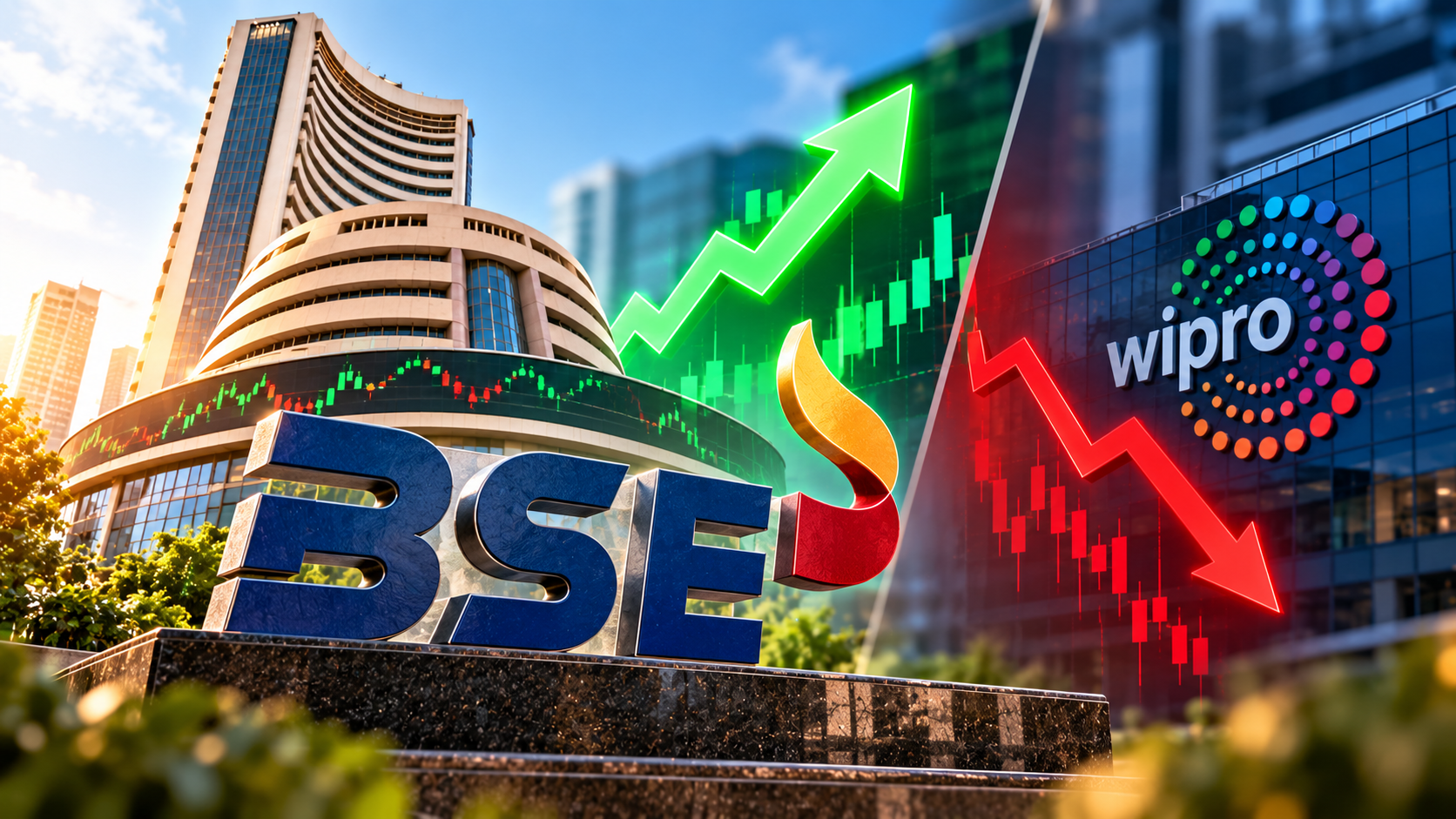
BSE replaces Wipro in the benchmark index from September 30 as index-linked funds adjust portfolios; estimated BSE inflows could be significantly larger than Wipro outflows
India's benchmark Nifty 50 underwent a significant reshuffle on September 30, with stock exchange operator BSE Ltd entering the index while information technology major Wipro Ltd exited.
The change is part of the semi-annual review conducted by NSE Indices and took effect after the close of trading on September 29. BSE's inclusion marks a notable shift in the composition of the country's flagship equity benchmark, bringing a capital-market infrastructure company into the Nifty 50 in place of an established IT services player.
The reshuffle is particularly important for investors because changes in major benchmark indices can trigger portfolio adjustments by passive funds, exchange-traded funds and other index-tracking strategies.
Why BSE qualified for the Nifty 50
BSE's inclusion was primarily driven by its significantly higher six-month average free-float market capitalisation.
According to NSE Indices data cited by Moneycontrol, BSE's six-month average free-float market capitalisation was ₹1,40,879 crore. This was substantially above the corresponding figure for Wipro, which stood at ₹55,930 crore.
The index methodology requires the average free-float market capitalisation of an incoming company to meet the prescribed threshold relative to the lowest-ranked existing constituent. BSE's free-float market capitalisation was therefore comfortably above the level required for inclusion.
The review also considered companies such as TVS Motor Company and Divi's Laboratories. However, they did not meet the relevant threshold required for replacing Wipro under the applicable methodology.
Estimated passive flows become a key market factor
One of the biggest immediate implications of the reshuffle is the potential flow of money from index-tracking portfolios.
Nuvama Alternative & Quantitative Research estimated that BSE could attract around $668 million of inflows as a result of its inclusion in the Nifty 50, while Wipro could face approximately $230 million of selling linked to its exclusion.
Earlier estimates had been somewhat higher, highlighting that such flow projections can change depending on index weights, market prices and the final portfolio adjustments undertaken by funds.
The important point for investors is that these are estimated index-related flows, not guaranteed investment flows. Actual transactions can vary depending on the timing and execution strategy of passive funds and other market participants.
BSE and Wipro take different paths
The index reshuffle comes after a sharp divergence in the stock-price performance of the two companies.
According to the Business Standard report, BSE had gained around 20 per cent in 2026 through September 29, despite declining around 7 per cent over the preceding month. Wipro, meanwhile, had fallen around 41 per cent during the year amid sustained weakness across technology stocks.
The contrasting performance illustrates why the index composition changed. BSE's free-float market capitalisation expanded substantially, while Wipro's relative position within the eligible universe weakened.
However, index inclusion itself does not guarantee sustained stock-price appreciation. Investors need to separate the mechanical effect of index-related demand from the company's underlying earnings and valuation fundamentals.
BSE shares volatile on inclusion day
BSE shares initially came under pressure despite formally joining the Nifty 50.
The stock declined around 3.75 per cent to approximately ₹3,149 in early trading on September 30, according to the Business Standard report. Wipro, meanwhile, gained around 3.1 per cent to ₹161.73 during the same period.
The contrasting moves demonstrate an important market phenomenon: index inclusion is often anticipated well before the effective date.
Investors and trading desks can position themselves ahead of a scheduled rebalance, meaning some of the expected passive buying or selling can already be reflected in stock prices before the actual index change takes effect.
Macquarie remains positive on BSE's longer-term opportunity
BSE has also attracted contrasting views from global and domestic brokerages.
Macquarie recently initiated coverage on BSE with an "outperform" rating and a ₹4,000 target price. The brokerage described BSE as a challenger in the capital-markets industry and highlighted the company's potential to benefit from structural growth in India's capital-market activity.
Macquarie estimates the total addressable market could grow at around 12 per cent annually, while BSE could deliver approximately 16 per cent revenue growth between FY26 and FY30, with margins potentially moving towards 70 per cent.
The brokerage also identified additional opportunities around self-clearing, SOR and other capital-market services, while acknowledging that the recently implemented closing auction session remains a near-term concern.
The brokerage target represents an external analyst view rather than a guaranteed future valuation and should be assessed alongside the company's financial performance and other market risks.
Jefferies and Nuvama highlight near-term risks
Not all brokerages have shared the same assessment.
Jefferies and Nuvama Research have highlighted concerns surrounding BSE's business following regulatory and market-structure changes, particularly the impact of the closing auction session (CAS), higher Securities Transaction Tax and changes to bank-guarantee requirements.
Nuvama downgraded BSE to "hold" with a ₹3,240 target price, while Jefferies assigned an "underperform" rating with a ₹2,940 target price in their respective reports cited by Business Standard.
Jefferies also pointed to a decline in options average daily turnover after the implementation of CAS. According to the brokerage's cited analysis, options ADTO for NSE and BSE in August was down 14 per cent and 12 per cent respectively compared with July.
These divergent brokerage views underline the uncertainty surrounding the next phase of BSE's growth.
The larger opportunity lies in India's derivatives market
BSE's investment case is closely connected to the rapid expansion of India's capital markets.
Growth in retail participation, derivatives trading, demat accounts, mutual funds and financialisation of household savings has created a larger addressable market for exchanges and market infrastructure companies.
For BSE, the opportunity extends beyond traditional equity trading. Its businesses span equity derivatives, currency derivatives, mutual funds, debt markets, data services and other capital-market infrastructure.
The key question for investors is whether BSE can convert its increasing market participation into sustainable revenue and earnings growth while maintaining healthy margins.
What happens to Wipro after Nifty exit?
Wipro's removal from the Nifty 50 does not change the company's underlying business operations or fundamentals.
However, the stock could face selling pressure from funds that are mandated to track the Nifty 50 or maintain exposure close to benchmark weights.
The company remains one of India's large IT services providers and continues to pursue cloud, artificial intelligence, cybersecurity and digital transformation opportunities. Its exclusion from the Nifty 50 should therefore be viewed primarily as an index-composition event rather than a direct change in the company's operating model.
The immediate impact will depend on how much index-linked capital is required to reduce Wipro exposure and how quickly those portfolio adjustments are completed.
Other Nifty stocks also see weight changes
The September reshuffle does not affect only BSE and Wipro.
According to Nuvama Alternative & Quantitative Research estimates cited by Business Standard, Adani Enterprises, Adani Ports, Bajaj Finance and JSW Steel are among the existing Nifty 50 constituents expected to see higher weights.
The estimated additional inflows for these four stocks were approximately $71 million, $35 million, $10 million and $10 million respectively.
On the other side, several constituents are expected to experience weight reductions. Reliance Industries and HDFC Bank were among the largest names facing estimated outflows of approximately $89 million and $56 million respectively.
These flows are mechanical consequences of index-weight adjustments and should not be interpreted as fundamental buy or sell signals.
Rejig extends beyond the Nifty 50
The September review has also resulted in changes across multiple Nifty indices.
The Nifty Next 50, Nifty Midcap 150, Nifty 500 and Nifty Smallcap 250 are among the indices undergoing additions and deletions.
The Nifty Midcap 150, for example, sees several new constituents, including Aster DM Healthcare, Embassy Office Parks REIT, FACT, Hindustan Copper, Indian Hotels, Indian Overseas Bank, Lodha, Meesho, Narayana Hrudayalaya, REC, Shree Cement and United Spirits.
At the same time, companies including 3M India, ACC, Apollo Tyres, AWL Agri, BSE, Hitachi Energy India, Honeywell Automation, KPIT Technologies, Polycab, SJVN, Tata Elxsi, NIACL and Vodafone Idea are among the stocks leaving that index.
The changes can create temporary trading opportunities and volatility as passive and quantitative funds rebalance their portfolios.
What investors should watch now
For BSE shareholders, the key issue after index inclusion will be whether the company can sustain the operating momentum that helped it qualify for the benchmark.
Investors should track exchange market share, derivatives volumes, transaction revenue, clearing income, data-related revenue, regulatory developments and operating margins.
For Wipro, attention is likely to remain on IT spending trends, artificial intelligence-led changes in technology services, large deal wins, margins and the company's ability to improve growth after a difficult period for the sector.
The index exit may create mechanical selling in the short term, but long-term valuation will ultimately depend on business performance.
Market Outlook
The BSE-Wipro reshuffle is more than a routine index change because it reflects a broader shift in the relative market capitalisation and investor positioning of two companies operating in very different sectors.
BSE's entry gives it greater visibility among domestic and global institutional investors and could result in meaningful passive inflows. At the same time, the stock's valuation and future performance will depend on trading volumes, market-share gains, regulatory changes and the company's ability to monetise India's expanding capital-markets ecosystem.
Wipro's exit could create index-related selling pressure, but the company's longer-term trajectory will continue to be determined primarily by technology spending, AI adoption, deal wins, margins and earnings growth.
The broader market backdrop is also important. Indian equities have experienced significant volatility in September, with the Nifty 50 declining sharply amid foreign outflows, elevated crude prices and higher global bond yields. Reuters reported that foreign investors sold around $2.7 billion of Indian equities during September, adding to the pressure on benchmark stocks.
Against this backdrop, investors should treat index-rebalance flows as a short-term market-structure factor, while assessing BSE and Wipro separately on their earnings, valuations, business prospects and sector outlook.