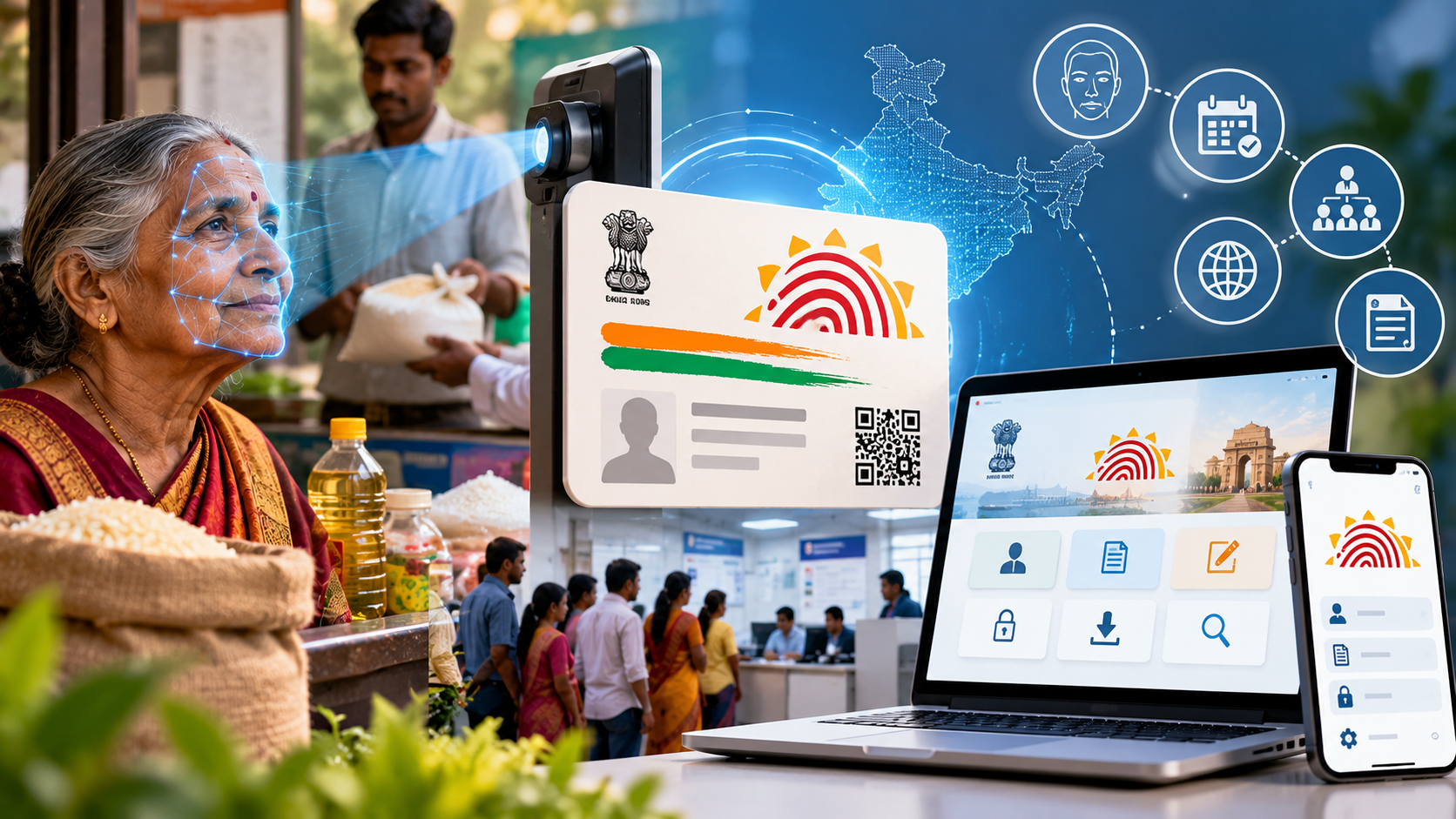
New measures include face authentication for ePDS, a token management system, SWIK Portal 2.0 and a redesigned multilingual UIDAI website
The Unique Identification Authority of India (UIDAI) has announced five initiatives aimed at making Aadhaar-related services more accessible, convenient and user-friendly as part of its broader digital governance efforts.
The announcements were made at ‘Aadhaar Samvaad’ in Kolkata, held alongside the 17th Aadhaar Day. The measures focus on expanding authentication options, simplifying onboarding for entities, improving access to UIDAI offices and making online Aadhaar services more accessible to residents.
The five initiatives include face authentication for the electronic public distribution system (ePDS), SWIK Portal 2.0, a new token management system, the Sub-AUA/Sub-KUA (LITE) framework and a revamped UIDAI website.
Face authentication introduced as an additional ePDS option
UIDAI, the Department of Food and Public Distribution (DFPD) and the National Informatics Centre (NIC) have introduced face authentication as an additional authentication option for beneficiaries using the electronic public distribution system.
The new mechanism is designed to provide a consent-based and contactless method of authentication, particularly in situations where fingerprint-based authentication may be difficult.
States and Union Territories can integrate face authentication into their respective ePDS systems.
The move could provide beneficiaries with an alternative authentication mechanism while supporting the continued digitisation of public distribution services.
SWIK Portal 2.0 aims to simplify Aadhaar authentication approvals
UIDAI has also launched SWIK Portal 2.0, which is intended to streamline the process through which eligible entities seek approval for Aadhaar authentication.
Under the Aadhaar Authentication for Good Governance framework, eligible non-government entities can use the portal to submit proposals for permissible Aadhaar authentication use cases to the relevant ministry or government department.
The initiative is expected to make the approval process more structured and easier for eligible organisations seeking to use Aadhaar authentication for permitted purposes.
New token management system for UIDAI office visits
Another initiative announced by UIDAI is a new Token Management System for residents visiting UIDAI's state and regional offices for Aadhaar-related services, wherever applicable.
The system is designed to improve the management of office visits and streamline the process for residents seeking services that require physical interaction with UIDAI offices.
By improving appointment and token-related processes, the system aims to reduce inconvenience and make office-based Aadhaar services more organised.
Sub-AUA/Sub-KUA LITE framework for low-volume users
UIDAI has introduced the Sub-AUA/Sub-KUA (LITE) framework to encourage wider adoption of Aadhaar authentication among eligible government and non-government entities with relatively low-volume authentication requirements.
Under the framework, eligible entities can use the authentication infrastructure of an existing Authentication User Agency (AUA) or Know Your Customer User Agency (KUA) rather than establishing their own infrastructure.
This approach is intended to simplify the technical onboarding process and reduce the infrastructure requirements for entities that do not generate large volumes of authentication requests.
UIDAI said the framework will operate within applicable security, privacy and regulatory safeguards.
UIDAI unveils redesigned website
UIDAI has also launched a redesigned website with the objective of making Aadhaar-related information and services easier to access.
According to the authority, residents primarily use the UIDAI website to understand Aadhaar, access services, locate documents or seek assistance. The new website has therefore been structured around these key requirements.
The redesigned platform follows Aadhaar brand guidelines and is intended to provide a more consistent digital experience across the UIDAI website, the myAadhaar portal and Aadhaar App.
Accessibility features added to the new website
Accessibility has been incorporated into the redesigned website to make Aadhaar information and services easier to use for a wider range of residents.
The website includes features such as:
-
Screen-reader compatibility
-
Adjustable font sizes
-
Improved colour contrast
-
Keyboard navigation
-
A simplified user interface
-
Easier access to Aadhaar-related services and information
These features are intended to improve accessibility, including for persons with disabilities.
Website to expand language support
The revamped UIDAI website is also designed to improve access for users across different linguistic backgrounds.
Through integration with BHASHINI, the website currently supports 13 languages, including English and Hindi.
UIDAI said it plans to expand language support to 23 languages in the near future.
The expansion could make Aadhaar-related information and online services more accessible to residents who prefer to interact with government platforms in regional languages.
New UIDAI Career Portal
The redesigned website also includes a UIDAI Career Portal, allowing applicants to apply online for deputation opportunities.
According to UIDAI, the portal is intended to make the application process more streamlined and transparent.
The addition of the career portal brings recruitment-related information and application functionality into the broader UIDAI digital ecosystem.
Five initiatives at a glance
| Initiative | Key objective |
|---|---|
| Face Authentication for ePDS | Provide an additional, contactless authentication option |
| SWIK Portal 2.0 | Simplify Aadhaar authentication approval processes |
| Token Management System | Streamline visits to UIDAI offices |
| Sub-AUA/Sub-KUA (LITE) | Facilitate Aadhaar authentication for low-volume users |
| Revamped UIDAI Website | Improve accessibility, usability and digital service delivery |
Focus shifts towards easier digital governance
The latest measures indicate a broader focus on improving the accessibility and usability of Aadhaar-linked services rather than simply expanding the identity infrastructure.
The introduction of face authentication provides an alternative to fingerprint-based authentication in selected ePDS use cases, while the Sub-AUA/Sub-KUA (LITE) framework is designed to lower infrastructure requirements for eligible low-volume users.
At the consumer-facing level, the revamped website, multilingual support and accessibility features are intended to make it easier for residents to find information and access services.
Privacy and security remain important considerations
As Aadhaar authentication expands across different services and organisations, security, privacy and consent remain important components of the digital identity ecosystem.
UIDAI has stated that the new Sub-AUA/Sub-KUA (LITE) framework will operate with the required security, privacy and regulatory safeguards. Similarly, the face-authentication facility for ePDS has been described as a consent-based mechanism.
The implementation of these initiatives across different entities and government systems will determine how effectively they translate into easier access while maintaining the applicable safeguards.
What the initiatives mean for residents
For Aadhaar holders, the initiatives could result in several practical changes over time.
Residents using eligible ePDS services may have an additional authentication option where face authentication is integrated. Those requiring services at UIDAI offices may benefit from improved token management, while website users can access a redesigned platform with enhanced accessibility and language support.
The planned expansion from 13 to 23 supported languages could further widen access to Aadhaar-related information and services.
Key Takeaways
-
UIDAI has announced five initiatives to improve Aadhaar service accessibility.
-
Face authentication has been introduced as an additional option for eligible ePDS beneficiaries.
-
SWIK Portal 2.0 aims to simplify Aadhaar authentication approval processes.
-
A new Token Management System will streamline visits to UIDAI offices.
-
The Sub-AUA/Sub-KUA (LITE) framework targets eligible low-volume authentication users.
-
The redesigned UIDAI website includes accessibility features and currently supports 13 languages.
-
UIDAI plans to expand website language support to 23 languages.
-
A new UIDAI Career Portal has also been integrated into the revamped website.