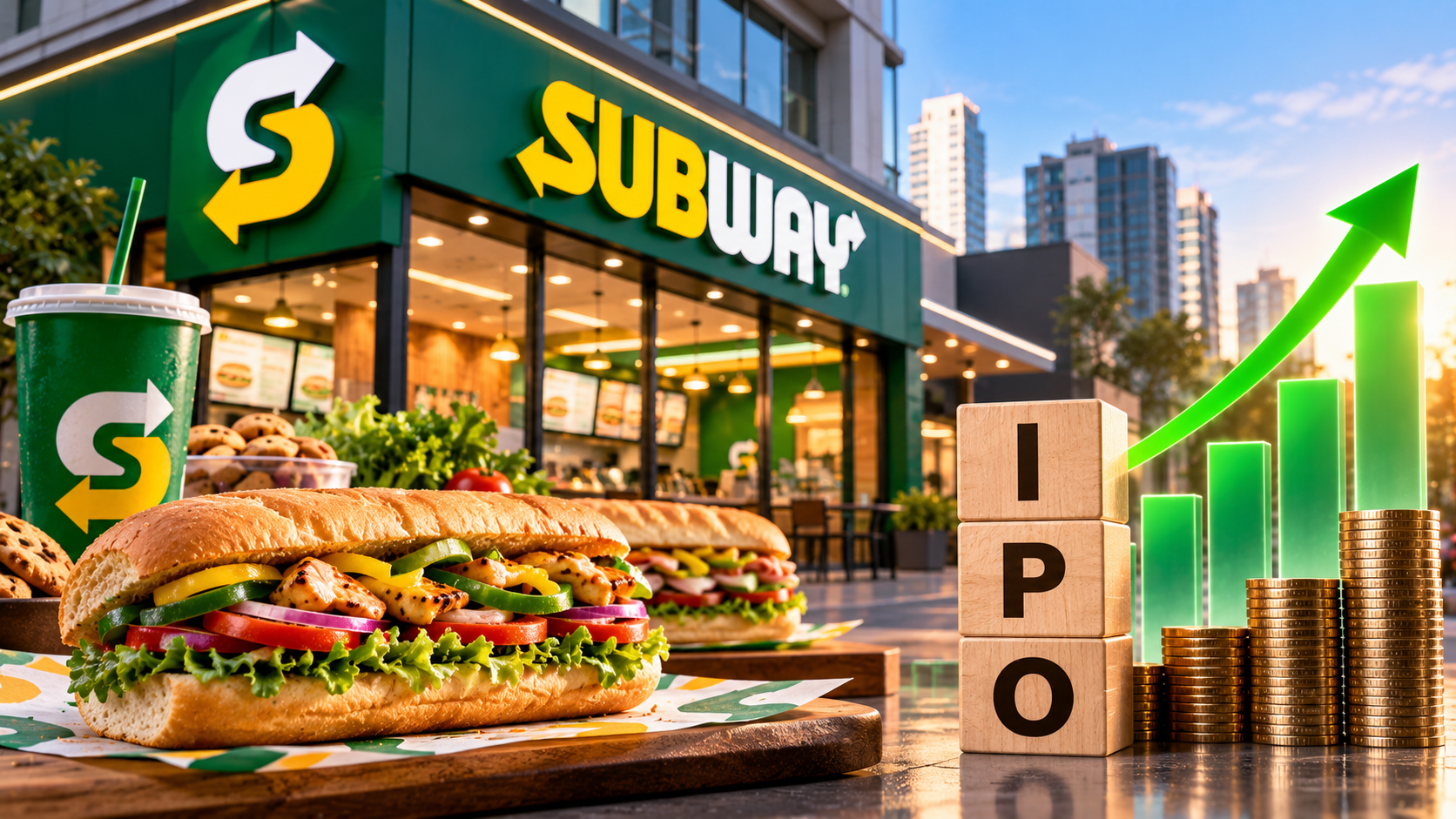
Entirely fresh issue to fund debt repayment and expansion of company-operated Subway stores as EverBrands strengthens its position across India’s QSR and beverage markets
EverBrands India Ltd, the operator of Subway restaurants across India and select neighbouring markets, has filed a Draft Red Herring Prospectus (DRHP) with the Securities and Exchange Board of India (Sebi) to raise ₹600 crore through an initial public offering.
The proposed IPO will comprise entirely of a fresh issue of equity shares, meaning the proceeds will flow to the company rather than being used by existing shareholders for an offer for sale. The filing comes at a time when India's quick-service restaurant (QSR) industry is witnessing continued expansion, driven by urbanisation, rising disposable incomes, changing consumption patterns and increasing demand for organised food-service brands.
₹600 Crore Fresh Issue: Where the Money Will Go
According to the DRHP, EverBrands plans to deploy ₹125 crore from the IPO proceeds towards repayment or pre-payment of borrowings of its wholly owned subsidiary, Culinary Brands India.
A much larger ₹326.85 crore has been earmarked for establishing new Subway restaurants under the company-owned-company-operated, or COCO, model.
The remaining funds will be used for general corporate purposes.
The planned allocation highlights the company's focus on expansion rather than providing an exit route for existing shareholders. By directing more than half of the proposed issue proceeds towards new stores, EverBrands is positioning the IPO as a growth-capital exercise aimed at increasing its physical footprint and strengthening its operating platform.
EverBrands' Multi-Brand Food and Beverage Platform
EverBrands India was formerly known as Culinary Brands Pvt Ltd and operates as a multi-brand food and beverage platform.
Its portfolio includes Subway, Lavazza, Dilmah and its own Fresh & Honest brand.
The company's QSR business is centred around its master franchisee rights for Subway restaurants across India, Sri Lanka and Bangladesh. This gives EverBrands a significant role in managing and expanding the Subway network in these markets.
The company's business model therefore combines restaurant operations with beverage and food distribution activities, providing exposure to multiple segments of India's organised consumption market.
More Than 1,000 Subway Stores in India
As of March 31, 2026, EverBrands operated 1,008 Subway stores in India.
Of these, 678 were company-owned-company-operated stores, while 33 were franchise-owned-franchise-operated outlets. The company also operated eight FOFO stores in Sri Lanka.
The large COCO network is particularly relevant to the proposed IPO because the company intends to use ₹326.85 crore of the fresh proceeds to add more stores under this format.
A larger company-operated network could provide EverBrands with greater direct control over store operations, customer experience, pricing and execution, although it also requires higher capital investment and exposes the company to operating costs associated with individual outlets.
QSR Revenue Shows Strong Growth
EverBrands' QSR vertical has recorded substantial revenue growth over the past three financial years.
Revenue from operations for the QSR business increased to ₹693.09 crore in FY26 from ₹480.38 crore in FY25 and ₹355.31 crore in FY24.
This represents growth of more than 44 per cent between FY25 and FY26, following a similarly strong increase in the previous year.
The expansion in revenue reflects the company's growing restaurant footprint as well as increasing scale across its Subway operations.
For investors assessing the IPO, the key question will be whether this growth can continue as EverBrands expands the network and whether additional stores can generate attractive returns on the capital invested.
Beverage Business Adds Another Revenue Stream
The company's beverage vertical has also shown steady growth.
Revenue from operations increased to ₹240.57 crore in FY26 from ₹206.36 crore in FY25 and ₹172.16 crore in FY24.
The beverage business includes brands such as Lavazza, Dilmah and Fresh & Honest, giving EverBrands an additional revenue stream beyond restaurant operations.
This diversification can reduce dependence on the performance of the QSR business, although the Subway network remains the most visible part of the company's consumer-facing operations.
COCO Expansion to Drive the Next Growth Phase
The proposed use of IPO proceeds indicates that store expansion will remain a central part of EverBrands' strategy.
Under the COCO model, EverBrands directly owns and operates the restaurants, allowing it to retain the economics of store-level operations while also bearing the associated costs and operational risks.
The company will need to carefully manage location selection, rental costs, staffing, food costs, supply chains and store-level profitability as it expands.
For a QSR operator, simply increasing store count does not necessarily guarantee proportional profit growth. New outlets must achieve adequate sales volumes and operating margins while maintaining consistent customer experience.
India’s Organised QSR Market Provides a Large Opportunity
India's organised food-service market has been expanding as consumers increasingly seek convenience, standardised quality and branded dining experiences.
QSR formats benefit from relatively quick service, delivery integration and the ability to operate across malls, high streets, airports, commercial districts and emerging urban centres.
The growth opportunity extends beyond major metros as organised restaurant brands increasingly enter Tier-II and Tier-III cities.
For EverBrands, a large existing Subway network provides an established platform from which to expand into new locations.
Franchise Model Versus Company-Owned Stores
EverBrands' business includes both company-operated and franchise-operated Subway stores.
The COCO model generally requires greater upfront investment because the operator funds store development and directly manages operations. However, it also gives the company greater control over revenue and customer experience.
The franchise model, by contrast, can allow faster network expansion with lower direct capital requirements, although the economics are shared with franchise partners.
The proposed IPO allocation towards COCO expansion indicates that EverBrands currently sees scope to increase its direct operating footprint.
The balance between COCO and franchise stores will therefore remain an important factor for investors to monitor following the listing.
Debt Reduction Is Another IPO Objective
The proposed ₹125 crore allocation towards repayment or pre-payment of Culinary Brands India's borrowings is another important component of the issue.
Reducing debt can lower financing costs and strengthen the company's balance sheet, depending on the level and cost of outstanding borrowings.
For a store-expansion business, maintaining an appropriate balance between debt-funded growth and equity-funded expansion is particularly important because new restaurants can take time to reach mature revenue levels.
The IPO therefore combines two objectives: strengthening the financial structure and funding additional growth.
Key IPO Risks to Monitor
While the proposed IPO offers exposure to an established QSR platform, investors will need to assess several risks before the issue's eventual launch.
Store-level economics: New outlets must achieve sufficient sales and profitability to justify the capital invested.
Rental and operating costs: Restaurant profitability can be sensitive to rent, employee expenses, food costs, utilities and logistics.
Consumer spending: Discretionary consumption can weaken when household budgets come under pressure.
Brand dependence: Subway represents a significant part of EverBrands' consumer-facing QSR business, making the company's relationship with the master-franchise brand strategically important.
Competition: India's organised restaurant market includes several domestic and international QSR brands competing for similar customers and locations.
Execution risk: Rapid expansion requires effective supply-chain management, staffing, location selection and quality control.
Capital intensity: The planned COCO expansion will require significant investment, making returns on new stores an important post-IPO metric.
IPO Pipeline Continues to Expand
EverBrands' filing adds another consumer-facing business to India's already active IPO pipeline.
Sebi's public-issue filings show continued activity among companies preparing to access the equity markets, while industry data has pointed to a substantial pipeline of companies awaiting or progressing through the IPO process.
For investors, the growing number of new issues also means greater competition for capital. Companies entering the market will increasingly be assessed not only on growth prospects but also on profitability, valuation, balance-sheet strength and the quality of their expansion plans.
What Investors Should Watch in the DRHP
The initial filing provides the broad framework of the proposed offering, but investors will need to examine the complete financial and risk disclosures as the IPO process progresses.
Important areas will include revenue and profit trends, store-level economics, same-store sales growth, cash generation, debt, related-party transactions, franchise arrangements and the company's obligations under its master-franchise relationship.
The eventual price band will also be critical because the attractiveness of an IPO cannot be assessed from the issue size alone.
Investors will need to compare the company's valuation with listed QSR and food-service peers after the price band and other offer details become available.
Market Outlook
EverBrands India's ₹600-crore IPO gives investors a potential new listed play on India's organised QSR and beverage consumption themes.
The company's existing scale — including more than 1,000 Subway stores in India — provides an established operating platform, while the proposed ₹326.85-crore investment in new COCO stores indicates an aggressive expansion strategy. At the same time, the planned ₹125-crore debt repayment could provide some balance-sheet support.
The most important factors to monitor as the IPO progresses will be the eventual valuation, store-level profitability, pace of new-store additions, same-store sales growth, cash generation and the sustainability of the company's relationship with its key franchise brands.
For the broader IPO market, EverBrands' filing also reflects continued investor interest in consumer businesses with established brands and expansion potential. However, the final investment case will depend on the valuation disclosed closer to the public issue and the financial details contained in subsequent offer documents.
Book-running lead managers to the proposed issue are Motilal Oswal Investment Advisors, ICICI Securities and Nuvama Wealth Management.