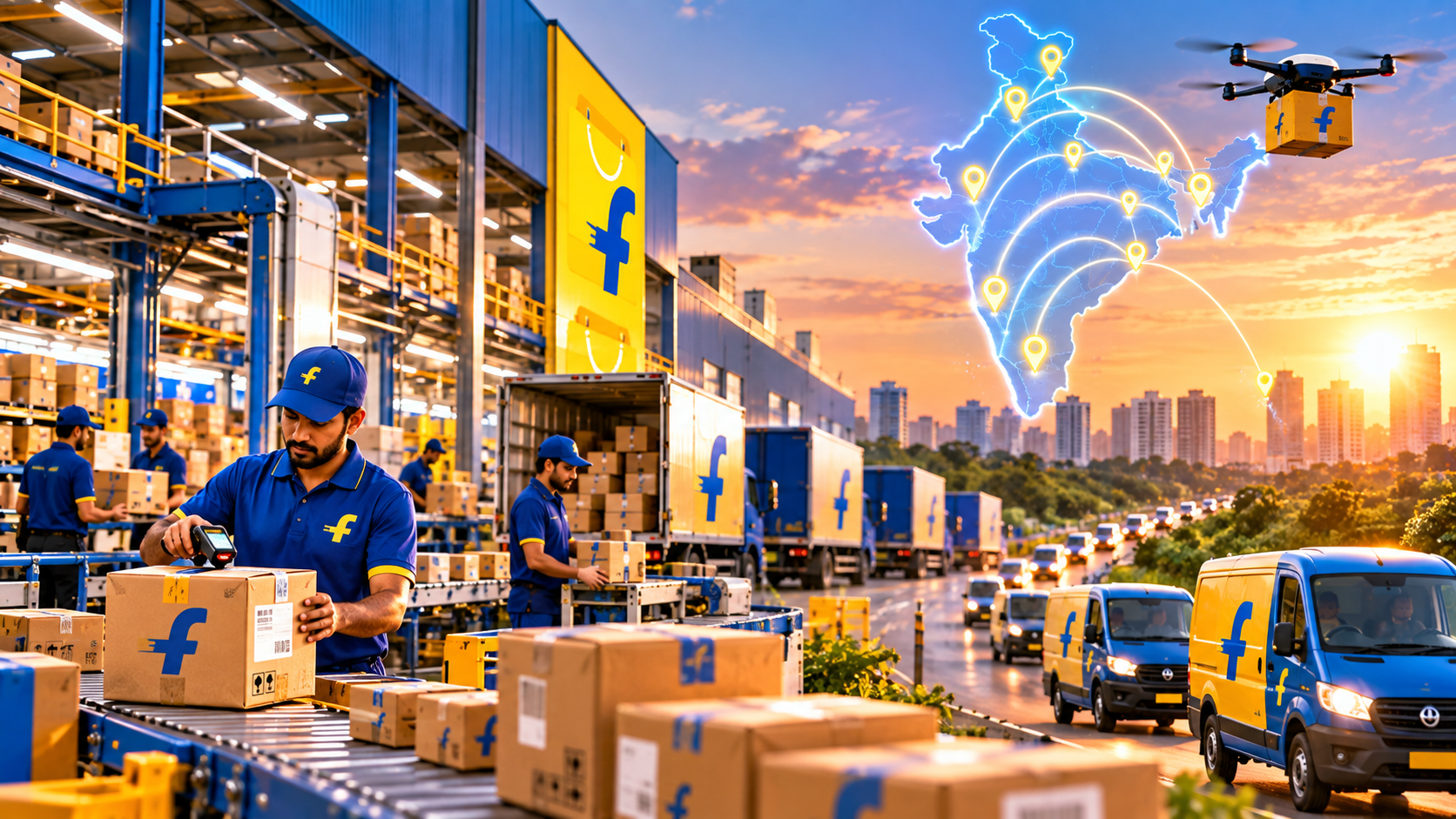
Ekart adds 14 million cubic feet of warehousing, more than 900 delivery hubs and 750 new PIN codes as Flipkart prepares for Big Billion Days and faster festive deliveries
Flipkart is significantly expanding its supply-chain infrastructure ahead of the 2026 festive shopping season, with its logistics arm Ekart adding warehousing capacity, delivery hubs and technology infrastructure to handle the expected surge in e-commerce orders.
Ekart has added 14 million cubic feet of warehousing space nationwide, increasing its storage capacity by around 50 per cent. Technology and automation upgrades have also raised its peak processing capacity by more than 30 per cent, according to the company.
The expansion comes ahead of Flipkart's flagship Big Billion Days event, with early access scheduled to begin on October 8 and the sale opening to the general public on October 9.
More Than 900 New Delivery Hubs Added
A major part of the expansion is focused on last-mile logistics.
Ekart has added more than 900 festive delivery hubs to improve delivery speed and expand its reach into additional markets. The company said these hubs are intended to support greater volumes of same-day and next-day deliveries during the festive period.
The latest additions take Flipkart and Ekart's network to more than 8,200 facilities, including fulfilment centres, sortation hubs and last-mile delivery operations, according to the company.
The expansion is particularly significant for Tier-2 and Tier-3 cities, where online shopping penetration has been increasing and customers are increasingly expecting delivery speeds similar to those available in larger metropolitan markets.
Flipkart Takes Festive Shopping Deeper Into India
The company has expanded its serviceable footprint by more than 750 PIN codes.
The new locations include markets such as Leh and Kargil, parts of Rajasthan and Madhya Pradesh and communities in the Northeast, including locations in Mizoram.
The expansion reflects a broader shift in India's e-commerce market. Online commerce is no longer concentrated only in the country's largest cities, with smaller towns increasingly contributing to order volumes.
For e-commerce companies, reaching these markets requires investment in warehouses, transportation, sorting infrastructure and local last-mile delivery networks.
More Than 2.5 Crore Units Pre-Positioned
To improve fulfilment speed during Big Billion Days, more than 2.5 crore units of products from MSMEs, small sellers, weavers and artisans have been pre-positioned across Ekart's fulfilment centres.
Pre-positioning inventory closer to expected demand centres can reduce the time between order placement and dispatch.
The strategy becomes particularly important during a major shopping event when order volumes can increase sharply within a short period.
Flipkart has also added 70 additional pickup stations in key seller locations to reduce the time required for sellers to hand over products for fulfilment.
Ekart Opens More Capacity to Third-Party Businesses
The expansion is not limited to Flipkart's own marketplace.
Ekart has been opening its logistics network to external businesses, including MSMEs, direct-to-consumer brands, FMCG companies and other enterprises.
The company introduced a franchise model for its logistics network in July, with more than 300 franchise outlets operational at the time and plans to expand that network further. It also said the external-business logistics offering would include technology such as real-time shipment tracking and AI-powered address resolution.
This creates the potential for Ekart to increasingly operate as a broader logistics platform rather than serving only Flipkart marketplace orders.
Third-Party Logistics Network Expands
Ekart's third-party logistics franchise network has also expanded rapidly.
The company said its 3PL franchises doubled to around 600 within two months of launch, allowing sellers and businesses outside the Flipkart marketplace to use its logistics infrastructure.
For Ekart, a larger third-party customer base can potentially improve utilisation of its warehouses, transportation network and delivery infrastructure.
The long-term opportunity will depend on how effectively the company balances external logistics volumes with the seasonal requirements of Flipkart's own marketplace.
Flipkart Minutes Adds to the Delivery Network
Quick-commerce business Flipkart Minutes is another important part of the company's logistics strategy.
Flipkart said in June that Minutes had reached 1,000 micro-fulfilment centres across more than 130 cities and 8,000-plus PIN codes, less than two years after its launch. The company also reported strong growth in Tier-2 and Tier-3 markets.
The quick-commerce network complements the broader Ekart infrastructure by placing inventory closer to customers.
The company has also said that Minutes has expanded beyond daily essentials into a broader range of categories, increasing the potential overlap between quick commerce and traditional e-commerce fulfilment.
Festive Season to Create 2.5 Lakh Employment Opportunities
The supply-chain expansion is also translating into seasonal employment.
Flipkart has announced the creation of more than 2.5 lakh direct and indirect employment opportunities for the festive season, including gig-worker opportunities.
Nearly 75,000 opportunities are for people entering the workforce for the first time, according to Flipkart. Around 60 per cent of the new opportunities are in last-mile delivery, reflecting the company's focus on expanding delivery capacity.
The company said the opportunities span more than 7,000 Ekart facilities, including fulfilment centres, sortation hubs and last-mile operations.
Focus on Last-Mile Delivery Workforce
Of the new employment opportunities, nearly 1.4 lakh are additional last-mile roles, according to Flipkart.
Delivery partners, or "Wishmasters", are central to the company's ability to offer faster delivery times, particularly in markets where delivery infrastructure is still developing.
Flipkart said its delivery partners receive benefits including term-life insurance, personal accident cover and medical benefits. It has also expanded support services such as its Doctor on Call programme.
The company has introduced joining, retention and referral incentives for the festive period as it seeks to build sufficient delivery capacity for the expected increase in orders.
AI Speeds Up Delivery Partner Onboarding
Technology is also being used to expand the delivery workforce.
Flipkart said AI-powered background verification through its Delivery Partners application has reduced onboarding time to less than 10 minutes while maintaining its verification protocols.
The same application also provides training for new delivery partners before they begin their first shifts.
For an e-commerce platform operating at festive-season scale, faster recruitment and training can be important because demand rises sharply over a relatively short period.
MSMEs and Small Sellers Get More Support
Small sellers, artisans and MSMEs are another major focus of the expanded network.
By positioning inventory ahead of the festive period and adding pickup infrastructure, Flipkart is attempting to reduce fulfilment bottlenecks for smaller sellers.
The company said its marketplace ecosystem enables millions of sellers and small businesses to reach customers across India. Its festive infrastructure therefore serves not only the platform's customers but also businesses that depend on the marketplace for national distribution.
The expansion of logistics infrastructure could be particularly relevant for sellers based outside major metropolitan centres.
Why Faster Delivery Matters During Big Billion Days
During normal periods, an additional day of delivery time may have limited impact on purchasing decisions. During major online sales, however, speed becomes more important because customers are simultaneously comparing prices and delivery commitments across multiple platforms.
Pre-positioned inventory, additional delivery hubs and automated sorting can help reduce the distance between inventory and customers.
For Flipkart, this is especially important as competition intensifies across traditional e-commerce and quick commerce.
The company's investment in infrastructure therefore goes beyond simply handling a higher number of parcels. It is also designed to improve delivery reliability and expand the geographic area in which faster delivery can be offered.
Competition Is Moving Beyond Metros
The expansion into Leh, Kargil, the Northeast and interior regions highlights another important trend in India's e-commerce market.
As internet access, digital payments and smartphone usage spread deeper into smaller cities and towns, e-commerce companies are looking to capture demand outside the traditional metropolitan customer base.
Tier-2 and Tier-3 markets are becoming increasingly important for both product categories and quick-commerce expansion.
Flipkart's own data indicates particularly rapid scaling of Minutes in these markets, suggesting that the company views smaller cities as an important part of its next phase of growth.
Supply Chain Investment Could Strengthen Seller Economics
A wider logistics network can also potentially benefit sellers.
More local fulfilment capacity means products can be positioned closer to customers, potentially reducing transportation distances and improving delivery times.
For high-volume festive categories, even small improvements in fulfilment efficiency can become meaningful when millions of orders are processed.
However, the economics of such infrastructure depend on utilisation rates. Warehouses and delivery hubs require substantial investment, and maintaining sufficient volumes outside peak periods remains an important operational consideration.
Big Billion Days Becomes a Major Logistics Test
The 2026 Big Billion Days will provide an important test of the expanded infrastructure.
Flipkart has scheduled early access for October 8, with the broader sale beginning on October 9.
The combination of additional warehouse capacity, more delivery hubs, pre-positioned inventory and a larger workforce is intended to reduce bottlenecks during the peak shopping period.
The ability to maintain delivery speeds while processing significantly higher order volumes will be an important indicator of the effectiveness of the investment.
What the Expansion Means for India's E-Commerce Ecosystem
Flipkart's logistics expansion has implications beyond its own marketplace.
A larger supply-chain network can create opportunities for logistics operators, warehouse providers, transportation companies, packaging businesses, technology providers and local delivery partners.
It can also improve market access for small businesses and artisans that may otherwise find nationwide distribution difficult.
The increasing integration of warehousing, quick commerce, AI-based logistics and last-mile delivery is gradually changing the structure of India's digital retail ecosystem.
Market Outlook
Flipkart's latest supply-chain expansion highlights the scale of infrastructure required to support India's rapidly evolving e-commerce market. The addition of 14 million cubic feet of warehousing capacity, more than 900 festive delivery hubs and over 750 PIN codes significantly increases the company's ability to handle peak-season demand.
The expansion also extends beyond festive sales. Ekart's growing third-party logistics business, Flipkart Minutes' expanding micro-fulfilment network and increasing reach into Tier-2 and Tier-3 markets point towards a broader strategy of building a nationwide commerce and logistics ecosystem.
For the wider market, the key indicators will be festive order volumes, delivery performance, seller participation, logistics utilisation and the sustainability of demand after the festive season.
With Big Billion Days beginning with early access on October 8, the upcoming festive period will provide an important real-world test of whether Flipkart's substantially expanded logistics network can translate additional infrastructure and manpower into faster deliveries, broader customer reach and efficient large-scale fulfilment.