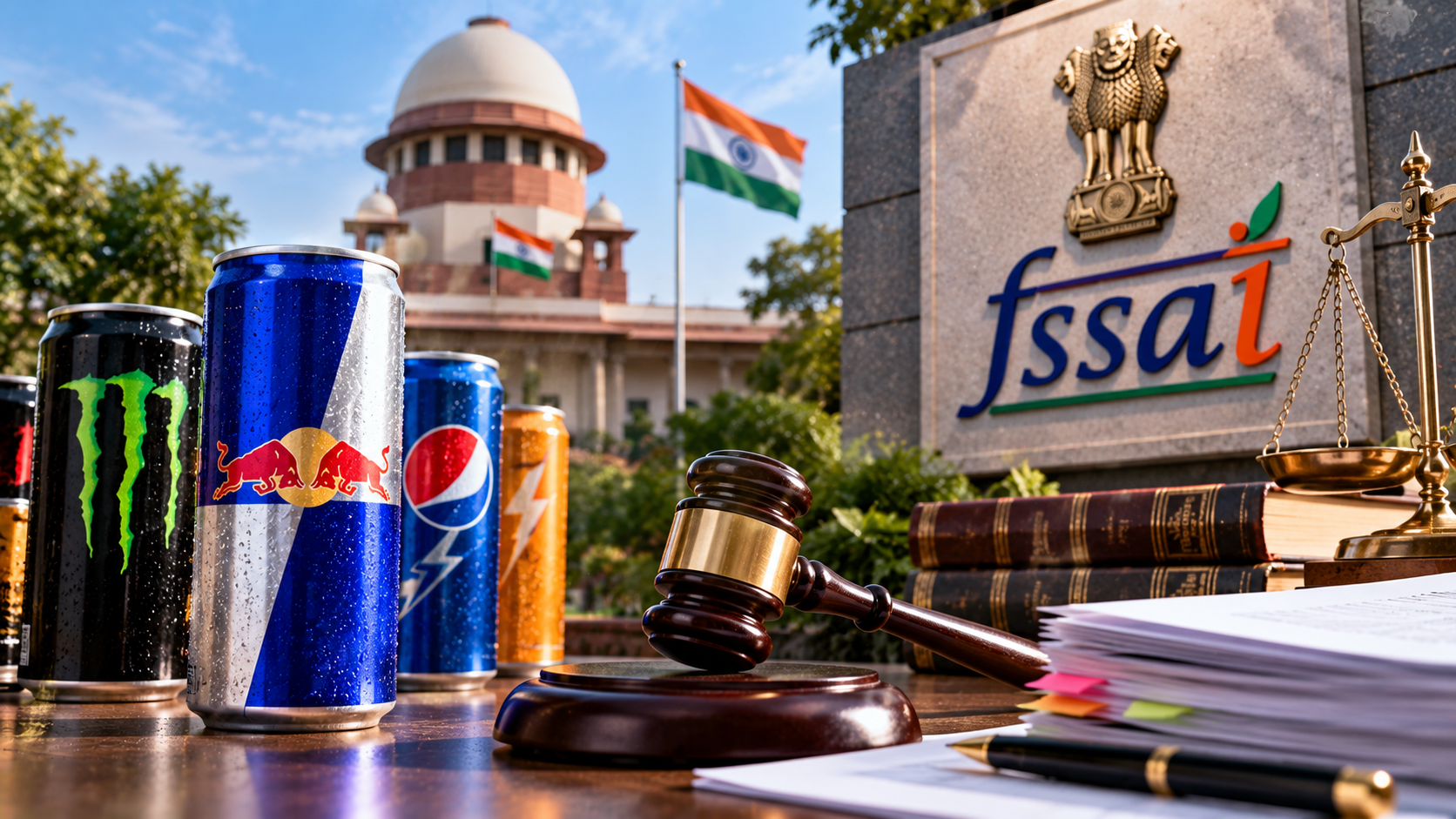
Delhi High Court challenge puts focus on labelling rules, regulatory process and the future of India's fast-growing high-caffeine beverage market
Red Bull has approached the Delhi High Court against the Food Safety and Standards Authority of India (FSSAI) over the regulator's direction restricting the use of the term “energy drink” on certain high-caffeine beverages.
The Austrian beverage company argues that the prohibition was introduced without adequate notice or due process and could affect its existing business and planned investments in India. The case represents the first legal challenge against the June 2026 regulatory intervention and could have implications for other major beverage companies operating in the category.
The dispute comes at a time when Indian authorities are increasing scrutiny of food and beverage labelling, product claims and consumer information. The wider regulatory push has also included proposed front-of-pack warning labels for packaged foods containing high levels of salt, sugar or fat.
What has Red Bull challenged?
According to the company's court filing reported by Reuters, Red Bull India has challenged the prohibition on using the descriptor “energy drink”.
Red Bull has argued that the abrupt restriction, without a prior warning, creates regulatory uncertainty and could adversely affect its existing and planned investments in India. The company has also contended that the term is internationally recognised and that the regulatory action affects the way its products are marketed and positioned.
The case is now before the Delhi High Court, where the legality and regulatory process surrounding the restriction will be examined.
The government's position is different. A government source told Reuters that FSSAI will defend its decision and said the regulator had historically not permitted the use of “energy drinks” on the label in the manner challenged by the company.
Why the “energy drink” label matters
The terminology is commercially important because “energy drink” has become a recognised product category for beverages containing caffeine and other functional ingredients.
Brands have built substantial marketing around the association between these drinks and alertness, stimulation and energy. Removing or changing the category description could therefore affect how consumers identify the products on retail shelves and online platforms.
For companies operating in the segment, the issue is not simply a labelling change. It could influence branding, consumer recognition, advertising communication and product positioning.
FSSAI's regulatory framework
India already has standards covering caffeinated beverages.
FSSAI's regulations specify requirements for carbonated and non-carbonated caffeinated beverages, including a total caffeine range of 145 mg to 300 mg per litre from all sources.
FSSAI's existing food standards also refer to beverages that include so-called energy drinks within relevant beverage categories.
The regulator has previously taken steps to prevent potentially misleading categorisation of beverages online. In a 2024 advisory, FSSAI said products falling under certain beverage categories should not be incorrectly listed on e-commerce platforms as “Health Drinks” or “Energy Drinks” where that categorisation did not match the applicable regulations.
The latest dispute is therefore taking place against a longer regulatory effort to ensure that beverage descriptions correspond with defined food categories and do not create misleading impressions for consumers.
Other major companies could be affected
The regulatory action has implications beyond Red Bull.
Reuters reported that Pepsi, Monster Beverage and Reliance are among companies concerned about the impact of removing the category label from high-caffeine beverages. These companies have significant interests in India's rapidly expanding beverage market.
For established brands, the category name is particularly important because years of advertising and consumer recognition can be linked to the terminology.
Any change could require companies to reconsider packaging, marketing communication and possibly how products are positioned across retail channels.
India's energy drink market continues to expand
The regulatory dispute comes as India's energy drink segment is growing rapidly.
Reuters, citing Euromonitor estimates, reported that retail sales of energy drinks in India are growing at around 12.6 per cent annually, faster than the corresponding growth rates in the United States and China. The market is projected to reach approximately $1.6 billion by 2028.
The category received a significant boost after PepsiCo launched Sting in India in 2017. The relatively low-priced format helped expand the consumer base, including among younger consumers.
Red Bull has also built a sizeable business in India. Reuters reported that the company's India revenue reached approximately $130 million in 2024, more than double its revenue four years earlier.
Health concerns remain part of the regulatory debate
Energy drinks have faced increasing scrutiny internationally because of their caffeine and sugar content and the presence of other ingredients such as taurine.
Regulators in several countries have examined restrictions on marketing and sales to younger consumers. England, for example, is set to prohibit the sale of energy drinks to children under 16 from April next year, according to Reuters.
In India, the debate is unfolding alongside a wider regulatory focus on the nutritional content and labelling of packaged foods.
FSSAI's proposed front-of-pack nutrition framework is another part of this broader regulatory direction, with the regulator moving towards clearer warnings for products exceeding specified thresholds for nutrients such as salt, sugar and saturated fat.
Could the dispute affect beverage companies?
The immediate impact is likely to depend on the outcome of the court proceedings and any subsequent clarification or modification by FSSAI.
If the restriction remains in place, beverage companies may need to adjust product packaging and marketing communication. Depending on the final interpretation of the rules, this could involve additional compliance costs and changes in consumer-facing communication.
For companies with large distribution networks, even a seemingly small packaging change can involve inventory management, redesign expenses and coordination across manufacturing and retail channels.
However, the financial impact cannot be quantified until the final regulatory requirements are known.
A wider question about regulatory certainty
The Red Bull case also raises a broader issue for India's packaged-food and beverage industry: how quickly regulatory interpretation can change and how companies receive notice before a new restriction takes effect.
Red Bull has specifically argued that the lack of prior warning created uncertainty for its investments. The government, meanwhile, maintains that FSSAI is enforcing its regulatory position.
The court's consideration of these arguments could therefore have significance beyond the specific use of the phrase “energy drink”.
What consumers could see next
For consumers, the immediate question is whether familiar products will continue to carry the same category description and packaging.
The underlying beverages are not automatically prohibited merely because the “energy drink” descriptor is being challenged. The dispute primarily concerns how products can be categorised and labelled under India's food regulations.
Consumers should therefore distinguish between a labelling or product-description dispute and a ban on the beverage itself.
What investors should monitor
Investors tracking beverage companies should watch the Delhi High Court proceedings, subsequent FSSAI clarifications and any changes in packaging or marketing requirements.
The broader regulatory environment is also important. India's food regulator is simultaneously working on stricter nutrition disclosures and other food-safety measures, which could increase compliance requirements across the packaged-food and beverage industry.
For beverage companies, the key variables will include regulatory compliance costs, consumer response to any packaging changes, sales growth, pricing power and the ability to maintain brand recognition under revised labelling rules.
Market Outlook
The Red Bull-FSSAI dispute highlights the growing regulatory attention on India's beverage and packaged-food industry. The energy drink market continues to expand, but companies are increasingly operating within a framework focused on clearer product classification, consumer information and food-safety compliance.
The immediate outcome will depend on the Delhi High Court proceedings and FSSAI's regulatory position. Until the legal process develops, the commercial impact on Red Bull and other beverage companies remains uncertain.
For investors, the case is worth monitoring alongside India's broader food-labelling reforms because changes in product descriptors, nutrition disclosures and compliance requirements could influence branding, marketing costs and consumer behaviour across the sector.